 Vera Clarissa
The historical limitation of IDE storage on early Macintosh hardware was long defined by the 137GB capacity ceiling, a constraint imposed by the ATAPI 6.0 (ATA/100) standard. For years, users of classic PowerPC machines were restricted to drive capacities below this threshold, effectively creating a hardware bottleneck that hindered the longevity and utility of legacy systems. Recent efforts by the vintage computing community, however, have demonstrated that this barrier is not absolute. By utilizing specialized software drivers and clever disk-cloning workflows, enthusiasts are successfully bypassing these long-standing storage limits, breathing new life into machines like the Summer 2000 400 MHz Indigo iMac G3.
The Evolution of the ATA Standard and Hardware Limitations
The 137GB (often cited as 128GB in binary terms) limitation was a hallmark of the transition era in personal computing. Before the widespread adoption of the 48-bit Logical Block Addressing (LBA) standard, older controllers were limited to 28-bit addressing, which could only reference 268,435,456 sectors. At 512 bytes per sector, this resulted in the 137,438,953,472-byte limit that defined the ceiling for Power Mac G4s and early iMac models.

Apple’s hardware migration away from this limitation began in earnest with the Revision B Quicksilver Dual 1.0 GHz Power Mac G4, which utilized an updated logic board (820-1342-B) to support higher capacities. For the iMac line, the shift was finalized with the introduction of the 17-inch 1 GHz model on February 4, 2003, which officially integrated Ultra ATA/100 support. Machines manufactured prior to this—including the popular G3 series—remained tethered to the 128GB capacity restriction, necessitating either a reliance on multiple smaller drives or the implementation of third-party software patches to extend addressable space.
Methodology: Overcoming the 128GB Threshold
The technical challenge of upgrading a machine like the 400 MHz Indigo iMac G3 involves more than simply installing a higher-capacity physical drive. Because the onboard firmware and the OS 9/early Mac OS X kernels expect 28-bit LBA, simply inserting a 500GB IDE drive often results in the drive not being recognized, or in some cases, catastrophic data corruption if the drive reports a capacity that the OS cannot correctly parse.
The solution lies in the implementation of the SpeedTools Hi-Cap ATA Driver. This utility intercepts the hardware’s communication with the drive at the driver level, forcing the system to utilize 48-bit LBA addressing. The process requires a precise sequence of operations:

- Initial Setup: The driver must be installed on a functional OS X volume before the high-capacity drive is formatted or partitioned.
- Cloning Workflow: To maintain system integrity, administrators often employ a secondary host machine—such as an iBook G3 running OS X 10.4.11—to serve as a staging environment. By using Target Disk Mode, the host machine can mount the iMac’s internal drive and perform the necessary formatting and cloning via Carbon Copy Cloner.
- Partitioning: Once the driver is operational, the 500GB drive can be partitioned to handle modern workloads, allowing for dual-boot configurations or the hosting of large repositories of PowerPC-native software.
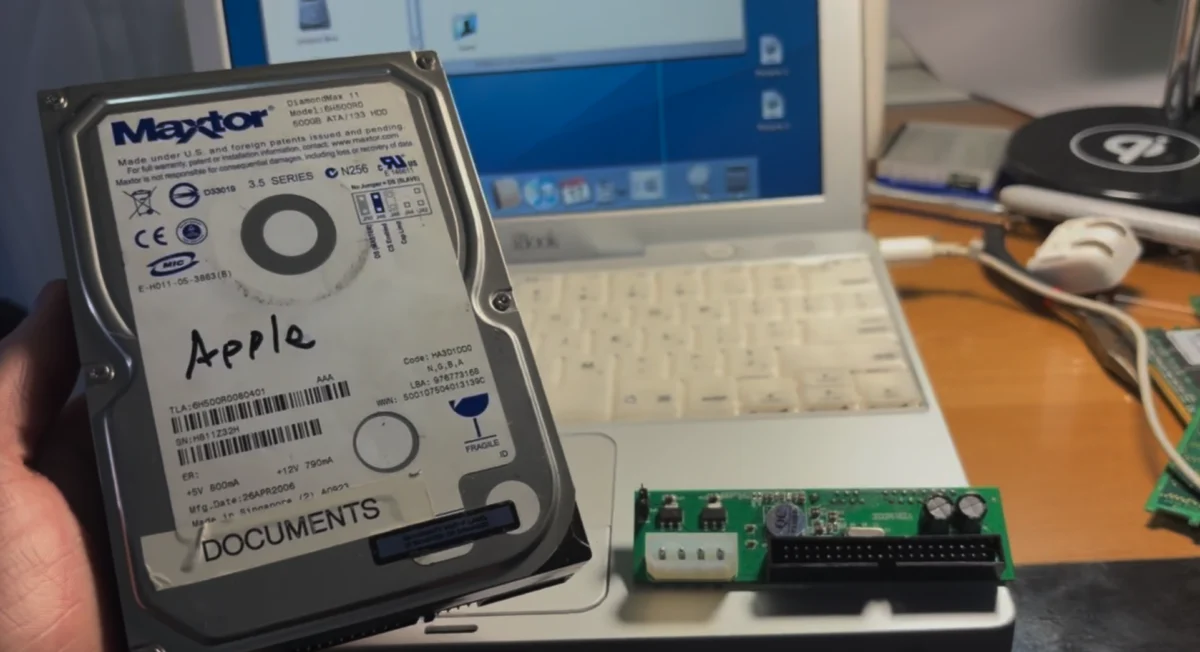
In a recent demonstration of this process, a 500GB Maxtor ATA/133 drive was successfully integrated into an Indigo iMac G3. The cloning process, conducted over FireWire 400, took approximately six hours to transfer 14GB of system data. Post-cloning, the iMac recognized the full capacity of the drive and booted into Mac OS X Tiger (10.4.11) without requiring modifications to the boot sequence or firmware parameters.
Technical Implications and Data Integrity
The use of legacy hard drives—specifically the Maxtor and Western Digital IDE units from the mid-2000s—introduces concerns regarding component age and reliability. While these drives are frequently acquired for minimal cost, they are approaching two decades of operational age. Analysts within the retro-computing space emphasize that while these mechanical upgrades are functionally successful, they should be accompanied by robust backup strategies.
The comparison between traditional IDE hard drives and modern alternatives, such as mSATA adapters, highlights a divergence in the vintage community. While mSATA or CompactFlash-to-IDE adapters provide near-silent operation and lower power consumption, the use of original mechanical IDE drives preserves the authentic acoustic and physical experience of the era. However, the survival of specific drive lines, such as the WD Green series or legacy Maxtor DiamondMax drives, remains a subject of ongoing observation, with many units showing unexpected longevity despite heavy use.

The Role of the Retro-Computing Community
The revitalization of the G3 architecture is currently fueled by a surge in community-developed software designed to bridge the gap between 2005-era hardware and modern utility. Projects such as "PowerFox for G3" and the "exFAT support for Tiger" patch represent a significant effort to keep PowerPC machines relevant for modern file-sharing and network protocols. Furthermore, the development of the "PPC Claude Agent" indicates that even early G3 processors are being tasked with modern LLM-based workloads, pushing the limits of the original 400 MHz clock speed.
The importance of preserving original hardware is further evidenced by the practice of dumping and cataloging original Boot ROM versions. In the case of the 400 MHz Indigo iMac, the unit was found to be running Boot ROM version 3.3.0f3—a legacy version that provides a historical snapshot of Apple’s early firmware evolution. By uploading these ROMs to public archives, such as the MacRumors forums, collectors ensure that the technical lineage of these machines is preserved against hardware failure or corruption.
Broader Impact and Future Outlook
The success of this 500GB retrofit illustrates a growing trend in the enthusiast market: the "maximalist" approach to vintage computing. By ignoring the original manufacturer specifications for maximum drive size, users are transforming machines that were once considered limited, specialized tools into capable, high-capacity workstations.

While the current usage of these machines is primarily for nostalgic or experimental purposes, the implications for digital preservation are clear. As original factory-shipped components fail, the ability to integrate modern storage—or at least larger-capacity legacy drives—is essential to the continued operation of these devices. The ability to run multiple partitions and modern-patched operating systems ensures that the iMac G3 remains a functional platform for exploring early GUI design and historical software compatibility.
For the Indigo iMac G3, the transition from a 128GB-limited machine to one capable of hosting 500GB of data represents a successful bypass of the historical "128GB wall." As long as the community continues to develop drivers and support patches, the usable lifespan of these vintage machines will continue to extend, far beyond the projections made by manufacturers at the time of their release in the early 2000s. Whether through the use of low-cost, repurposed IDE drives or advanced solid-state storage solutions, the message to the vintage community is clear: hardware limitations are often mere software hurdles waiting to be cleared.