 Vera Clarissa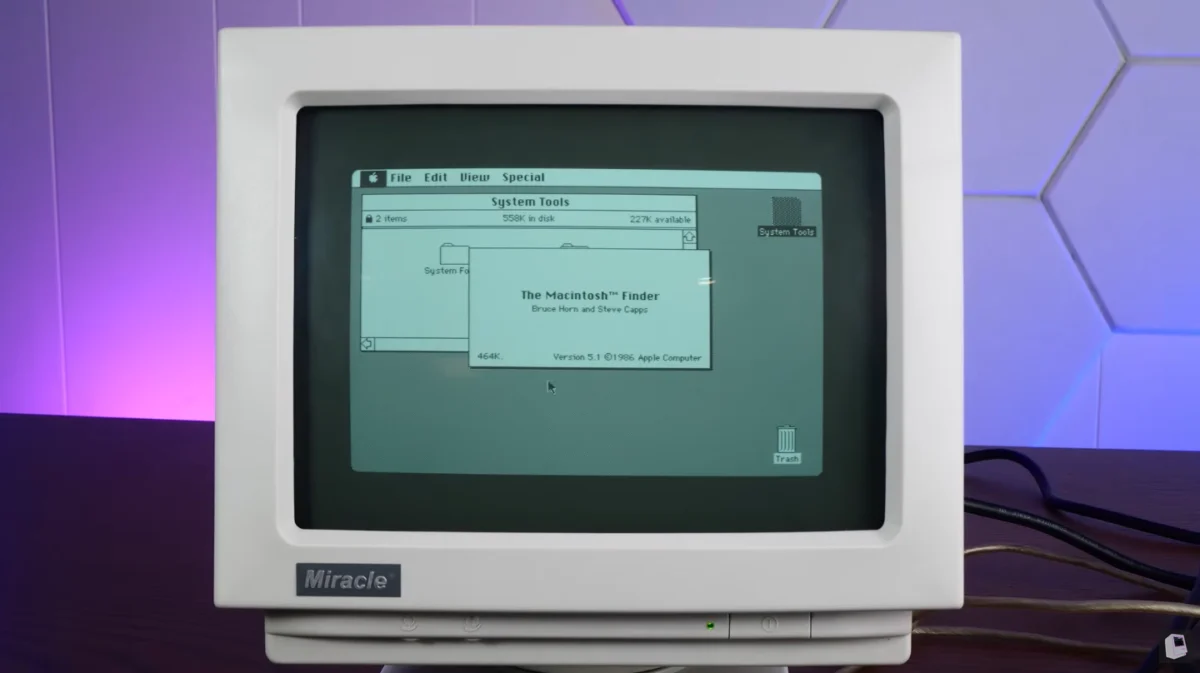
The landscape of retro-computing has been fundamentally altered by the introduction of the Pico Micro Mac, a device that effectively shrinks the original 1984 Macintosh 128K architecture into a form factor roughly equivalent to an Altoids tin. Developed under the stewardship of the popular content creator Ron’s Computer Videos, the project leverages modern microcontroller technology to replicate the functionality of Apple’s seminal personal computer. With a price point ranging between $19.99 and $24.95, this development represents one of the most accessible entry points into vintage hardware emulation to date, garnering significant attention following its feature on the Action Retro YouTube channel.
Historical Context: From 1984 to the Present
When the Macintosh 128K was released on January 24, 1984, it stood as a monumental achievement in industrial design and user interface architecture. Priced at $2,495—the equivalent of over $7,500 today—the original machine featured an 8 MHz Motorola 68000 processor and 128 KB of RAM. Its iconic beige, all-in-one chassis housed a 9-inch monochrome CRT display, creating a footprint that, while compact for the era, required significant desk space.
The Pico Micro Mac project arrives 42 years after the launch of the original, serving as a testament to the exponential growth in silicon efficiency. Where the original Macintosh required a substantial power supply, a complex analog board, and a massive CRT yoke to function, the Pico Micro Mac utilizes a modern microcontroller to handle the heavy lifting of instruction sets. By abstracting the hardware requirements into a high-performance, low-power chip, developers have essentially distilled decades of computing evolution into a device that can fit into a shirt pocket.
Technical Specifications and Implementation
The Pico Micro Mac is built upon the architecture of modern microcontrollers, which offer the necessary clock speeds to emulate the original 68000 processor at a fidelity that provides a seamless user experience. The device outputs a native VGA signal, allowing users to connect to a variety of modern and legacy displays.
To achieve a functional Macintosh experience, the device requires a few peripheral components supplied by the user: a standard USB keyboard, a USB mouse, a USB hub, and a 5V power supply via a Micro-B connector. While the device defaults to the original 128 KB of RAM, it provides a configurable path to expand memory up to 208 KB, allowing for greater stability when running older software suites that might have struggled with the original’s tight memory constraints.

The compatibility requirements are intentionally broad to ensure accessibility. The system expects a monitor capable of handling 640 x 480 resolution at a 60 Hz refresh rate. While the project is compatible with modern LCDs, the developers and enthusiasts in the community frequently recommend the use of a vintage CRT display. This recommendation is not merely aesthetic; the native 640 x 480 output of the Pico Micro Mac closely mimics the scan-line characteristics of 1980s monitors, providing a visual experience that is closer to the original 1984 intent than most modern high-definition panels can provide.
Chronology of the Development
The project’s rise to prominence began with a series of technical breakthroughs in the retro-computing community regarding the emulation of Motorola 68K processors on inexpensive, low-power platforms. Throughout late 2025 and into 2026, Ron’s Computer Videos documented the iterative refinement of the Pico Micro Mac, moving from breadboard prototypes to a finalized, commercially available printed circuit board (PCB).
The viral nature of the project reached a critical mass when the Action Retro channel produced an in-depth video demonstration. The video served as a catalyst, driving thousands of viewers to the project’s documentation and sales page at jcm-1.com. As of September 2026, demand has frequently outpaced supply, leading to temporary stock shortages. The project team has indicated that they are working to ramp up production to meet this unanticipated surge in interest from the vintage computing community.
Economic and Market Analysis
The pricing strategy of the Pico Micro Mac is noteworthy for its disruption of the high-end emulator market. While hardware-based emulators like the MiSTer FPGA or specialized Raspberry Pi-based kits can cost upwards of $150 to $300, the Pico Micro Mac offers a stripped-down, singular focus on the 1984 Macintosh experience for under $30.
This low barrier to entry has profound implications for digital preservation. By removing the cost of entry, the project encourages a younger demographic—who may have never seen a physical 1984 Macintosh—to engage with the software and UI paradigms of the early GUI era. The option to purchase a pre-assembled unit or to build the device from a kit also caters to both casual retro-gaming enthusiasts and the hardware hobbyist community that prioritizes assembly and customization.
Broader Impact on Digital Preservation
The emergence of the Pico Micro Mac is a microcosm of a broader movement within the technology sector: the "miniaturization of history." As original 1984 hardware becomes increasingly prone to component failure—specifically the degradation of electrolytic capacitors and the scarcity of functional analog boards—emulation becomes the primary vehicle for ensuring these computing experiences survive.

The Pico Micro Mac differentiates itself from software-based emulation (such as Mini vMac or Basilisk II) by providing a physical, tactile connection to the past. By requiring an external keyboard and mouse, it forces the user to interact with the system in a way that feels physical, rather than simply clicking a window on a modern operating system. This distinction is critical for educational institutions and museums, which are increasingly seeking ways to demonstrate the history of personal computing without the logistical burden of maintaining fragile, 40-year-old hardware.
Official Responses and Community Reception
Though official statements from Apple regarding such projects remain nonexistent—as is standard for a company that generally ignores or occasionally engages in quiet acknowledgement of third-party hardware projects—the community response has been overwhelmingly positive. Tech influencers have praised the design for its "no-nonsense" approach, highlighting the clever use of a 5V power supply, which allows the machine to be powered by almost any modern portable battery pack.
The developer community surrounding the Pico Micro Mac has already begun discussing potential expansions, including the implementation of virtual floppy drive support via SD cards and potential network integration. These future-proofing measures suggest that while the project began as a niche experiment in miniaturization, it is quickly evolving into a robust platform for the future of Macintosh emulation.
Future Outlook
As the Pico Micro Mac continues to move through its initial production cycles, the focus will likely shift toward maintaining supply chain stability and refining the build quality of the 3D-printed cases. The current model, which offers a standard option and a premium 3D-printed enclosure, demonstrates a sophisticated understanding of the hobbyist market’s needs.
The success of the Pico Micro Mac underscores a fundamental truth about the vintage computing market: there is a hunger for accessibility. When enthusiasts can experience the birth of the Macintosh era for the price of a standard modern computer peripheral, they are far more likely to engage with the software, the history, and the engineering principles that defined the 1980s. This project does more than just emulate a machine; it keeps the "Macintosh experience" alive in a form factor that is as practical for a modern desk as it is historically significant. As we look toward the future of technology, the Pico Micro Mac serves as a poignant reminder that while computing power may increase by orders of magnitude, the fundamental charm and utility of the original 1984 Macintosh remain undiminished.