Jia Lissa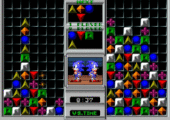
Sonic Eraser, developed by Sega CS1 and released in 1991, remains one of the most obscure entries in the history of the Sonic the Hedgehog franchise, serving as a landmark case study in early digital distribution and the experimentation phase of the 16-bit era. While the title is ostensibly a puzzle game, its significance extends far beyond its mechanics, as it represented an ambitious, albeit primitive, attempt by Sega to pioneer online gaming via the Japanese Mega Drive streaming service, Game Toshokan.
The Genesis of Digital Distribution
The landscape of the early 1990s was defined by physical media—cartridges and disks were the standard for home console gaming. However, Sega of Japan sought to challenge this paradigm with the Mega Modem, a peripheral that allowed users to connect their Mega Drive consoles to a centralized server. The Game Toshokan (Game Library) service was the primary beneficiary of this technology, providing a rotating catalog of titles that could be streamed directly to the console.
Sonic Eraser was launched during this nascent period of telecommunications. Unlike traditional retail titles, the game was never manufactured for mass-market consumption in cartridge form. This unique distribution model was intended to incentivize subscriptions to the Game Toshokan service, offering exclusive content to users who had invested in the hardware required for dial-up connectivity. From a technical perspective, the game was designed to be lightweight, prioritizing minimal ROM size to ensure efficient transmission over the limited bandwidth of the early 1990s.
Chronology of an Obscure Release
The timeline of Sonic Eraser is fragmented, reflecting the instability of early digital platforms:
- 1991: Sonic Eraser is released exclusively on the Game Toshokan service in Japan.
- 1992: Sega discontinues the Game Toshokan service, rendering the game inaccessible to the general public.
- 2004: Following over a decade of total unavailability, Sega of Japan briefly restores the game via its B-Club download service.
- Post-2004: An unofficial fan-led translation project emerges, allowing the game to circulate globally for the first time, albeit through emulated formats.
Throughout its existence, Sega never authorized a physical Western release, nor was the game included in subsequent major compilations such as the 2005 Sonic Gems Collection, despite reported discussions regarding its inclusion. This absence contributed to the title’s status as a "lost" game, sparking significant interest among preservationists and enthusiasts of the 16-bit era.
Technical Analysis and Gameplay Mechanics
At its core, Sonic Eraser operates as a block-matching puzzle game. The objective is to clear the screen of falling shapes, which arrive in clusters of four. The game distinguishes itself from competitors like Tetris or Columns by requiring a match of only two identical blocks to initiate a clearance, a design choice that facilitates faster, more aggressive gameplay.
The title features four distinct modes, each attempting to add depth to the basic premise:
- Round Mode: A 40-stage progression-based mode that emphasizes score optimization as falling speed increases.
- Normal Mode: A traditional endless style where the primary challenge is scaling difficulty.
- Doubt Mode: A randomized mechanic where pieces convert into neutral white squares upon landing, requiring players to recalibrate their strategies in real-time.
- Block Mode: A high-stakes configuration focusing on chain reactions and structural integrity, where mistakes lead to severe penalties.
The competitive component, while rudimentary, introduced an early iteration of "battle puzzle" mechanics. By clearing blocks, players could trigger offensive maneuvers—including spin dashes and shield-based attacks—that would temporarily stun the opponent’s interface. This system rendered the opposing player unable to rotate or place pieces, creating a "snowball effect" where a single advantage could quickly lead to a total board collapse for the opponent.
Industry Context and Critical Reception
From a design standpoint, the inclusion of the Sonic the Hedgehog intellectual property was a strategic choice rather than a narrative necessity. By 1991, Sonic was the primary face of the Sega brand. Integrating the character—and the associated aesthetic—was a calculated attempt to drive engagement with the Game Toshokan platform.
However, historical analysis suggests that the implementation of the IP was superficial. Critics have noted that the game lacks the cohesive visual identity and audio depth associated with the main franchise. The sound design consists of a singular, repetitive background track, and the visual assets were largely repurposed from existing files to maintain the necessary, slim file size. The lack of original music or high-fidelity sprites serves as a stark reminder of the constraints placed on developers during the early years of online streaming.
Legacy and Preservation
The legacy of Sonic Eraser is largely defined by its rarity rather than its gameplay quality. For researchers and historians of the medium, the game is a significant artifact of the "pre-internet" online age, illustrating how developers grappled with the limitations of 1990s infrastructure.
There is a consensus among gaming historians that Sega viewed the title as a disposable asset. Once the service was retired, the company shifted focus toward more profitable retail software, effectively abandoning the project. The decision to not re-release the game in any official capacity—even as a digital bonus in later years—suggests that the company viewed the title as a technical prototype rather than a core component of the Sonic franchise.
The Broader Impact of Early Online Experiments
The failure of the Game Toshokan service to sustain a long-term audience provides important context for the evolution of modern digital storefronts. At the time, the infrastructure for mass-market online gaming was not yet viable. The latency issues, limited user base, and the inherent friction of dial-up connections created a barrier that prevented titles like Sonic Eraser from achieving mainstream success.
Despite its flaws, the game occupies a permanent place in the history of the Blue Blur. It represents the first instance where the Sonic brand was used to explore the puzzle genre, paving the way for more successful iterations such as Dr. Robotnik’s Mean Bean Machine. While modern players may find the controls responsive and the mechanics functional, the game is best viewed through the lens of a historical footnote.
In terms of overall quality, the game remains a curiosity. Its 5 out of 10 score reflects a title that is technically competent but conceptually thin. For collectors, the fascination remains in the "lost" nature of the software—a relic of an era when the future of gaming was being written in lines of code that were never meant to be permanent. As digital preservation efforts continue to grow, the story of Sonic Eraser serves as a reminder of how much gaming history is often lost to the obsolescence of its original delivery hardware. The title remains a case study in how intellectual property is leveraged to support experimental technology, and how quickly those experiments can fade into obscurity once the technology evolves.