Jia Lissa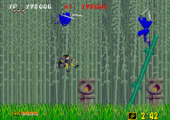
The landscape of 1980s American pop culture was defined by a profound fascination with East Asian martial arts, specifically the lore of the ninja. Capitalizing on this cultural zeitgeist, Sega Enterprises released Shinobi in 1987, a title that would serve as the foundational pillar for one of the most successful action franchises in the history of interactive entertainment. Developed by the R&D 1 division under the creative direction of Yutaka Sugano, Shinobi departed from the vibrant, colorful aesthetic of contemporary Sega titles like Fantasy Zone, opting instead for a gritty, somber, and uncompromisingly difficult experience that challenged the limits of arcade player endurance.
Technical Origins and Market Strategy
Shinobi was built upon Sega’s System 16A hardware, a board architecture that allowed for superior sprite handling and more complex background layering compared to the 8-bit systems of the era. The decision to move away from the whimsical themes of earlier Sega arcade efforts was a calculated risk. By targeting a more mature, challenge-oriented demographic, Sega aimed to capture the "quarter-cruncher" market—a segment of the gaming industry where difficulty was a primary value proposition.
A critical factor in the game’s widespread reach was its distribution model. During the mid-1980s, the arcade industry faced economic pressure to reduce the overhead costs associated with dedicated, custom-built cabinets. Sega Enterprises USA pioneered the use of "conversion kits," which allowed arcade operators to replace the boards of aging or underperforming machines with new, high-demand software. Shinobi was specifically designed to be easily integrated into existing cabinet setups. According to industry reports from the period, the Shinobi conversion kit became the highest-selling unit of its type since Universal’s 1982 success, Mr. Do!, effectively cementing its presence in thousands of arcades across North America and Europe.
Chronology of Development and Release
The development of Shinobi followed the completion of the arcade version of Alex Kidd: The Lost Stars. Yutaka Sugano sought to pivot from the platforming-heavy, whimsical nature of Alex Kidd toward a more tactical, combat-focused design.
- 1987 (Early): Initial development phases focus on the System 16A architecture, emphasizing high-contrast visuals and rapid-fire input response.
- 1987 (Mid-Year): Shinobi is released to arcades, featuring five distinct mission series, each culminating in a boss encounter designed to test the player’s pattern recognition and reflexes.
- 1988: Following the arcade success, Sega tasks Katsuhiro Hasegawa with porting the title to the Sega Master System. This version introduced significant mechanical changes, including a health bar, which mitigated the "one-hit-death" structure of the original.
- 1989: The success of the Shinobi intellectual property leads to the development of The Revenge of Shinobi for the Sega Genesis, directed by Noriyoshi Ohba. This sequel refined the mechanics introduced in the original and expanded the lore of the protagonist, Joe Musashi.
Core Gameplay Mechanics and Design Philosophy
While the title suggests a focus on stealth, the gameplay of Shinobi is categorized by high-intensity, direct confrontation. The player controls Joe Musashi, a modern-day ninja tasked with infiltrating the territory of the terrorist organization known as Zeed to rescue kidnapped children. The game design relies on two primary pillars: mobility and resource management.
Musashi’s arsenal includes a near-infinite supply of shurikens for ranged combat and a martial arts repertoire for close-quarters engagement. A defining feature of the game is the inclusion of "Ninjutsu" magic—a third-button input that allows the player to trigger screen-clearing effects such as thunder, tornadoes, or physical clones. These spells are limited to one use per stage, forcing players to exercise strategic restraint. The introduction of the "POW" power-up icon—a common trope of the decade—provided a critical upgrade path, transforming shurikens into ballistic fire and martial arts into a katana, effectively shifting the game’s tempo from defensive evasion to aggressive offense.
The design also emphasized verticality. By allowing players to jump between foreground and background planes, the developers introduced a layer of complexity that was uncommon in side-scrolling titles of the time. This mechanic was not merely cosmetic; it was essential for navigating stages, locating power-ups, and rescuing hostages, which served as the primary win condition for advancing to subsequent mission sectors.
Comparative Analysis: Arcade vs. Home Console
The transition from arcade to home console provided a study in design adaptation. The arcade iteration was optimized for short-burst play sessions, utilizing a high difficulty curve to maximize revenue. In contrast, the Sega Master System port, overseen by Katsuhiro Hasegawa, acknowledged the differences in home-use patterns.
The addition of a health meter in the home version was a revolutionary design choice that influenced the broader industry. By allowing for a degree of error, the developers created a more forgiving environment for home players, yet the game maintained its core challenge. This balance is widely credited with establishing the blueprint for the action-adventure genre on home consoles, providing a template for how difficulty could be scaled for different platforms without sacrificing the core "feel" of the experience.
Historical Significance and Industry Impact
Shinobi did more than just provide entertainment; it set a standard for the "ninja action" subgenre. The game’s influence can be observed in the stylistic choices of subsequent titles, including the Ninja Gaiden series and various other side-scrolling action games of the late 1980s and early 1990s.
From a technical perspective, the use of atmospheric, albeit static, backgrounds paired with an evocative, Eastern-influenced musical score demonstrated the potential for arcades to provide immersive storytelling through brevity and action. The vocalizations and sound effects, which were sophisticated for the hardware of the time, added a layer of sensory feedback that was crucial for player immersion.
The legacy of Joe Musashi remains a cornerstone of Sega’s corporate history. The character evolved from a generic avatar into a recognizable mascot, appearing in numerous sequels across multiple hardware generations, including the Sega Genesis, the Sega Saturn, and later iterations on the PlayStation 2. The longevity of the franchise speaks to the robustness of the original 1987 design.
Conclusion: A Enduring Benchmark
In analyzing the historical record, Shinobi stands as a primary example of how a singular, well-executed design concept can influence a global market. By bridging the gap between the arcade and the home console, and by perfecting the formula of high-speed, pattern-based combat, Sega created an enduring legacy.
While the lack of parallax in the backgrounds or the static nature of the environments might be critiqued by modern standards, the objective success of the title—both in terms of unit sales and its long-term contribution to gaming history—is undeniable. The game remains a critical point of study for developers interested in the evolution of difficulty curves, level design, and the effective use of limited hardware to achieve a distinct atmospheric experience. As a commercial product, it successfully maximized the potential of the conversion kit business model, providing a blueprint for the distribution of arcade software that would remain relevant for years to follow. The ninja master, Joe Musashi, remains a quintessential figure in the history of digital media.