Jia Lissa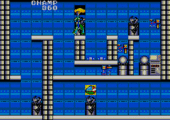
The release of Zillion for the Sega Master System in 1987 represents a pivotal moment in the evolution of the action-adventure genre, blending the burgeoning popularity of Japanese animation with complex, non-linear gameplay mechanics. Developed and published by Sega Enterprises, the title emerged during a period of rapid industry expansion, capitalizing on the success of the Tatsunoko Productions anime series of the same name. While the original animation served as the primary intellectual property, the video game adaptation established a unique identity through its focus on infiltration, environmental puzzle-solving, and a distinct multi-character tactical system.
Historical Context and Transmedia Origins
In the mid-1980s, the Japanese animation industry underwent a significant international expansion, with studios seeking to leverage their intellectual properties across various entertainment platforms. Zillion, which debuted on Japanese television in 1987, was at the forefront of this trend. While the series achieved moderate recognition in North America—most notably through a brief appearance in the 1995 music video for "Scream" by Michael and Janet Jackson—the Master System game arrived in the Western market with little reliance on the source material’s existing fan base.
Sega’s decision to develop an interactive experience based on the anime reflected a broader corporate strategy to distinguish the Master System from its primary competitor, the Nintendo Entertainment System (NES). By prioritizing titles that offered depth and mechanical sophistication, Sega aimed to capture a demographic interested in more than just arcade-style reflex challenges. The development, spearheaded by designer Kotaro Hayashida, incorporated elements that would later become hallmarks of the "Metroidvania" genre, though Zillion predates the standardized terminology used to describe such titles today.
Gameplay Mechanics and Strategic Infiltration
The core loop of Zillion centers on a high-stakes mission within the Norsa Empire’s subterranean facility. Players control JJ, an operative of the White Knights peacekeeping force, tasked with infiltrating the base to retrieve five encrypted floppy disks, rescue captured comrades, and neutralize the central computer.
The game utilizes a proprietary interface where the player’s primary weapon, the Zillion laser, functions as both a combat tool and a utility device. This dual-purpose design is integral to the game’s progression, as the laser is required to interact with terminals, unlock storage lockers, and manipulate environmental hazards. The inclusion of two additional playable characters, Apple and Champ, introduced a layer of strategic depth uncommon for the era. Each character possesses distinct physical attributes: JJ serves as the balanced operative; Apple offers superior mobility and vertical reach; and Champ provides enhanced durability. The ability to swap characters upon their rescue allows players to adapt to the escalating difficulty of the base’s three distinct sectors.
Comparative Analysis: Zillion and the Industry Standard
Analysts often compare Zillion to Nintendo’s 1986 title, Metroid, due to shared elements of non-linear exploration and power-up progression. However, a technical breakdown reveals fundamental differences in design philosophy. While Metroid emphasizes isolation and a solitary descent into alien environments, Zillion maintains a focus on tactical infiltration within a high-tech, man-made installation.
The influence of earlier titles, specifically the 1984 game Impossible Mission, is evident in Zillion’s design. The focus on navigating electrified barriers, hacking terminals, and managing security systems reflects a shift toward computer-inspired puzzle mechanics. Unlike the expansive, interconnected planet of Samus Aran, the environment in Zillion is a singular, massive, and highly structured facility. The lack of a save-game feature or password system—a common limitation of 1987 technology due to the prohibitive cost of battery-backed RAM chips—forced players to rely on manual mapping and consistent performance, a design choice that defined the game’s difficulty curve.
Technical and Design Challenges
The development of Zillion required balancing complexity with the hardware limitations of the Master System. The game features nearly 50 interconnected rooms, each requiring the player to clear guards and solve logic puzzles to advance. The integration of computer terminals, which can be reprogrammed to deactivate specific environmental hazards like turrets and laser grids, demonstrated an early commitment to player agency in problem-solving.
However, the title faced criticism regarding its narrative climax. The transition from an intricate infiltration mission to a final encounter with a singular mechanical creature—devoid of a direct conflict with the primary antagonist, Baron Ricks—highlighted a discrepancy in the game’s pacing. Despite the depth of the gameplay, the absence of a climactic showdown with the leader of the Norsa forces left a portion of the narrative unresolved, a recurring theme in the limited sequel efforts that followed.
The Impact of Hardware Limitations
The absence of a persistent save state, while a source of frustration for contemporary players, was a direct consequence of the 1987 retail market. At the time, titles that included battery-backed saves, such as the original Phantasy Star, retailed at significantly higher price points (often exceeding $100 USD). By omitting this feature, Sega ensured that Zillion remained accessible to a wider consumer base, though it ultimately dictated the game’s longevity and difficulty rating.
For the modern enthusiast, these limitations are mitigated by current emulation technology, which allows for the use of save states. This evolution in how the game is experienced has led to a renewed appreciation for the precision of its level design and the catchiness of its chiptune soundtrack. When evaluated without the constraints of 1987 hardware, the game’s systems—specifically the character-switching mechanic—are recognized as innovative precursors to modern team-based action games.
Broader Industry Implications
Zillion remains a significant case study in the transition from linear arcade experiences to complex console-based adventures. Its failure to secure a successful franchise trajectory on the Sega Genesis platform remains a point of historical contention among industry observers. While the sequel did not iterate upon the core strengths of the original, the mechanical foundations established by Hayashida influenced subsequent titles within the Sega library.
The success of the game, despite its technical limitations, underscored a shift in consumer demand. Players were increasingly seeking titles that required patience, memorization, and long-term planning. By offering a blend of high-tech atmosphere and challenging puzzle-based gameplay, Zillion successfully carved out a niche that validated the Master System’s viability as a platform for deeper, more immersive gaming experiences.
Legacy and Final Assessment
In the decades since its release, Zillion has maintained a reputation as a "cult classic." Its enduring appeal lies in the satisfaction of mastering its labyrinthine structure and the tactical depth provided by the character-switching system. While it is rarely cited in the same breath as global industry titans, its contribution to the refinement of the side-scrolling action-adventure genre is undeniable.
The game stands as a testament to the creativity of 1980s developers who were tasked with delivering expansive experiences on limited hardware. From a historical perspective, Zillion represents a bridge between the twitch-reflex arcade era and the narrative-driven, exploration-heavy titles that would come to dominate the 16-bit generation. For those who appreciate the intersection of technical ingenuity and atmospheric world-building, Zillion serves as an essential, if challenging, chapter in the history of home video game consoles. Its, at times, uncompromising design remains a hallmark of an era where success was measured not by ease of access, but by the skill and dedication of the player.