 Jia Lissa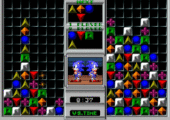
Sonic Eraser represents a pivotal, albeit frequently overlooked, chapter in the history of Sega’s early 1990s digital distribution efforts. Released in 1991 for the Mega Drive (known as the Sega Genesis in North America), the game was developed by Sega CS1 as an experimental puzzle title. Unlike the platforming giants that defined the Sonic the Hedgehog brand, Sonic Eraser was designed specifically for the Game Toshokan streaming service, a Japan-exclusive subscription platform accessible via the Mega Modem peripheral. Its legacy is characterized by extreme rarity, technological ambition, and its status as one of the earliest examples of console-based online multiplayer gaming.
The Genesis of Digital Distribution
In the early 1990s, the concept of digital video game delivery was in its infancy. Sega’s Game Toshokan—literally translated as "Game Library"—offered subscribers access to a rotating catalog of titles that could be streamed directly to the Mega Drive console. This service required the Mega Modem, an expensive and niche piece of hardware that facilitated communication over telephone lines.
The service was remarkably ahead of its time, mirroring modern subscription models like Xbox Game Pass or PlayStation Plus, albeit with significantly lower bandwidth and storage capabilities. Titles featured on the service, including Sonic Eraser, Phantasy Star II text-based adventures, and Fatal Labyrinth, were optimized for low file sizes to accommodate the limited data transmission speeds of the era. However, the high cost of the hardware, combined with a limited consumer base for early online services, resulted in the eventual termination of the Game Toshokan service in 1992. Consequently, Sonic Eraser was rendered inaccessible to the public, existing only on local storage media within a small circle of Japanese subscribers.
Gameplay Mechanics and Technical Constraints
Sonic Eraser functions as a competitive block-matching puzzle game. The core loop involves the player manipulating falling clusters of four blocks, aiming to group two or more identical colors to clear them from the playfield. While it shares a lineage with established titles like Tetris and Sega’s own Columns, Sonic Eraser introduced unique mechanics, such as the inclusion of "mystery pieces" that function as clearing agents for surrounding blocks.
The game offers four distinct modes of play, each designed to test different cognitive and reflex skills:
- Round Mode: A 40-stage progression system focused on clearing specific "spiral rings" while managing increasing block-drop speeds.
- Normal Mode: A traditional scoring-based mode that prioritizes longevity and pattern recognition.
- Doubt Mode: An adaptive challenge where specific pieces transform into neutral white squares upon landing, forcing players to reorganize their strategy in real-time.
- Block Mode: A high-risk, high-reward mode that encourages the construction of precarious stacks, rewarding players for executing complex chain reactions.
The competitive component of the game was particularly sophisticated for the time, allowing players to engage in head-to-head matches. During these bouts, the screen displays a representation of the opponent’s Sonic avatar. By clearing blocks, players can trigger offensive maneuvers—including spin dashes and shield-based strikes—that temporarily stun the opponent. This mechanic introduced a layer of active interference rarely seen in contemporaneous puzzle games, effectively balancing defensive play with offensive pressure.
The Decade of Obscurity and Re-emergence
Following the discontinuation of the Game Toshokan service in 1992, Sonic Eraser entered a period of extreme scarcity. For over a decade, it remained a "lost" title, known only to collectors and enthusiasts of early digital distribution. The game’s profile was briefly raised in the early 2000s when it was included in Sega of Japan’s "B-Club" service, which allowed users to download specific Mega Drive titles from a web portal.
Although a planned inclusion in the 2005 compilation Sonic Gems Collection was ultimately abandoned by the publisher, the title’s visibility grew through the efforts of the fan community. Dedicated enthusiasts successfully reverse-engineered and translated the ROM, facilitating an unofficial, global digital release. This grassroots preservation effort remains the primary method by which modern players access the title. From an industry standpoint, this underscores the fragility of early digital-only releases; without community-driven archiving, the title would likely have vanished entirely from the historical record.
Comparative Analysis and Franchise Impact
When evaluated against the broader Sonic the Hedgehog franchise, Sonic Eraser stands as an anomaly. Released during a period when Sega was aggressively diversifying the brand into educational software, fighting games, and licensed spin-offs, the game lacks the stylistic polish and thematic consistency of its contemporaries.
Critics and historians often point to the game’s "lean" presentation as a byproduct of its development constraints. To ensure compatibility with the limited streaming speeds of the 1991 Mega Modem, developers were forced to minimize ROM size. This necessitated the reuse of existing Sonic sprites and the implementation of minimalist, geometric block designs. The audio, limited to a singular, repetitive background track, lacks the melodic complexity associated with the mainline Sonic series.
From a market perspective, the title failed to establish a long-term foothold because it was fundamentally a generic puzzle game utilizing a popular mascot for brand recognition rather than narrative or mechanical synergy. While Dr. Robotnik’s Mean Bean Machine—a reskin of Puyo Puyo—succeeded by integrating the Sonic universe into its core mechanics, Sonic Eraser treated the mascot as a superficial layer. This lack of integration is cited by analysts as the primary reason the game never received a console sequel or a wider commercial release.
Historical Significance and Legacy
Despite its mechanical simplicity, Sonic Eraser occupies a significant position in the history of interactive entertainment. It serves as a case study for the technical challenges faced by developers attempting to bridge the gap between console gaming and network connectivity in the early 1990s. Its existence proves that the concepts currently defining the gaming industry—online multiplayer, subscription services, and digital distribution—were not only envisioned but prototyped decades before their eventual mainstream adoption.
For the modern audience, the title serves as a "historical footnote." It does not provide the depth of modern puzzle titles, nor does it offer the platforming excellence of the mainline Sonic series. However, its value lies in its rarity and its role as a technological pioneer. The competitive mode, while rudimentary, displays a design philosophy that would eventually evolve into the complex "battle-puzzle" genre currently dominated by titles such as Puyo Puyo Tetris.
In conclusion, Sonic Eraser remains a testament to Sega’s early willingness to experiment with distribution models. While it may not be considered a standout entry in the Sonic franchise by traditional metrics of gameplay quality, its preservation is essential for understanding the evolution of gaming technology. It serves as a reminder that even the most obscure titles can offer valuable insight into the developmental trajectory of an industry that has since moved from telephone-line streaming to high-speed, cloud-based global gaming. As the industry continues to move toward a purely digital future, the lessons learned from the rise and fall of services like Game Toshokan remain as relevant as ever.