 Jia Lissa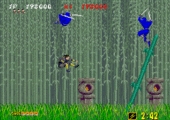
The release of Shinobi in 1987 by Sega R&D 1 marked a pivotal evolution in the side-scrolling action genre, defining the aesthetic and mechanical standards for ninja-themed video games during the peak of the 1980s arcade era. Developed under the direction of Yutaka Sugano, the title debuted on the Sega System 16A hardware, a board renowned for its superior graphical capabilities and processing power at the time. Unlike its contemporaries, which often leaned into lighthearted or abstract themes, Shinobi introduced a gritty, somber atmosphere that prioritized high-octane combat and precise technical execution. The game’s commercial success, bolstered by its distribution as a cost-effective conversion kit, solidified Sega’s position as a dominant force in the global coin-op market.
Development and Technological Context
During the mid-1980s, the video game industry was experiencing a resurgence, largely driven by the popularity of martial arts and ninja-themed media in Western pop culture. Sega, seeking to capitalize on this trend, tasked Yutaka Sugano—fresh off the production of Alex Kidd: The Lost Stars—with creating a project that felt distinct from the company’s existing portfolio. The decision to utilize the System 16A board was strategic; the hardware allowed for larger, more detailed sprites and a broader color palette, which enabled the developers to create the distinct urban and industrial environments that serve as the backdrop for protagonist Joe Musashi’s journey.
Unlike many of its predecessors that focused on platforming or exploration, Shinobi discarded the concept of stealth entirely, despite its title. The core design philosophy centered on "screen-clearing" mechanics and aggressive pacing. By prioritizing combat-heavy encounters over traditional infiltration, Sega created a high-difficulty loop that demanded mastery of both standard martial arts and specialized "ninjutsu" magic. This design choice effectively segmented the arcade audience, attracting players who sought a significant challenge, similar to the reputation established by games like Ghosts ‘n Goblins.
Chronology of Gameplay Mechanics and Progression
The gameplay loop of Shinobi is characterized by five distinct mission series, each culminating in a boss encounter that tests the player’s ability to recognize patterns and optimize their resource management. Players control Joe Musashi, a ninja tasked with infiltrating the terrorist organization known as "Zeed" to rescue kidnapped children.
The progression is structured as follows:
- Standard Combat: The primary engagement loop relies on shuriken projectiles and close-quarters combat. The introduction of the "POW" power-up icon is a hallmark of 1987-era design, temporarily transforming Musashi’s basic attacks into high-damage katana strikes and long-range ballistic weaponry.
- Ninjutsu Implementation: The game features a third-button command that allows the player to unleash one of three screen-clearing magical abilities: doppelganger clones, thunderstorm bolts, or wind-based whirlwinds. These are limited to one use per stage, forcing players to strategize their deployment for critical moments or boss encounters.
- Verticality and Stage Design: A significant departure from linear side-scrollers of the era was the inclusion of vertical navigation. Players are often required to ascend or descend to rescue hostages, which is a prerequisite for advancing to the next segment of a level. This design forces the player to engage with the entire vertical space of the screen, adding complexity to the navigation of enemy-dense environments.
- Bonus Rounds: Serving as a transitional phase between missions, the bonus rounds shift to a first-person perspective, challenging players to eliminate swarms of incoming enemies using precise timing. Success in these rounds grants an extra life, providing a vital incentive for high-skill play.
Commercial Distribution and Market Impact
The widespread adoption of Shinobi was significantly aided by its distribution model. During the late 1980s, dedicated arcade cabinets were expensive for independent operators to acquire. Sega Enterprises USA capitalized on the success of its earlier conversion kit, Choplifter, by releasing Shinobi in the same format. A conversion kit allowed operators to replace the internals of an existing cabinet with new game software, side art, and control decals, drastically reducing the barrier to entry.
According to industry reports from the period, Shinobi became the most successful conversion kit since Universal’s 1982 title, Mr. Do!. This accessibility ensured that the game was ubiquitous in arcades, bowling alleys, and corner stores throughout North America and Europe, which played a major role in establishing the intellectual property as a household name.
Evolution and Platform Adaptations
The transition of Shinobi to home consoles, specifically the Sega Master System, represented a critical juncture in the franchise’s history. Directed by Katsuhiro Hasegawa, the port was tasked with translating the high-intensity arcade experience into an 8-bit environment. To accommodate the limitations of the hardware and the expectations of home players, the Master System version introduced a health meter, departing from the "one-hit-kill" logic of the arcade original.
This change, while seemingly minor, had a profound impact on game design philosophy, as it allowed for a more forgiving learning curve. It is widely speculated that these mechanical adjustments directly influenced Noriyoshi Ohba during the development of the 1989 sequel, The Revenge of Shinobi, for the Sega Genesis. By introducing more complex narrative elements and refined movement mechanics, the sequel successfully bridged the gap between the punishing difficulty of the 1987 original and the evolving demands of home console consumers.
Historical Analysis and Legacy
The enduring legacy of the original Shinobi lies in its synthesis of atmosphere, challenge, and feedback. Even decades after its debut, the game is frequently cited by industry analysts and historians as a primary example of "quarter-crunching" design—a philosophy where difficulty is intentionally tuned to encourage repeat play and constant coin input.
While critics of the era noted the lack of parallax scrolling and the relatively static backgrounds compared to newer arcade boards, the game’s soundtrack and audio design were lauded for their immersive qualities. The use of Eastern-inspired musical motifs combined with distinct, high-fidelity sound effects created a cohesive sensory experience that elevated the title above many of its competitors.
Furthermore, the character of Joe Musashi became a flagship figure for Sega, serving as an unofficial mascot for the company’s arcade-to-home pipeline. His influence can be observed in a variety of subsequent action titles, from the rapid-fire platformers of the 16-bit era to modern "souls-like" games that prioritize high-difficulty boss encounters and patterns-based gameplay.
In conclusion, Shinobi stands as more than just a nostalgic relic; it is a foundational pillar of the action genre. Its success as a conversion kit democratized high-end arcade experiences, while its mechanical depth provided a blueprint for the future of the ninja sub-genre in gaming. Through its transition from the System 16A board to the Master System and beyond, the series demonstrated a remarkable ability to adapt, ensuring that the legend of Joe Musashi remained relevant long after the golden age of the arcade had passed. With a score of 9 out of 10, the title remains a standard-bearer for the type of disciplined, high-reward design that defined a generation of digital entertainment.