 Jia Lissa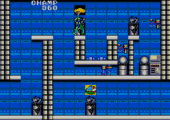
The release of Zillion for the Sega Master System in 1987 represents a pivotal moment in the evolution of the action-adventure genre, marking a sophisticated convergence of Japanese animation culture and console-based interactive design. Developed and published by Sega Enterprises, the title was a direct tie-in to the Tatsunoko Productions anime series of the same name. While the anime gained a foothold in Japan’s burgeoning animation market, the game’s reach extended globally, finding an unexpected cultural footprint in Western pop culture through a cameo in the music video for Michael and Janet Jackson’s "Scream" in 1995. Despite its association with a broader multimedia franchise, Zillion distinguished itself as a standalone technical achievement that pushed the limits of the Master System’s hardware.
Historical Context and Development Origins
During the mid-1980s, the Japanese animation industry began an aggressive expansion into global markets, seeking to leverage the success of flagship properties through cross-media licensing. Zillion, which debuted on Japanese television in 1987, was a centerpiece of this strategy. Sega, aiming to compete with the rising dominance of Nintendo’s Famicom, recognized that original intellectual properties could be bolstered by established narrative brands.
The development of the Zillion video game was helmed by Kotaro Hayashida, a key figure at Sega whose design philosophy emphasized non-linear exploration and complex environmental puzzles. At the time of its release, the gaming landscape was defined by linear experiences. By introducing a sprawling, interconnected facility as the primary setting, Hayashida shifted the player’s focus from mere reflex-based combat to tactical navigation and systematic problem-solving.
Gameplay Mechanics and Narrative Framework
In Zillion, the player assumes the role of JJ, an operative of the White Knights peacekeeping force. The mission objective is defined by a high-stakes infiltration of the Norsa Empire’s subterranean base. The player must retrieve five sensitive floppy disks containing encrypted intelligence and ultimately neutralize the base’s central computer.
The gameplay loop is built upon the interaction between the player and the environment, mediated by the "Zillion" laser—a signature weapon that serves as both a tool for defense and an interface for manipulating the base’s internal security. The inclusion of two additional characters, Apple and Champ, adds a layer of character-based strategy. Each operative possesses distinct physical attributes:
- JJ: A balanced operative suited for general infiltration.
- Apple: Distinguished by superior agility and jumping height, essential for navigating complex platforming sequences.
- Champ: Defined by increased durability, serving as a robust alternative for high-threat combat zones.
The rescue of these characters is not merely a narrative beat but a fundamental requirement for traversing the game’s most challenging sectors. The necessity of character switching necessitates a deeper understanding of the environment, forcing players to weigh the risks of movement against the specific capabilities of their team.
Structural Analysis: The Architecture of the Maze
The facility consists of nearly 50 interconnected rooms, organized in a non-linear fashion. Unlike contemporary titles that relied on simple horizontal progression, Zillion utilized verticality, elevators, and security-controlled barriers to restrict and grant access.
This environment functions as a complex puzzle. Players are frequently tasked with identifying terminal nodes, which must be programmed with specific codes to deactivate laser grids, electric barriers, and automated turrets. This design choice shifted the game’s difficulty curve from purely mechanical execution to intellectual retention. The mapping of this facility became a de facto requirement for completion, as the game lacked an in-game navigational interface.
Technical and Comparative Evaluation
When evaluated against its peers, such as Nintendo’s Metroid—released on the Famicom/NES in 1986—Zillion demonstrates a different approach to the exploration-based action genre. While both titles share the "gradual power acquisition" loop, Zillion diverges significantly in its thematic and mechanical execution.
Metroid is characterized by themes of isolation, environmental hostility, and alien exploration. Conversely, Zillion focuses on high-tech infiltration, human-led squads, and electronic counter-measures. The inclusion of complex terminal puzzles draws more significant parallels to titles like Impossible Mission than to the atmospheric exploration of Samus Aran’s debut.
The technical constraints of 1987, however, imposed significant limitations on the final product. The absence of a battery-backed save system or a password mechanism necessitated that the entire experience be completed in a single, uninterrupted session. Given the game’s length and the complexity of its layout, this design choice represented a significant barrier to entry, though it was consistent with the era’s focus on skill-based endurance. By comparison, other titles released that year, such as Phantasy Star, utilized high-cost battery technology, which was deemed too expensive for the Zillion project’s retail price point.
The Impact of Design Shortcomings
Despite its innovations, Zillion faced criticism for its uneven pacing and narrative conclusion. The final act introduces a mechanical, flame-breathing lizard as a boss encounter—a design choice that deviates from the game’s established "infiltrator" aesthetic.
Furthermore, the absence of a climactic confrontation with the Norsa Empire’s leader, Baron Ricks, left a narrative void. Ricks appears only during the "Game Over" sequence, failing to serve as a meaningful antagonist throughout the gameplay. This missed opportunity to synthesize the narrative with the mechanical challenge has been noted by critics as a point of frustration, particularly as the sequel failed to address these unresolved plot threads or capitalize on the series’ momentum.
Legacy and Broader Implications
Zillion remains a significant artifact of the 8-bit era. It served as a proving ground for Sega’s ability to merge narrative-heavy, anime-inspired content with robust, non-linear gameplay. The title’s reliance on player ingenuity and map-making helped cultivate a dedicated community of players who prioritized exploration and tactical planning.
The legacy of the game is complicated by the commercial trajectory of the series. The lack of a transition to the 16-bit era on the Sega Genesis effectively halted the evolution of the Zillion formula. While the sequel did not meet the critical expectations established by its predecessor, the original 1987 title persists as a foundational example of the "Metroidvania" subgenre—a term coined years later to describe the very structure that Zillion helped pioneer.
In the contemporary context, the game is frequently revisited through emulation, which addresses the original’s primary technical hurdle: the lack of save functionality. By utilizing save states, modern players are able to experience the architectural complexity of the Norsa base without the prohibitive requirement of a multi-hour, single-session commitment. This accessibility has allowed for a re-evaluation of the game’s sharp graphics, responsive controls, and atmospheric sound design.
Ultimately, Zillion stands as a testament to the ambitions of mid-80s game design. It balanced the demands of a high-speed action game with the patience required for deep-level exploration. While it may have been limited by the technology and economic constraints of its time, its influence on the development of non-linear action games remains an essential component of video game history. Whether viewed through the lens of its animation roots or its mechanical innovations, Zillion remains a distinct, albeit challenging, achievement in Sega’s storied portfolio.