 Jia Lissa
The Sega Master System, while revered for its foundational role in the history of 8-bit gaming, has historically occupied a secondary position regarding the vertical scrolling shooter (shmup) genre. While the Sega Genesis and the Saturn became the primary vessels for high-octane, arcade-perfect shooters, the Master System’s library—dominated by iconic platformers such as Alex Kidd in Miracle World and the Phantasy Star series—left little room for the shmup genre to flourish. Despite the existence of technical marvels like Power Strike and R-Type, the genre largely remained a niche interest. However, a recent development from independent developer badcomputer is challenging this historical precedent with the 2026 release of Razing Core, a title engineered to demonstrate the untapped capabilities of Sega’s 8-bit architecture.
A Chronology of Technical Evolution
The emergence of Razing Core is the culmination of a multi-year development trajectory by badcomputer. The developer first signaled an interest in the Master System’s hardware limitations and potential with the release of Blast Arena, a single-screen title that served as a proof-of-concept for high-intensity action on the platform. This was followed by a series of iterative projects, most notably Frontier Force and Astro Climber in 2025. These titles provided the foundation for the complex scrolling mechanics and sprite handling found in Razing Core.
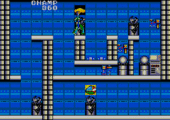
Unlike its predecessors, Razing Core transitions the action across multiple distinct, vertically scrolling environments. This shift represents a significant technical leap for the platform, requiring sophisticated memory management to maintain consistent frame rates while populating the screen with enemy projectiles, complex boss sprites, and varied terrain. The project’s development timeline highlights an increasing mastery of the Zilog Z80 processor—the heart of the Master System—allowing for a level of performance that challenges contemporary perceptions of 8-bit hardware limitations.
Narrative Framework and Core Mechanics
The narrative of Razing Core centers on the "Horizon" spacecraft, a vessel whose navigational systems are compromised by an alien entity designated as "the Core." The plot serves as the primary driver for the game’s progression, thrusting the player into a defense of Earth against an alien armada. While the premise adheres to traditional science-fiction tropes common in the 1980s and 90s, the focus of the design remains firmly on the mechanical execution.
The control scheme has been optimized for both standard Master System two-button controllers and the three-button Genesis gamepad. The game features a tiered combat system:
- Primary Fire: Standard rapid-fire projectiles, upgradable through collection cycles.
- Core Attack: A secondary rotating defensive and offensive maneuver with a tactical cool-down requirement.
- Burst Charge: An invincibility-granting maneuver triggered by simultaneous button inputs, designed for high-pressure scenarios.
The game also incorporates a secondary weapon system, ranging from wide-area spreads to high-velocity penetrating lasers, labeled A through D. These weapons are susceptible to both optimization and degradation; while "S" icons provide incremental power-ups to a maximum of five levels, the "X" icon serves as a negative modifier, stripping the player of their current secondary loadout. This risk-reward structure forces players to balance aggressive playstyles with defensive navigation.
Technical Performance and Hardware Compatibility
A primary concern for developers working on legacy hardware is the mitigation of "flicker" and "slowdown"—common side effects of the Master System’s hardware when processing high sprite counts. Razing Core demonstrates a high degree of optimization, maintaining a stable performance profile even during intense boss encounters.
Testing conducted on various hardware platforms, including the Analogue Mega SG and the Terraonion Mega SD flash cart, indicates that the game operates reliably at 60Hz. Because the software was developed with the original Master System and Mark III hardware in mind, it avoids the common pitfalls of reliance on modern emulation shortcuts. However, the developer has noted that compatibility with the myriad of third-party clone consoles currently on the market remains untested, suggesting that players utilize original hardware or high-fidelity FPGA systems to ensure an optimal experience.
Aesthetic and Auditory Design
The visual presentation of Razing Core is characterized by high-contrast, colorful environments that push the Master System’s color palette to its effective limits. The artwork, credited to digital artist danmakuman, emphasizes clear readability of enemies and projectiles against the backdrop of the game’s seven distinct stages.
The auditory experience is equally significant. Composed by Lovepenguin, who also contributed to Astro Climber, the soundtrack utilizes the Master System’s sound chip to produce a clear, robust soundscape. By avoiding the distorted percussion common in earlier Western-developed titles, the score achieves a level of fidelity rarely associated with the console’s library. Each stage features a unique, multi-minute musical theme, contributing to the game’s overall sense of polish.
Broader Implications for the Retro-Development Scene
The release of Razing Core at a price point of $7.99 highlights a growing trend in the indie-game community: the revival of "dead" platforms through high-quality, fan-driven development. This trend provides a significant value proposition for retro-enthusiasts, as these titles often match or exceed the technical complexity of late-era official releases from the 1990s.
The success of such projects has implications for the secondary market as well. With a physical release planned for the coming year, Razing Core aims to bridge the gap between digital accessibility and physical collection. For the Master System, a console often overshadowed by the 16-bit era, these titles serve as a necessary re-evaluation of its hardware longevity.
Strategic Analysis of Gameplay Features
While the game is largely lauded for its technical execution, some mechanics have invited scrutiny from the community. The "Burst Charge" ability, for instance, has been identified by some as having a disproportionately long charge time, which may limit its utility in fast-paced scenarios. Similarly, the durability of standard enemy units—which often require significant fire-power to neutralize—can lead to scenarios where evasion is a more strategic choice than engagement. These design choices reflect a philosophy that prioritizes difficulty and resource management, forcing players to adapt to the game’s specific cadence rather than relying on standard shooter tropes.
The scoring system, which includes the tracking of points for additional lives and the inclusion of "Carrier Cubes" containing power-ups, serves as a nod to the arcade-style incentives that defined the era. The implementation of a continue system that allows for progression from the start of a stage or a boss encounter provides a balanced experience, preventing the extreme frustration associated with older titles that mandated a full reset upon death.
Conclusion and Future Outlook
Razing Core stands as a testament to the viability of the Master System in a modern gaming landscape. By balancing the limitations of the Z80 processor with creative design, badcomputer has produced a title that serves both as a love letter to the 8-bit era and a functional, modern shooter. The project underscores the importance of independent developers in maintaining the legacy of older hardware. As the retro-gaming community continues to expand, titles like Razing Core provide the necessary momentum to keep historical platforms relevant, ensuring that the Master System’s library continues to grow decades after its official cessation of production. With the upcoming physical release, the title is positioned to become a staple for collectors and enthusiasts of the shmup genre, marking a significant milestone in the ongoing preservation and evolution of 8-bit software.