 Edi Durjana
The emulation and display technology landscape has taken a significant step forward with the introduction of a novel shader designed to drastically enhance motion clarity on modern high-refresh-rate displays. Developed through a collaborative effort between display authority Mark Rejhon of BlurBusters and veteran graphics programmer Timothy Lottes—widely recognized as the creator of the original FXAA shader and the crt-lottes suite—this new technological tool addresses one of the most stubborn visual artifacts in modern flat-panel screens: sample-and-hold motion blur.
By taking advantage of RetroArch’s recently implemented "subframe" shader capabilities, the new software can operate at precise multiples of standard content frame rates. This breakthrough allows modern liquid crystal displays (LCDs) and organic light-emitting diode (OLED) monitors to simulate the crisp motion characteristics of vintage cathode-ray tube (CRT) displays and professional scanning monitors without inheriting the severe brightness penalties and flickering issues historically associated with conventional black-frame insertion (BFI) techniques.
The software, officially designated as a CRT beam simulator, is built upon a foundation first demonstrated via Shadertoy. It marks a convergence of modern GPU shader architecture and historic display science, offering enthusiasts a sophisticated method to bridge the gap between retro software assets and cutting-edge display hardware.
Technical Background and the Evolution of Motion Clarity
To understand the significance of this development, one must examine the fundamental differences in how legacy displays and modern flat panels render motion. Traditional CRT displays operate on an impulse-driven model. An electron beam rapidly sweeps across the phosphor-coated screen from top to bottom, illuminating pixels momentarily before they naturally decay. Because the image is only visible for a fraction of a millisecond per refresh cycle, human persistence of vision integrates the movement smoothly, resulting in sharp, highly legible motion even during rapid camera pans or fast-paced action sequences.
Conversely, modern flat-panel displays—including both LCD and OLED panels—predominantly utilize a sample-and-hold mechanism. In this paradigm, a given frame of video is held statically on the screen for the entire duration of the refresh cycle (e.g., 16.6 milliseconds at 60Hz). When the human eye tracks a moving object across a sample-and-hold display, the eye moves smoothly while the image remains static in discrete steps, causing the image to smear across the retina. This perceptual phenomenon is known as sample-and-hold motion blur.
For years, display engineers attempted to mitigate this by implementing Black-Frame Insertion, which periodically blanks the screen between frames to trick the eye into perceiving an impulse-type response. However, traditional BFI implementations suffer from severe drawbacks: they drastically reduce overall light output (causing significant dimming), often introduce aggressive visible flicker that leads to eye strain, and can interact poorly with the fixed refresh intervals of variable refresh rate (VRR) technologies.
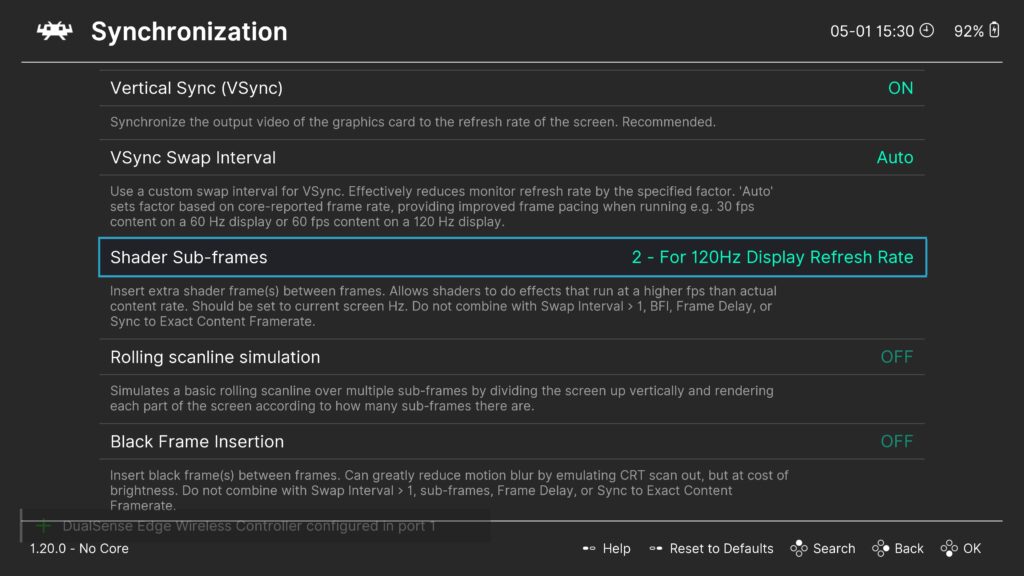
The collaboration between Rejhon and Lottes bypasses these limitations by leveraging RetroArch’s newly introduced Shader Sub-frames feature. Available natively in RetroArch version 1.20.0 and subsequent nightly builds, this framework enables shaders to execute multiple times within a single display refresh window. By synchronizing these subframes with the display’s high refresh rate—such as 120Hz, 240Hz, or higher—the shader can simulate a moving scanline (beam-racing) across the panel. This achieves the motion clarity benefits of traditional CRT scanning without plunging the overall image into darkness or inducing high-amplitude flicker.
Integration, Compatibility, and Setup Requirements
Deploying the new CRT beam-racing shader requires adherence to specific software and hardware prerequisites. Users must first ensure they are running RetroArch 1.20.0 or a later nightly release, as older iterations lack the underlying architecture required to process shader subframes. Furthermore, the technology is optimized for high-refresh-rate monitors capable of operating at 120 Hz or greater, allowing sufficient headroom for the subframe logic to execute effectively.
Within the emulator’s slang shader directory, users can locate pre-made presets under the shaders_slang/presets/crt-beam-simulator path. The shader is designed with high modularity in mind, meaning it can be seamlessly prepended to existing graphics chains, allowing users to combine the beam-racing motion clarity enhancements with their preferred CRT mask, curvature, or color-bleed presets without compatibility conflicts.
Calibration and Tuning Parameters
Because modern displays vary widely in panel technology, peak luminance, and pixel response times, the shader incorporates a comprehensive suite of runtime parameters designed for user calibration.
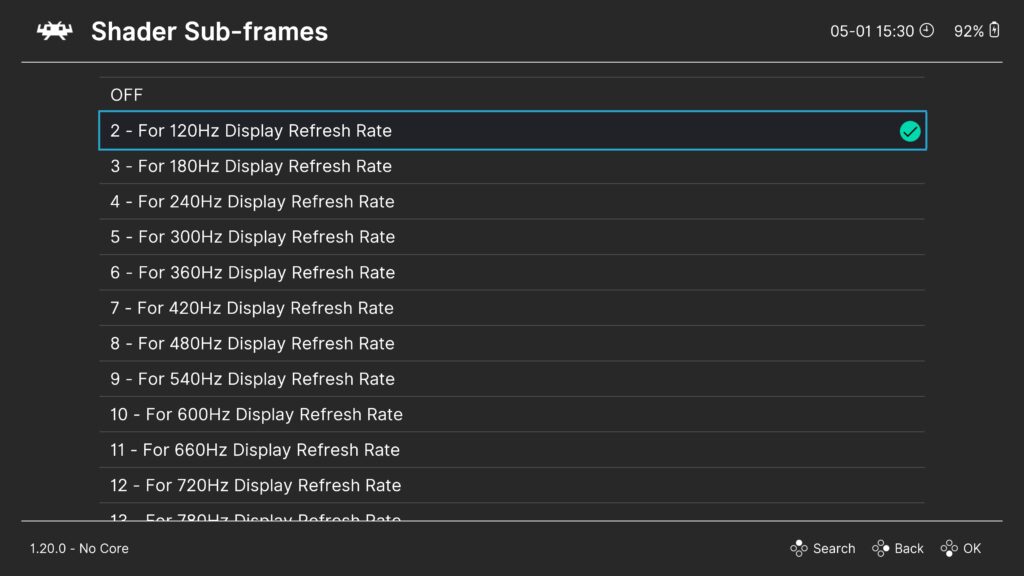
Foremost among these adjustments is gamma correction, which allows operators to establish a neutral image profile and eliminate unusual dark lines that can sometimes manifest during subframe rendering. Additionally, users can finely tune the balance between panel brightness and motion clarity. Field testing indicates that for standard 120 Hz monitors—which accommodate two subframes per primary frame—a parameter value of approximately 0.5 yields optimal results. For 240 Hz displays capable of supporting four subframes, a value closer to 0.7 is generally recommended.
The software also accounts for hardware-specific anomalies, such as image persistence. While modern OLED panels are largely immune to the voltage accumulation and uneven pixel wear caused by rapid flickering, certain panel topologies or refresh rate configurations can introduce visual artifacts. To combat this, the developers included a runtime parameter that disables the cycle timing offset, effectively preventing the simulated raster line from visibly rolling up or down the screen. Users can manually reposition the raster line to place it in the most visually unobtrusive location for their specific multi-monitor or ultra-wide hardware configurations.
Industry Implications and Future Outlook
The release of the CRT beam-racing shader represents a maturing of software-based display enhancement tools within the emulation community. For decades, achieving authentic motion reproduction required bulky hardware scan converters, expensive line doublers, or specialized vintage display hardware that is increasingly scarce and difficult to maintain.
By shifting the burden to modern graphics processing units and leveraging high-refresh-rate consumer monitors, this technique democratizes access to professional-grade motion clarity. Enthusiasts utilizing high-end gaming laptops, desktop PC monitors, and modern high-refresh OLED televisions can now experience retro software assets closer to how their original creators intended, minus the physical bulk and thermal output of a cathode-ray tube.
While the primary use case currently centers around retro-gaming emulation via Libretro-compliant cores, the underlying principles of subframe shader manipulation hint at broader applications for modern native PC gaming and digital video playback. As display manufacturers continue to push refresh rates higher—with 360 Hz and 480 Hz panels entering the consumer mainstream—the headroom for subframe-based post-processing will only expand, potentially redefining standards for motion fidelity across the entire consumer electronics market.
For users encountering configuration hurdles or seeking advanced troubleshooting advice, Mark Rejhon and the BlurBusters team maintain an active public issue tracker and FAQ repository on GitHub. Comprehensive community support is also readily available through the established Libretro forums, Reddit communities, and official Discord channels, ensuring that both novice enthusiasts and advanced power users can successfully integrate the technology into their digital display pipelines.