 Farhan hamdan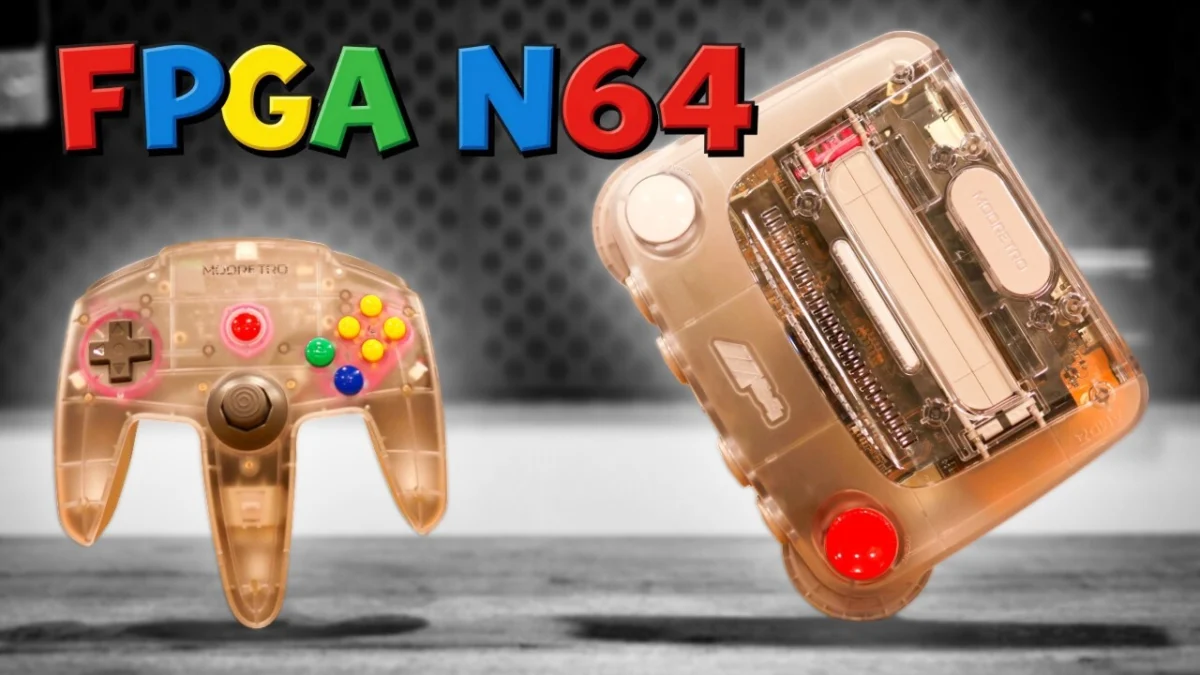
The landscape of retro video game preservation and hardware emulation has reached a significant milestone with the introduction of ModRetro’s M64, a completely open-source, FPGA-based implementation of the legendary Nintendo 64 console. Recently, hardware enthusiast and technical content creator Ken, known for his work on the platform What’s Ken Making, published a comprehensive teardown video examining the internal architecture and component selection of the device. This deep dive has shed light not only on the engineering choices made by ModRetro but also on the broader commercial and technical implications of utilizing advanced silicon in retro-hardware development. At the center of this technical discussion is the device’s deployment of the AMD Artix UltraScale+ FPGA, a component that industry observers suggest could redefine the performance ceiling for modern hardware emulation platforms.
Main Facts and Architectural Overview
The ModRetro M64 represents a departure from traditional software emulation by attempting to recreate the authentic hardware behavior of the Nintendo 64 at the silicon logic level. Field-Programmable Gate Arrays (FPGAs) achieve this by allowing engineers to configure uncommitted blocks of logic gates to mimic the exact physical circuitry of original microprocessors, graphics co-processors, and audio chips. Unlike software emulators that run abstract translations of code on a general-purpose CPU, an FPGA-based system operates via hardware description languages (HDLs), theoretically eliminating input lag, timing inaccuracies, and compatibility hurdles inherent to software-driven wrappers.
Ken’s teardown of the M64 provides a granular look at how these principles have been executed in physical hardware. The standout element of the teardown is the inclusion of the AMD Artix UltraScale+ FPGA. This semiconductor family represents a high-performance, power-efficient leap forward compared to older generations of programmable logic commonly found in the retro-gaming community, such as the aging Cyclone V architecture featured on the widely utilized DE-10 Nano board. The UltraScale+ architecture provides a massive density of logic cells, high-speed transceivers, and robust internal memory resources, giving developers the headroom necessary to handle the complex, multi-threaded graphics pipeline and memory management unit of the Nintendo 64.
The Nintendo 64 was notoriously complex to develop for during its commercial lifecycle, primarily due to its non-standard architecture, dual-coprocessor design (the Reality Co-Processor handling both graphics and audio), and high-bandwidth Rambus DRAM (RDRAM) memory subsystem. Recreating this intricate environment inside a programmable gate array requires immense processing capability. The selection of the AMD Artix UltraScale+ indicates that ModRetro prioritized future-proofing and high-end performance over minimizing bill-of-materials costs, setting a new benchmark for what commercial FPGA retro consoles can achieve.
Chronology of Development and Community Engagement
The progression of the M64 from concept to hardware release mirrors the rapid evolution of the open-source hardware community. Over the past decade, FPGA-based retro gaming has transitioned from niche academic projects and DIY hobbyist boards to a vibrant, semi-commercial market. Devices targeting 8-bit and 16-bit systems have saturated the market, but accurately replicating fifth-generation consoles—such as the Sony PlayStation, Sega Saturn, and Nintendo 64—has proven exponentially more difficult due to the sheer transistor count and clock speeds involved.
As ModRetro rolled out the M64, the developer community immediately began probing the hardware boundaries of the platform. Shortly after the initial hardware distribution, indications emerged that third-party FPGA cores and alternative firmware implementations were in active development. This open ecosystem approach mirrors the trajectory of platforms like the MiSTer FPGA, where community-driven software and core development often outpace official manufacturer updates.
A significant development in this timeline involves an independent developer known as Fulvio, who has begun creating a complete replacement firmware suite for the M64, designated as "OM64" (Open M64). According to developer logs and community updates, Fulvio’s custom firmware aims to unlock advanced capabilities, including stable operational output at native 4K resolutions. While independent verification remains ongoing as units circulate more widely among hardware reviewers and developers, the emergence of projects like OM64 highlights the rapid adaptability of the M64’s underlying architecture. The ability of community developers to rewrite and optimize firmware layers underscores the practical value of ModRetro’s open-source philosophy, transforming the M64 from a static consumer product into an evolving development platform.
Supporting Data and Component Analysis
To understand the engineering significance of the AMD Artix UltraScale+ FPGA within the M64, it is necessary to examine the technical metrics that separate it from previous industry standards. For years, the DE-10 Nano board—featuring an Intel Cyclone V SoC—has served as the de facto reference standard for high-end FPGA retro gaming, powering the popular MiSTer project. While the Cyclone V is a capable and cost-effective platform for systems ranging from the arcade era up to 32-bit consoles, it hits strict thermal and logic-gate ceilings when tasked with the parallel processing demands of fifth-generation 3D hardware.

The AMD Artix UltraScale+ family, by contrast, is built on an advanced 16nm FinFET fabrication node, contrasting sharply with older 28nm processes common in legacy FPGA designs. This smaller lithography translates directly to higher clock frequencies, lower power consumption, and significantly denser logic utilization within the same physical footprint.
- Logic Density: UltraScale+ devices offer vastly increased numbers of system logic cells, enabling the concurrent simulation of multiple specialized processors without running out of routing resources.
- Memory Integration: The architecture includes advanced Block RAM (BRAM) and UltraRAM resources, which are essential for buffering the complex framebuffer operations, texture caches, and microcode execution loops native to the Nintendo 64’s Reality Coprocessor (RCP).
- I/O and Display Capabilities: High-speed serial transceivers and robust internal clock management tiles allow the M64 to output pristine digital video signals at high refresh rates and elevated resolutions, such as the 4K output targets being explored by community firmware developers.
When Ken performed his physical teardown, these architectural advantages translated into a remarkably clean board layout. The integration of high-speed power management ICs and efficient thermal dissipation pathways ensures that the AMD chip can sustain peak processing loads during intensive gameplay sessions without throttling.
Official Responses and Ecosystem Dynamics
While ModRetro has positioned the M64 as an open-source hardware platform, the broader implications of third-party core support and firmware modifications like OM64 introduce complex dynamics regarding hardware governance, warranty support, and intellectual property.
ModRetro’s official stance on open architecture has generally invited community participation, distinguishing the product from closed-ecosystem emulation hardware. By encouraging transparency and allowing developers to inspect the hardware layer, the company has fostered a collaborative environment. However, the introduction of unofficial replacement firmware—such as Fulvio’s OM64—places the product in a unique grey area between consumer electronics and open-source development boards.
Industry analysts tracking the retro hardware sector note that hardware manufacturers increasingly view community engagement as a key driver of long-term product viability. When a device is perceived as "open," its lifespan extends far beyond the manufacturer’s official support lifecycle. Creators like Ken have emphasized that the willingness of companies to adopt powerful, modern silicon like the Artix UltraScale+ is a direct response to consumer demand for uncompromising accuracy. Users are no longer satisfied with simple HDMI-out adapters for original hardware or inaccurate software ports; they expect modern convenience paired with cycle-accurate behavior, a balance that only high-end FPGA implementations can reliably provide.
Broader Impact and Industry Implications
The technical success and community-driven evolution of the ModRetro M64 carry profound implications for the future of hardware-level retro preservation. As fifth-generation consoles age, original hardware suffers from degrading capacitors, failing optical or cartridge-slot connectors, and dying custom silicon. Emulation via FPGA offers the only permanent, scalable solution for maintaining these digital artifacts in their original operational states.
The ripple effects of the M64 teardown and subsequent firmware experiments extend beyond Nintendo’s catalog:
- Component Adoption Shifts: The successful implementation of the AMD Artix UltraScale+ in a commercial retro console proves that modern, high-density FPGAs can be integrated into consumer-tier hardware without prohibitive cost scaling. Other hardware developers are likely to follow suit, moving away from older Intel/Altera Cyclone architectures toward AMD’s UltraScale+ lineup for next-generation retro projects.
- Standardization of High-Resolution Output: The pursuit of stable 4K output via custom firmware demonstrates that consumers and developers view modern display compatibility as a mandatory baseline rather than an optional luxury. Future FPGA consoles will be expected to interface seamlessly with modern digital displays, HDR standards, and variable refresh rate (VRR) technologies.
- The Open-Source Development Model: The synergy between hardware manufacturers and independent software developers—exemplified by the relationship between ModRetro’s hardware and community projects like OM64—reinforces a collaborative model where hardware serves as a canvas for software innovation. This model reduces the maintenance burden on original manufacturers while accelerating feature delivery through decentralized developer networks.
In summary, Ken’s exhaustive teardown of the ModRetro M64 has provided the technical community with a rare, transparent look at the engineering required to bring fifth-generation console emulation into the modern era. By pairing forward-thinking silicon architecture with an open-source hardware ethos, the M64 has established a new benchmark for the industry. As developers continue to test the limits of the AMD Artix UltraScale+ through custom firmware and alternative cores, the platform stands as a testament to the viability, resilience, and ingenuity of modern hardware preservation.