 Farhan hamdan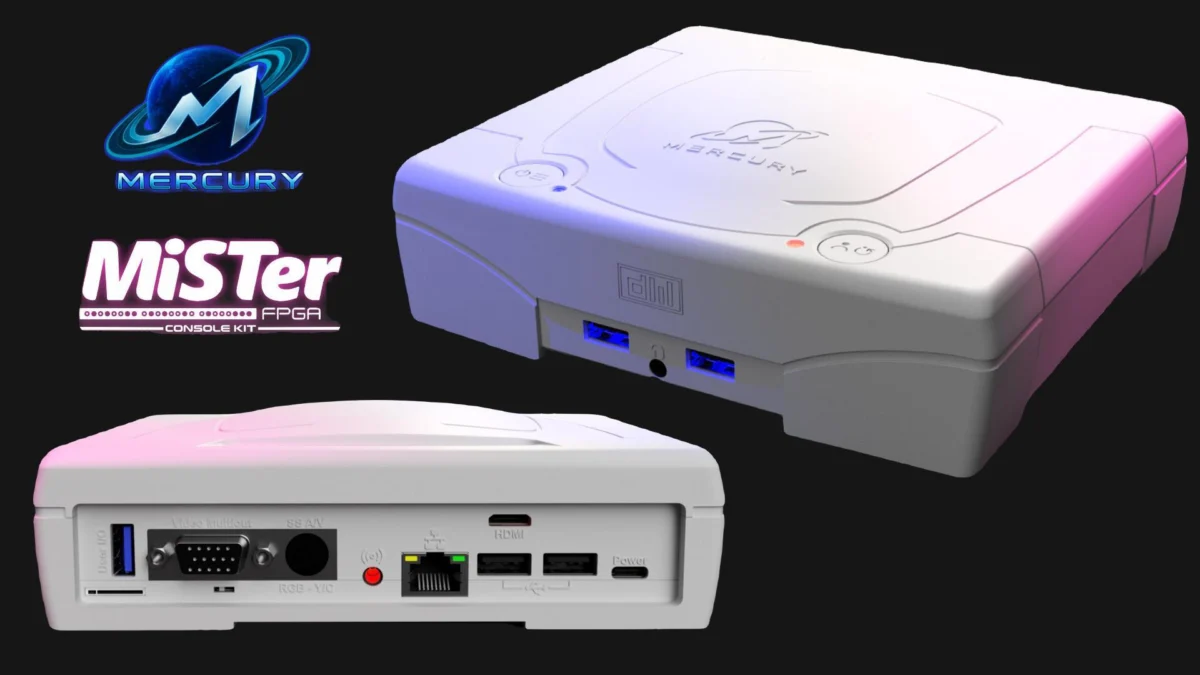
The landscape of retro gaming hardware preservation has entered a new phase of aesthetic integration with the official pre-order announcement of the Mercury, a comprehensive MiSTer FPGA kit styled after the iconic Sega Saturn. Developed by df3mod—recognized previously for engineering the MiSTer Ironclad—the Mercury draws direct inspiration from the original 32-bit console’s development moniker. Designed to bridge the gap between open-source hardware capabilities and classic console nostalgia, the kit offers enthusiasts a custom-molded, white injection-molded shell housing specialized video routing hardware, peripheral interfaces, and modular expansion capabilities.
With pre-orders now live on df3mod’s official web store and initial shipments projected for early 2027, the release highlights a growing market demand for dedicated, console-styled chassis solutions within the burgeoning FPGA community. While base pricing for the kit starts at approximately $260, consumers must factor in additional hardware investments—specifically the core processing board required to run the open-source emulation cores.
Main Facts and Hardware Specifications
At its architectural core, the Mercury kit is engineered to accommodate the DE-10 Nano FPGA board, which serves as the computational engine for the MiSTer platform. However, keeping pace with recent hardware developments in the open-source community, df3mod has confirmed native compatibility with the newer MiSTer Pi platform via a modest $5 adapter. This dual-compatibility ensures that prospective buyers utilizing either the legacy Terasic DE-10 Nano or modern alternative carrier boards can integrate their processing hardware seamlessly into the Saturn-styled housing.
The physical dimensions and external presentation of the Mercury replicate the design ethos of mid-1990s Japanese home consoles. The enclosure utilizes a high-grade, injection-molded white polymer shell designed to sit naturally within entertainment centers alongside original hardware from the fourth and fifth generations of video game consoles.
Beyond its exterior aesthetics, the internal architecture features a high-performance 24-bit Digital-to-Analog Converter (DAC). Video output routing is handled via a dual-connector configuration incorporating both a standard VGA port and a specialized Sega Saturn-style MiniDIN connection. While composite video output is omitted from the hardware design, the integrated circuit includes a built-in Luma Trap, enabling users to leverage S-Video Sega Saturn cables for enhanced analog clarity on CRT displays and legacy monitors.
Chronology and Development Trajectory
The journey toward the Mercury kit reflects a broader evolution in the retro-computing and hardware emulation sphere. Over the past half-decade, the MiSTer FPGA project has transitioned from a niche developer-focused ecosystem into the gold standard for cycle-accurate hardware recreation of classic arcade boards, home computers, and video game consoles.
Initially, early adopters of the MiSTer platform relied on bare-bones printed circuit board stacks, exposed wiring, and utilitarian enclosures that prioritized electrical functionality over aesthetic appeal. However, as the user base expanded, hardware designers began developing integrated "all-in-one" chassis solutions. Df3mod established a reputation within this sector through previous hardware ventures, most notably the MiSTer Ironclad.
The conceptualization of the Mercury shifted focus from generic industrial designs toward targeted, console-specific tributes. By selecting "Mercury"—the internal engineering codename utilized by Sega during the hardware development cycle of the original Saturn—df3mod aligned the project directly with historical hardware lore. Following months of prototype iteration, material sourcing, and circuit board optimization, df3mod finalized the production blueprints in late 2026, culminating in the opening of public pre-orders with a targeted fulfillment window set for the first quarter of 2027.
Supporting Data, Pricing, and Configuration Options

The financial framework surrounding the Mercury kit requires careful consideration of modular pricing tiers and necessary supplementary components. The base kit pricing begins at approximately $260 USD. This entry-level cost covers the custom injection-molded chassis, the internal power distribution systems, the 24-bit DAC, and the integrated audio-video routing infrastructure.
However, consumers must budget for several external variables to achieve a fully operational system:
- Processing Hardware: The kit does not include a DE-10 Nano board or a MiSTer Pi board. Acquiring a DE-10 Nano typically requires monitoring secondary markets or authorized industrial distributors, where pricing historically fluctuates between $130 and $200 depending on global semiconductor supply chains.
- Alternative Boards: Users opting for the MiSTer Pi must purchase the specific $5 adapter interface provided through df3mod’s ecosystem.
- Accessories and Expansion: Df3mod has structured the product rollout with numerous optional add-ons, including custom cabling solutions, specialized power supply units, and expansion modules designed to enhance input-output capabilities. Consequently, fully configured orders equipped with premium accessories can scale significantly higher than the baseline entry cost.
When evaluated against competing all-in-one FPGA chassis systems currently available on the market—such as the SuperStation One, which features an integrated computing board within its baseline price—the Mercury operates at a distinct price point. Analysts note that while consumers pay a noticeable financial premium for the specialized Saturn-inspired industrial design, the cost reflects the lower production economies of scale associated with injection-molded custom plastics compared to standard metal or 3D-printed enclosures.
Official Responses and Community Reactions
Reactions from the retro gaming community and hardware preservation circles have been overwhelmingly positive, particularly among enthusiasts specializing in fifth-generation console libraries. Online forums dedicated to FPGA development and classic Sega hardware have praised the attention to detail in replicating the physical footprint of mid-90s hardware design philosophy.
Industry observers and community commentators have highlighted the psychological appeal of "modern-retro" industrial design. By housing open-source hardware inside chassis that mirror vintage aesthetic standards, developers are effectively lowering the psychological barrier to entry for mainstream consumers who prefer living room setups free of exposed circuit boards and tangled ribbon cables.
Furthermore, community feedback indicates strong enthusiasm for the inclusion of S-Video capabilities via the Luma Trap circuit. While modern setups heavily favor digital HDMI connections for high-definition flat-panel displays, a dedicated sub-sect of retro gaming purists continues to utilize standard-definition cathode-ray tube (CRT) monitors to experience authentic scanline rendering and color bleeding. The inclusion of a Saturn-style MiniDIN port directly caters to this demographic, allowing collectors to repurpose high-end legacy cables without resorting to custom adapter splicing.
Broader Impact and Implications for Hardware Emulation
The release of the Mercury kit underscores a maturing trend within the open-source hardware community: the fusion of high-end computational fidelity with museum-grade industrial presentation. As FPGA cores become increasingly sophisticated—capable of accurately mirroring complex architectures like the Sega Saturn, Sony PlayStation, and arcade hardware of the late 1990s—the demand for polished physical presentation has grown in tandem.
Historically, hardware preservation relied heavily on original physical media and aging console motherboards suffering from capacitor degradation, optical drive failures, and custom chip scarcity. While original hardware remains the gold standard for purists, hardware degradation presents a mounting operational challenge. FPGA technology resolves longevity concerns by replicating hardware behavior at the transistor level rather than relying on software translation layers. Kits like the Mercury demonstrate that open-source hardware projects no longer need to sacrifice aesthetic appeal for technical functionality.
By providing a polished, console-grade physical shell, df3mod and similar hardware designers are redefining how enthusiasts interact with preservation technology. As production ramps up toward the early 2027 delivery target, the market performance of the Mercury will likely serve as a benchmark for future console-themed FPGA enclosures, potentially inspiring further hardware tributes to classic systems of the 16-bit and 32-bit eras. Prospective buyers and hardware historians can review complete technical documentation, wiring diagrams, and pre-order specifications directly through df3mod’s official product portal.