Jia Lissa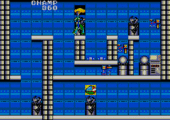
The release of Zillion for the Sega Master System in 1987 represents a pivotal moment in the evolution of home console software, bridging the gap between Japanese animation culture and the burgeoning non-linear action-adventure genre. Developed and published by Sega Enterprises, the title emerged during a period of rapid expansion for the 8-bit market, serving as an interactive tie-in to the Tatsunoko Productions anime series of the same name. While the game was initially positioned as a cross-media marketing effort, its complex design and mechanical depth established it as a significant, albeit challenging, entry in the Master System library.
Historical Context and Transmedia Integration
In the mid-1980s, the Japanese animation industry began seeking international reach, utilizing various media formats to build brand awareness. Zillion, which debuted on Japanese television in April 1987, was designed with a futuristic, high-tech aesthetic that mirrored the era’s fascination with space-age narratives. Sega’s decision to develop a corresponding game highlighted the company’s strategic shift toward building proprietary intellectual properties that could capitalize on existing fan bases.
Although the anime saw only limited exposure in the North American market—most notably appearing as a brief visual reference in the 1995 music video for "Scream" by Michael and Janet Jackson—the game functioned as a standalone experience for many Western players. Without the immediate context of the show’s plot, players approached the Master System release as a technical exercise in maze navigation and tactical combat. The synergy between the software and the television show was one of the early instances of coordinated media franchising in the gaming industry, setting a precedent that would eventually become standard practice for global publishers.
Core Gameplay Mechanics and Structural Design
The narrative of Zillion tasks the player with controlling JJ, a member of the elite White Knights peacekeeping force. The objective is to infiltrate the subterranean stronghold of the Norsa Empire, secure five encrypted floppy disks containing vital intelligence, and sabotage the base’s central mainframe. The gameplay is characterized by a sprawling, non-linear environment comprising nearly 50 interconnected rooms.
Central to the gameplay loop is the "Zillion" laser, a versatile tool that functions both as a primary weapon for neutralizing Norsa guards and as a utility device for interacting with the environment. Players must navigate a variety of hazards, including electrified barriers, automated security beams, and rotating turrets. A key mechanical innovation involves the rescue of teammates, Apple and Champ. Upon their liberation, the player gains the ability to swap between characters, each possessing distinct physical attributes:
- JJ: A balanced operative suitable for general reconnaissance and combat.
- Apple: Distinguished by superior agility and higher jump capacity, essential for navigating vertical architecture.
- Champ: Defined by increased durability, allowing for more aggressive engagement in high-threat zones.
This character-swapping system introduced a layer of strategic planning rarely seen in contemporary action games. Players were required to assess the environmental hazards of specific sectors and select the appropriate operative to mitigate risk. Furthermore, the inclusion of programmable computer terminals allowed players to manipulate the base’s infrastructure—disabling security systems and unlocking restricted doors—which moved the gameplay beyond simple reflex-based action into the realm of environmental puzzle-solving.
Comparative Analysis: Zillion and the Metroid Paradigm
During its release window, Zillion was frequently compared to Nintendo’s Metroid, which launched in the same year. Both titles shared core design tenets: side-scrolling exploration, a gradual progression of power, and a non-linear map structure. However, a technical analysis reveals fundamental differences in design philosophy.
Metroid focused on the theme of isolation, casting the player as a solitary protagonist in an alien, hostile ecosystem. Zillion, conversely, emphasized a military-style infiltration mission with a heavy reliance on teammate synergy and high-tech electronic sabotage. The design influences for Zillion appear more closely aligned with the 1984 title Impossible Mission, which prioritized the systematic disabling of electronic security within a time-sensitive environment.
While Metroid encouraged long-term exploration of an expansive planet with interconnected zones, Zillion kept players within the confines of a single, massive installation. This distinction shifted the player’s focus from survival-exploration to high-speed tactical execution and resource management.
Technical Limitations and User Experience
A significant hurdle for players in 1987 was the absence of a save or password system. In an era where complex, long-form games were beginning to incorporate battery-backed RAM or password-entry features—such as those found in the 1987 title Phantasy Star—Zillion required completion in a single session. Industry experts suggest this limitation was a cost-mitigation measure, as the inclusion of battery-backed save technology would have pushed the retail price of the cartridge beyond the competitive threshold of the mid-80s home console market.
This constraint fundamentally altered the player experience, shifting the game from a casual endeavor to a test of endurance and preparation. The necessity of creating manual maps to track progress through the labyrinthine base became a standard practice for dedicated players. The game’s reliance on player memorization and repetitive practice served as a common design trope of the period, though it ultimately limited the game’s accessibility for a broader, less committed audience.
Critical Reception and Post-Release Assessment
Retrospective analysis of Zillion’s narrative execution highlights a disconnect between the game’s challenging gameplay and its climactic payoff. Despite the depth of the infiltration mechanics, the final encounter is limited to a single boss fight against a mechanical creature, leaving the primary antagonist, Baron Ricks, absent from the active gameplay loop. This lack of a direct confrontation with the main villain is widely regarded as an anti-climactic conclusion to a high-stakes mission.
Furthermore, while the rescue mechanic provided a tactical advantage, the implementation was viewed by some critics as underutilized. The secondary characters served primarily as additional "lives" rather than providing unique, game-changing abilities that could have expanded the scope of the mission.
Despite these structural shortcomings, Zillion maintains a reputation for high-quality audiovisual design. Its sharp 8-bit graphics, responsive control scheme, and atmospheric soundtrack contributed to its longevity as a cult classic.
Broader Industry Impact and Legacy
The legacy of Zillion is one of untapped potential. It demonstrated that 8-bit hardware was capable of sustaining complex, non-linear gameplay experiences that prioritized player agency and environmental interaction. However, the subsequent entry in the series failed to iterate upon these foundations, and the transition to the 16-bit era on the Sega Genesis did not see the franchise move into the next generation of console gaming.
The absence of a modernized save system on the original hardware remains the primary barrier for historical preservationists and players attempting to experience the game today. In modern contexts, the use of emulation and save-state technology has mitigated these original design limitations, allowing for a more accurate assessment of the game’s core mechanics.
Ultimately, Zillion serves as an essential case study for historians tracking the integration of anime-style narrative into interactive media. While it may have fallen short of the commercial dominance achieved by its contemporaries, its influence on the development of exploration-based action games remains a significant chapter in Sega’s corporate history. The title stands as a testament to the ambitious, experimental nature of the 1987 software market, where design ingenuity often outpaced the technological constraints of the era.