Jia Lissa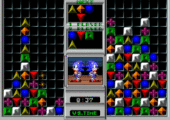
Sonic Eraser stands as a profound historical artifact within the early 1990s video game industry, representing one of the first attempts by a major console manufacturer to utilize digital distribution and networked play. Developed by Sega CS1 and released in 1991, the title was an exclusive offering for the Japanese Mega Drive’s Game Toshokan, a subscription-based streaming service facilitated by the Sega Mega Modem. While the Blue Blur has since become synonymous with high-speed platforming, educational software, and multifaceted spin-offs, Sonic Eraser occupies a singular position as the character’s first foray into the puzzle genre—a title that was effectively lost to time for over a decade before being rediscovered by an international audience.
The Technological Context of the Early 1990s
To understand the significance of Sonic Eraser, one must first examine the environment in which it was born. In 1991, the concept of home console online connectivity was in its absolute infancy. Sega’s Game Toshokan—literally translating to "Game Library"—was a visionary, if technically limited, service. Through the use of a proprietary modem, subscribers could download titles directly to their Mega Drive consoles. This was not a permanent installation; the games existed in the console’s memory only while it remained powered on.
This model, while archaic by modern standards of cloud gaming and digital storefronts, was revolutionary. Alongside Sonic Eraser, the service hosted titles such as Fatal Labyrinth and various text-based adventures within the Phantasy Star II universe. These games were intentionally designed with small ROM sizes to accommodate the constraints of early telecommunications infrastructure, which struggled with latency and data transfer speeds. Consequently, these games were often minimalist in presentation, prioritizing functionality over graphical complexity.
Chronology of an Obscure Release
The trajectory of Sonic Eraser’s availability is a case study in the fragility of early digital media. Released in 1991, the game was tethered to the lifecycle of the Game Toshokan service. As the market for the Sega Mega Modem failed to achieve widespread adoption, Sega discontinued the service in 1992. With the termination of the server, Sonic Eraser was effectively deleted from the public sphere.
For the next twelve years, the game existed only in the archives of those who had access to the original hardware in Japan. It was not until 2004 that the title surfaced once more. During this period, Sega of Japan experimented with the B-Club download service, allowing users to purchase and download classic Mega Drive titles from a web portal. Although Sonic Eraser was briefly resurrected here, it remained inaccessible to Western audiences. Furthermore, a highly anticipated inclusion in the 2005 compilation Sonic Gems Collection was scrapped, leaving the game in a state of purgatory. The eventual "release" of the title to the West was accomplished exclusively through fan-led efforts, which involved the extraction and English-language translation of the ROM, a testament to the preservationist efforts of the Sonic community.
Mechanics and Gameplay Design
Mechanically, Sonic Eraser functions as a competitive puzzle game, emphasizing rapid pattern recognition and strategic management of falling blocks. Players manipulate clusters of four tiles, attempting to clear the screen by matching two or more identical colors. This design choice—requiring only a pair rather than the more traditional triplet seen in competing titles like Columns—renders the game significantly more forgiving.
The title includes four distinct modes, each designed to test different cognitive reflexes:
- Round Mode: The primary game mode, featuring 40 levels of increasing difficulty where players must remove specific ring-shaped blocks to progress.
- Normal Mode: A focus-oriented mode that prioritizes high scores over survival, with the speed of falling blocks scaling based on player performance.
- Doubt Mode: A variant that introduces "mystery" blocks, which transform into white, neutral squares upon landing, requiring players to alter their strategies mid-match.
- Block Mode: A high-risk, high-reward mode that encourages the construction of complex, unstable towers to facilitate massive chain reactions.
The competitive aspect remains the most notable component of the game. When playing against a computer or a human opponent, clearing lines triggers offensive maneuvers, such as punch attacks or shield-augmented spin dashes. These moves temporarily paralyze the opponent’s ability to manipulate their falling blocks, creating a "stun lock" dynamic that can be difficult to recover from once a player begins to lose momentum.
Critical Analysis and Industry Implications
From an analytical perspective, Sonic Eraser serves as a prime example of "brand-stretching." At the time of its release, the Sonic the Hedgehog franchise was in its explosive growth phase, following the massive success of the original 1991 platformer. By affixing the Sonic brand to a generic, low-budget puzzle game, Sega sought to incentivize adoption of the nascent Game Toshokan service.
Industry analysts have often noted that the game lacks the cohesive identity associated with the Sonic brand. The audio-visual presentation—relying on recycled animations and a singular, repetitive musical track—suggests that the development team was constrained by the technical limitations of the streaming medium rather than a lack of creative intent. The absence of iconic sound design or familiar character motifs beyond the avatar underscores the "footnote" status of the title.
While the game provides a stable and competent puzzle experience, it fails to achieve the depth or character integration seen in later successes such as Dr. Robotnik’s Mean Bean Machine. The latter, a re-skin of the established Puyo Puyo franchise, demonstrated how the Sonic aesthetic could be successfully merged with puzzle mechanics. Sonic Eraser, conversely, remains a title where the character feels like an aesthetic overlay rather than a foundational element of the game’s identity.
Legacy and Preservation
The legacy of Sonic Eraser is defined more by its rarity than by its mechanical innovation. It is an artifact of a company attempting to navigate the intersection of telecommunications and entertainment long before the infrastructure was ready to support such ambitions. For historians of the medium, the title provides valuable data on the limitations of early streaming services and the evolution of the "Sonic" brand as a versatile marketing asset.
In the contemporary landscape, where digital preservation is an increasing concern for the gaming industry, Sonic Eraser serves as a cautionary tale regarding the reliance on server-side distribution. Had the fan community not intervened to preserve the game code, the title would likely be lost to history entirely. Today, while it is widely recognized by enthusiasts and collectors, it does not occupy a place in the pantheon of essential Sonic titles. It remains a curiosity—a technical prototype that illustrates the experimental, often turbulent, era of 16-bit gaming. For those interested in the puzzle genre, its value is largely restricted to its historical context and the novelty of its competitive multiplayer mode.