Farhan hamdan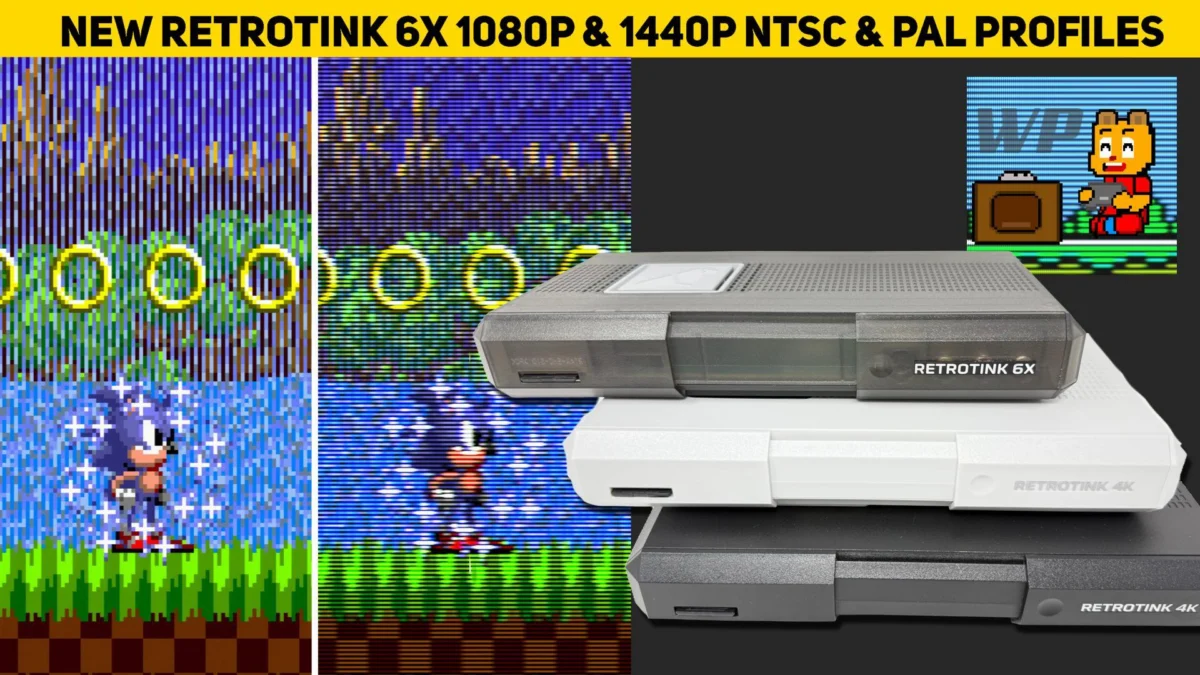
The retro gaming and hardware enthusiast community has received a major update to its display optimization toolkit as prominent community developer Wobbling Pixels officially releases a comprehensive profile pack tailored specifically for 1080p and 1440p resolutions. Designed primarily for the cost-effective RetroTINK 6X platform while maintaining full backward and cross-compatibility with the flagship RetroTINK-4K, this new release bridges a critical gap for users who operate their hardware outside of native 4K outputs. The release follows closely on the heels of the developer’s August profile pack, continuing a consistent pipeline of software enhancements aimed at narrowing the visual fidelity gap between vintage cathode-ray tube (CRT) displays and modern high-refresh-rate flat-panel screens.
Background Context and Technological Evolution
To understand the significance of this release, one must examine the rapid evolution of video upscaling hardware in recent years. RetroTINK upscalers, developed by RetroTINK LLC, have fundamentally transformed how classic video game consoles—ranging from fourth-generation 16-bit systems like the Super Nintendo Entertainment System (SNES) to sixth-generation hardware—interface with modern digital displays such as OLED and LED panels.
While the RetroTINK-4K remains the industry benchmark for ultra-high-definition video processing, a significant segment of the enthusiast community routinely operates their hardware at lower resolutions like 1080p and 1440p. There are two primary technical drivers for this workflow: video streaming constraints, which often prioritize lower resolutions for bitrate stability and compatibility, and the implementation of Black Frame Insertion (BFI). BFI is a technique used to combat motion blur on modern sample-and-hold displays by inserting black frames between active video frames. However, achieving high-frequency BFI—such as 120Hz, 180Hz, or 240Hz refresh rates—frequently requires scaling down the output resolution from 4K to lower tiers to accommodate bandwidth and processing limitations.
Prior to Wobbling Pixels’ new release, users operating the RetroTINK-4K at 1080p or 1440p had to manually load 4K-optimized profiles, navigate the menu systems to downscale the output, and subsequently readjust scaling modes, pixel masks, and scanline structures. While not technically difficult, this repetitive workflow added friction to the user experience. The new dedicated profile pack eliminates this overhead by providing pre-optimized scaling parameters specifically engineered for sub-4K canvas sizes, ensuring pixel-perfect integer scaling without requiring exhaustive manual intervention.
Chronology of Recent Updates
The release of the 1080p and 1440p profile pack represents the latest milestone in an ongoing series of software and configuration updates for high-end upscalers:
- August 28, 2026: Wobbling Pixels releases the foundational profile pack for the RetroTINK-4K, establishing new benchmarks for CRT simulation, color matrices, and scanline blending.
- Early September 2026: Initial beta testing and community feedback regarding sub-4K workflows highlight the demand for dedicated 1080p and 1440p configurations, particularly for high-refresh-rate BFI setups and streaming environments.
- September 2026: Official public launch of the dedicated 1080p and 1440p profile pack, featuring integrated console-specific CRT blur profiles and specialized modelines for high-refresh-rate displays.
Detailed Overview of the New Profile Features
The newly released software package introduces several advanced visual features designed to replicate the authentic physical characteristics of vintage CRT monitors on modern digital panels. Among the standout additions are integrated console-specific CRT-blur algorithms. Unlike digital pixel grids, which can appear excessively sharp and artificial when displaying legacy 240p content, authentic CRTs exhibit natural phosphor persistence and beam diffusion that soften harsh geometric edges. By embedding these characteristics directly into the profile parameters, the new pack provides an image that closely mirrors vintage hardware behavior.
Furthermore, the profiles support advanced color conversion matrices, including D93 color space implementations, which simulate the cooler white points commonly found on consumer-grade vintage televisions rather than the sterile D65 standard used in modern computer monitors and broadcast displays.
For owners of the RetroTINK 6X, this update represents an immediate and substantial enhancement. Power users gain access to precision-engineered profiles previously exclusive to higher-end hardware tiers, democratizing high-end display calibration across different budget brackets within the ecosystem.

Installation Procedures and Firmware Requirements
Implementing the new profile pack requires adherence to specific installation sequences to ensure stability and prevent configuration conflicts. Both RetroTINK 6X and RetroTINK-4K users must ensure their hardware is operating on the latest available firmware versions.
For users who have already installed the August profile release, the installation process is streamlined: users can simply extract the new update pack directly onto their existing SD card, allowing the system to overwrite duplicate files.
For users configuring a clean installation or updating from older software versions, a more methodical approach is required:
- Connect the hardware’s SD card to a personal computer.
- Search the directory for files and folders associated with "Wobbling Pixels."
- Back up any custom user profiles to prevent accidental data loss.
- Delete all identified Wobbling Pixels-related files and directories.
- Extract the foundational August profile pack to the root directory of the SD card.
- Extract the new 1080p and 1440p profile pack, overwriting prompts as necessary.
For RetroTINK 6X Central Edition (CE) users encountering storage read errors, the development team recommends formatting the SD card entirely and deploying the complete factory image provided via the official distribution channels, which bundles the latest firmware alongside all historical and current profile updates.
Analysis of Broader Industry Implications
The continuous refinement of open-source and community-driven profile packs for hardware scalers highlights a broader trend within the retro gaming ecosystem: the relentless pursuit of hardware-accurate preservation through software flexibility.
As flat-panel display technology continues to dominate the consumer electronics market, traditional display hardware is aging out, becoming scarcer, and growing increasingly expensive to maintain. Upscalers like the RetroTINK series, combined with meticulous community profiling, serve as a vital bridge keeping vintage interactive media accessible and visually authentic on modern displays.
By streamlining the workflow for sub-4K resolutions, developers like Wobbling Pixels reduce the technical barriers that often intimidate casual enthusiasts. The ability to achieve near-CRT visual fidelity at high refresh rates—such as 1440p120 or 1080p240—demonstrates that modern digital signal processors possess the agility to honor the aesthetic intent of classic game developers without imposing modern visual artifacts.
Access and Availability
The new profile packs, along with necessary firmware documentation and companion resources, are hosted publicly via established enthusiast distribution networks. Users seeking to acquire the RetroTINK hardware required to run these profiles, as well as those looking to access the community repositories, can find direct links through standard hardware documentation hubs maintained by the retro computing community. As developers continue to refine color science, scanline algorithms, and scaling ratios, the visual gap between vintage analog displays and modern digital panels continues to narrow, establishing a robust standard for digital heritage preservation.