Jia Lissa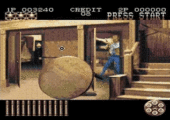
Technological Context and Hardware Constraints
The hardware ecosystem of 1994 placed significant limitations on the home port experience. The title was designed to interface with the Sega Genesis controller or the dedicated Konami Justifier light gun. The Justifier remains a notable piece of peripheral history, though its utility is tethered to the constraints of cathode-ray tube (CRT) technology. Because light guns function by detecting the rapid refresh rate and electron beam patterns of CRT monitors, the game is functionally incompatible with modern liquid crystal display (LCD) or organic light-emitting diode (OLED) screens without specialized hardware adapters.
From a performance standpoint, the Justifier provides a level of parity with the arcade experience that a standard game controller cannot replicate. Testing indicates that the latency inherent in a directional pad (D-pad) movement, used to maneuver a reticle across the screen, creates a tangible disadvantage against the game’s aggressive enemy AI. Players using controllers are forced to compensate for mechanical travel time, which leads to a higher rate of missed shots and incidental damage to non-hostile targets. In contrast, the Justifier allows for instantaneous target acquisition, mirroring the "muscle memory" developed by arcade patrons during the early 90s.
Gameplay Mechanics and Structural Progression
The game follows a linear structure across five distinct stages, each introducing escalating tactical requirements. The foundational loop—identifying and neutralizing hostile threats while avoiding innocent bystanders—is augmented by a dynamic weapon-upgrading system. By targeting specific environmental assets such as signage, vases, or crates, players can temporarily swap their standard six-shooter for higher-caliber weaponry, including rifles, shotguns, and Gatling guns. These power-ups are ephemeral, necessitating strategic conservation for high-intensity boss encounters.
The progression is as follows:
- The Bank Heist: The introductory stage focuses on basic target identification, culminating in a boss battle against an armored covered wagon. Success here relies on the player’s ability to manage two threat vectors: incoming cannonball projectiles and the boss’s own vulnerability window.
- The Stagecoach Pursuit: This level increases the density of moving targets, requiring higher precision as players navigate a chase sequence. The boss encounter here introduces the "barrel-toss" mechanic, testing the player’s multitasking capabilities.
- The Saloon Standoff: This stage emphasizes crowd control, as players must navigate through hostile gunmen while avoiding non-combatant characters. The sequence concludes with a classic quick-draw duel, a staple of the western genre.
- The Train Robbery: A vertical-scrolling style encounter where players clear a moving train. The final confrontation involves an aerial projectile mechanic, where the player must intercept dynamite thrown by the antagonist.
- The OK Mine Company: The final act introduces supernatural elements, featuring skeletal warriors. The climax involves a multi-phase boss fight that concludes with a brief animation, transitioning into the end credits.
Comparative Analysis: Genesis vs. Arcade
When evaluating the conversion quality, technical analysts observe a clear dichotomy between the visual and auditory performance. Visually, the Genesis version adheres to the console’s limited color palette, which results in a softer, less defined image compared to the vibrant, high-resolution sprites of the arcade original. The loss of color depth and pixel density renders the home version’s graphics somewhat muddy.
Conversely, the audio performance of the home release is a marked improvement. Leveraging CD-quality sound capabilities, the game achieves a level of fidelity in voice samples, sound effects, and musical composition that rivals the arcade source material. The clarity of the audio acts as a critical feedback mechanism, allowing players to distinguish between the distinct sounds of different firearms and environmental cues, which is essential for success in a high-speed light gun game.
Difficulty Scaling and Player Retention
A critical design choice in Lethal Enforcers II was the modification of the progression requirements. In the 1993 original, players were required to maintain a specific accuracy percentage to advance to the next level. This often created a "barrier to entry" that discouraged less skilled players. In the sequel, Konami removed the accuracy floor, allowing players to progress regardless of their proficiency.
To balance this, developers increased the speed and lethality of the enemy AI. Hostile characters in the sequel appear and fire with significantly shorter telegraphing windows. Furthermore, the introduction of "damage-soaking" enemies—opponents that require multiple hits to neutralize—forces players to adopt a rhythm of controlled, rapid-fire bursts rather than single-shot precision.
To mitigate the frustration caused by this increased difficulty, the developers implemented a more generous credit system. While the first game provided five continues, the sequel offers nine. This adjustment demonstrates a conscious effort by Konami to balance the arcade-style "quarter-munching" difficulty with the realities of home console play, where users expect to see the full content of the game they purchased.
Ranking and Scoring Metrics
The game utilizes a post-stage ranking system to quantify player performance. Accuracy is the primary metric, with penalties applied for hitting civilians. The grading scale is as follows:
- U.S. Marshal: 90% or higher
- Deputy Marshal: 80-89%
- Sheriff: 70-79%
- Deputy: 60-69%
- Posse: 59% or lower
This ranking system provides the necessary replay value required for home console longevity. By incentivizing accuracy through title-based rewards, the game encourages players to master the patterns and timing of each stage, effectively extending the lifespan of the software beyond the initial completion.
Broader Impact on the Industry
Lethal Enforcers II: Gun Fighters stands as a testament to the "Golden Age" of the light gun genre. Its release signaled a shift in how publishers approached the home console market—moving away from direct, compromise-heavy ports and toward hardware-specific experiences that rewarded dedicated peripheral ownership. While the limitations of 1990s hardware were evident in the graphical output, the attention to audio fidelity and the refinement of the difficulty curve established a template for later titles.
In the modern context, the game is frequently cited in discussions regarding the preservation of light gun titles. Because the hardware requires specific legacy display technology, the game is increasingly viewed as a relic of a tactile era of gaming. Its success in 1994 proved that with the right balance of challenge and reward, the arcade-at-home model could thrive, ultimately influencing the design philosophy of subsequent console shooters for years to come. The title remains a benchmark for the genre, successfully blending historical Western tropes with the high-octane, reaction-based gameplay that defined Konami’s output during the mid-90s. With a final score of 8 out of 10, it remains a highly regarded entry for collectors and enthusiasts of 16-bit era hardware.