Jia Lissa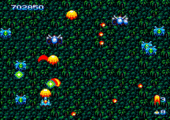
The Sega Master System, a console historically overshadowed by its 16-bit successor, the Sega Genesis, has experienced an unexpected technical renaissance in recent years due to the efforts of independent developers. The latest addition to this niche but dedicated library is Razing Core, a vertically-scrolling shoot-em-up (shmup) developed and published by the creator known as badcomputer. Released in 2026, the title serves as a high-fidelity demonstration of the 8-bit machine’s capabilities, challenging long-held perceptions that the platform lacked the technical overhead to support complex, action-heavy arcade experiences.
Historical Context and Development Trajectory
To understand the significance of Razing Core, one must examine the Master System’s historical standing within the shmup genre. Throughout its retail lifespan, the Master System played host to notable titles such as Power Strike and R-Type. However, these games were often eclipsed by the sheer library volume of the Genesis and the later technical prowess of the Saturn. The genre remained a secondary concern for developers, who prioritized the platform’s strength in action-adventure and platforming titles, such as Alex Kidd in Miracle World and Phantasy Star.
The developer, badcomputer, has spent the last several years working to shift this narrative through a series of iterative projects. His 2025 releases, Frontier Force and Astro Climber, laid the groundwork for his current technical methodology. Before these, his early work included Blast Arena, a single-screen title that tested the limits of sprite management on the hardware. Razing Core represents the culmination of these experiments, transitioning from the confined environments of his earlier works to multi-stage, vertically scrolling environments that demand more from the console’s Z80 processor and VDP (Video Display Processor).
Narrative and Gameplay Mechanics
Razing Core follows a traditional, albeit functional, science-fiction premise. The player assumes the role of a scout pilot operating the “Horizon” spacecraft. The vessel’s navigation systems are compromised by an alien entity designated as “the Core,” which forcibly transports the craft to Earth. Upon arrival, the pilot discovers a global alien invasion and must use the unique properties of the Core to repel the armada.
While the narrative adheres to established tropes common in the 8-bit era, the mechanical depth of the game distinguishes it from its predecessors. The control scheme has been optimized for both the standard two-button Master System controller and the more robust Genesis gamepad. The Horizon is equipped with three primary offensive functions:
- Rapid Fire: A standard, upgradable attack mapped to button 1.
- Core Rotation: A defensive/offensive spin attack mapped to button 2, featuring a necessary cool-down period to prevent player exploitation.
- Burst Charge: An invincibility-granting maneuver activated by holding both buttons (or button A on a Genesis controller).
The game utilizes a complex weapon acquisition system. Players can collect secondary weapons labeled A through D, which are upgradeable to five tiers via "S" icons. A "Super Upgrade" icon allows for instantaneous maximization, while an "X" icon serves as a punitive mechanic, stripping the player of their secondary armament. Unlike many arcade titles of the 1980s, Razing Core employs a more forgiving progression system; upon destruction of the player’s ship, the player is downgraded by one tier rather than losing all power-ups entirely.
Technical Performance and System Architecture
One of the most notable aspects of Razing Core is its technical stability. The game operates at 60Hz and was designed with original Master System and Mark III hardware in mind. Performance analysis indicates a near-total absence of the graphical flicker and frame-rate degradation typically associated with high-density sprite count on 8-bit hardware.
The game’s optimization is particularly evident during complex boss encounters, which occur across seven distinct stages. The lack of slowdown suggests that the developer utilized efficient sprite-multiplexing techniques, a necessity for hardware that historically struggled to maintain smooth performance when multiple enemies occupied the screen. While tests conducted on FPGA-based hardware, such as the Analogue Mega SG and the SuperStation One, show seamless operation, the developer notes that performance on various clone consoles may vary due to inconsistent timing architectures in third-party hardware.
Audio-Visual Presentation
The aesthetic direction of Razing Core was led by digital artist danmakuman, who provided a vibrant, high-contrast visual palette. The environments are characterized by detailed, colorful assets that push the limits of the Master System’s color palette. While the title lacks advanced features such as multi-plane parallax scrolling—a technique often limited by the Master System’s hardware constraints—the visual clarity is consistent throughout.
The auditory experience is bolstered by a soundtrack composed by Lovepenguin, a musician known for his work on Astro Climber. The soundtrack distinguishes itself through technical precision; unlike many Western-developed titles of the 8-bit era that suffered from "scratchy" percussion or poor frequency modulation, Razing Core’s audio is clear and composed of loops exceeding two minutes in length. This level of audio fidelity is rarely seen in homebrew or independent software for legacy consoles.
Critiques and User Experience
Despite the high praise from the enthusiast community, there are noted areas for refinement. The "Burst Charge" mechanic has been criticized for its high activation threshold, which limits its utility to approximately once per stage. Some players have argued that this mechanic would be more effective if it functioned as a finite "bomb" item, which would allow for more frequent tactical use. Additionally, the balancing of standard enemy units has been identified as a point of contention; certain mid-tier enemies possess high health pools that can discourage engagement, leading players to prioritize evasion over combat.
Regarding the scoring system, the game retains the legacy "points-for-lives" mechanic. Players can earn extra lives by destroying "Carrier Cubes" or uncovering hidden environmental secrets. The continue system is considered balanced, as it allows players to restart the active stage or spawn immediately prior to a boss fight, a significant quality-of-life improvement compared to the punishing restart-from-beginning mechanics of the original 8-bit era.
Broader Implications and Market Impact
The release of Razing Core highlights the continued viability of the homebrew market for legacy hardware. With a digital retail price of $7.99 via the itch.io platform, the game demonstrates that small, independent teams can produce software that exceeds the production quality of original commercial titles.
The success of such projects serves as a testament to the persistent demand for new content on vintage hardware. The announcement of a physical release for 2027 further validates the market for cartridge-based media in the modern era. As of this report, the developer has not signaled any intent to port the game to modern platforms, choosing instead to remain dedicated to the Master System and Mark III ecosystem.
Ultimately, Razing Core stands as a benchmark for contemporary development on 8-bit architecture. By balancing technical constraints with modern design philosophies, badcomputer has provided a template for how legacy hardware can be pushed beyond its original design specifications. The game represents not merely a technical curiosity, but a functional, enjoyable entry into a genre that, for many, defined the early years of the console gaming industry. Whether viewed as an archival achievement or a modern piece of software, Razing Core has secured its position as an essential title for the Master System library.