 Cecilia Chamidah Nur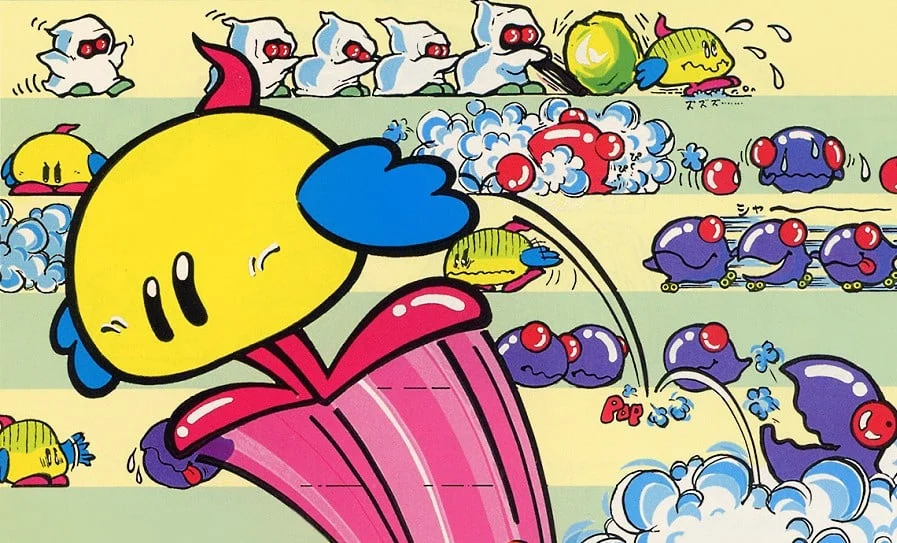
The Arcade Archives series, curated by Hamster Corporation, has officially added the Famicom port of Taito’s 1984 platformer, Chack’n Pop, to its expansive digital library on PlayStation 5 and Nintendo Switch 2. This release marks another milestone in the preservation of early arcade history, offering players a rare opportunity to experience one of the most enigmatic precursors to the legendary Bubble Bobble franchise. While often overshadowed by its more commercially successful successors, Chack’n Pop serves as a foundational piece of Taito’s library, reflecting the experimental design philosophy prevalent in the Japanese gaming industry during the mid-1980s.
Historical Context and Development Origins
When Chack’n Pop debuted in Japanese arcades in 1984, the platforming genre was still in its infancy, attempting to move beyond the single-screen limitations of titles like Donkey Kong. Taito, looking to expand its footprint beyond the success of Space Invaders, experimented with physics-based movement and non-linear level design.
The game was subsequently ported to a variety of domestic Japanese hardware platforms, including the MSX, the FM-7, and the NEC PC-8801 series. These ports, along with the console versions for the Famicom and the SG-1000, were essential for Taito in establishing its brand identity across different consumer demographics. At the time, the development team focused on creating a "puzzle-platformer" hybrid—a concept that was considered highly innovative for 1984. The design intent was to emphasize verticality and tactical movement rather than the reflex-heavy gameplay that would later define the genre in the late 1980s.
Gameplay Mechanics and Technical Design
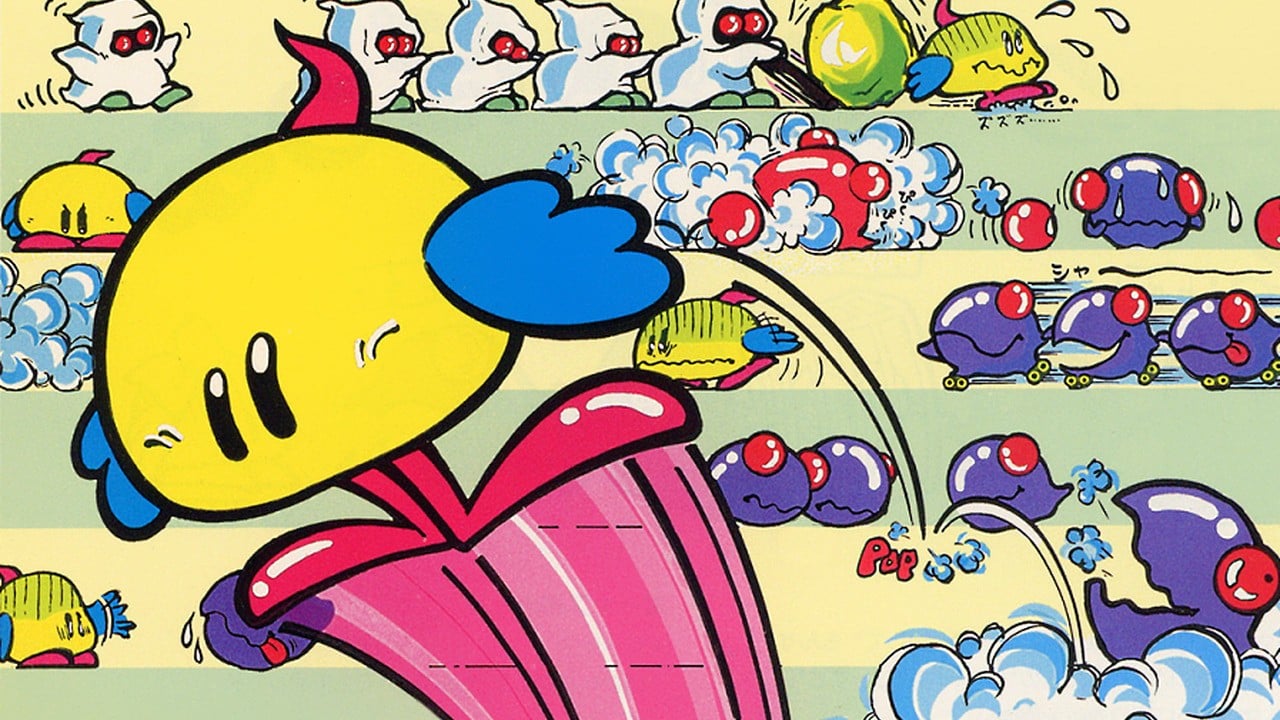
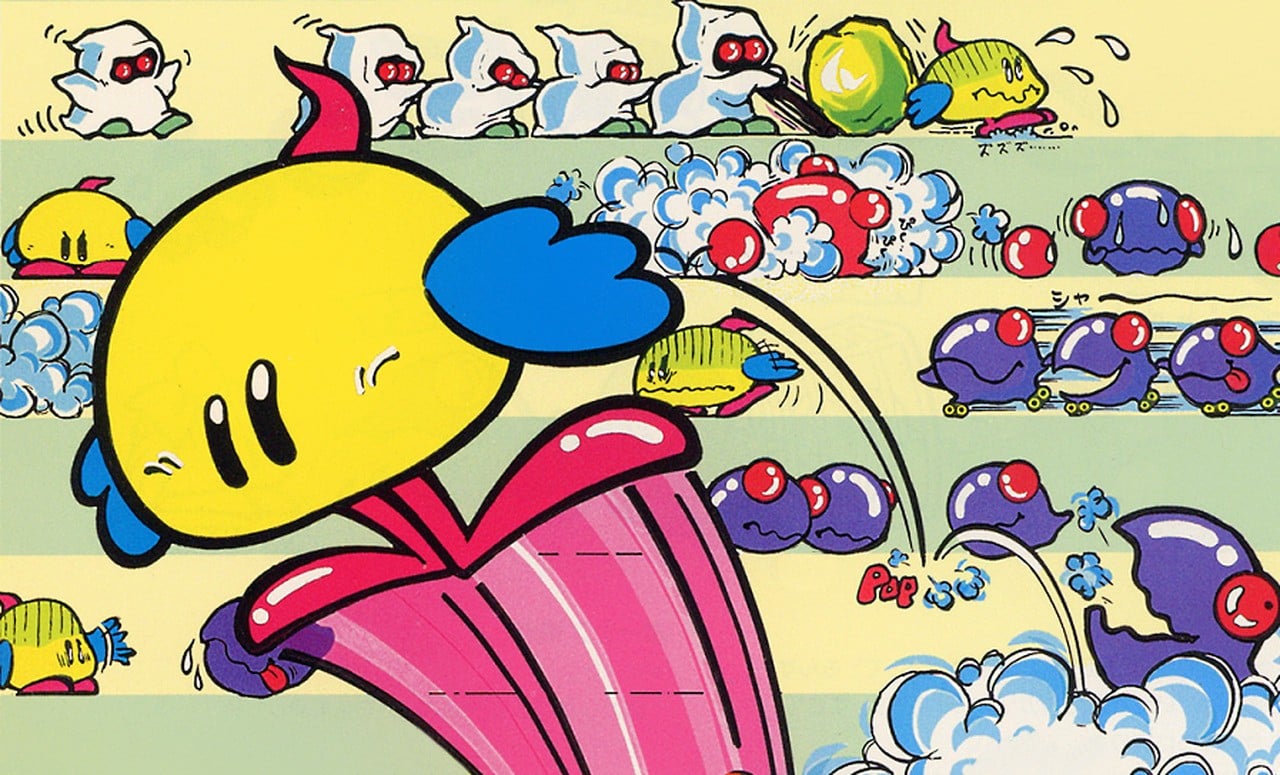
The core gameplay of Chack’n Pop revolves around the player controlling a yellow, blob-like creature named "Chack’n." The character possesses a unique anatomical feature: extendable legs that allow for traversal across ceilings and floors, though notably not walls. This movement mechanic introduced a degree of spatial awareness that was rarely utilized in contemporary titles.
The primary objective in each maze-like stage is to liberate caged hearts. Once all hearts are released, an exit becomes available at the top of the screen. However, the path is complicated by the presence of enemies, most notably the "Monstah" creatures—bipedal entities that would later achieve iconic status in the Bubble Bobble series. To defend against these adversaries, Chack’n is equipped with a limited supply of grenades. The player must exercise extreme caution, as the explosions are capable of damaging the player as well as the enemies.
This inclusion of projectile-based combat combined with environmental puzzles required a more strategic approach to movement, as the player had to calculate blast radiuses while navigating treacherous, maze-like structures. From a technical perspective, the Famicom version adapted these arcade mechanics to fit the hardware limitations of the console, resulting in a more contained, yet challenging, experience that tested the player’s ability to manage limited resources under pressure.
Chronological Evolution: From Chack’n to Bubble Bobble
The lineage between Chack’n Pop and the 1986 landmark title Bubble Bobble is evident upon close inspection. Retrospective analysis of Taito’s development trajectory confirms that Chack’n Pop acted as a vital proving ground for the assets and mechanics that would eventually define the company’s most famous duo, Bub and Bob.

- 1984: The arcade debut of Chack’n Pop establishes the "Monstah" enemy archetype and the concept of maze-based platforming with vertical movement.
- 1985: Technical refinements from the console ports of Chack’n Pop lead the Taito development team to iterate on the "bubble" mechanic, shifting from grenades to projectile trapping.
- 1986: Bubble Bobble is released, featuring the "Belugah" wizard—a character design directly influenced by the enemy sprites found in Chack’n Pop.
- 1987-1989: The success of the Bubble Bobble formula leads to several sequels and spin-offs, effectively relegating the original Chack’n Pop to a cult-classic status within the company’s archives.
The presence of the "flashing heart" power-up in Chack’n Pop is perhaps the most direct link to the later series, as this mechanic became a cornerstone of the score-attack loop in Bubble Bobble. By studying the progression of these assets, gaming historians have identified Chack’n Pop as the critical "missing link" that transformed Taito’s design language from experimental maze games into the polished, high-energy arcade experiences of the late 80s.
Implications for Digital Preservation
The inclusion of Chack’n Pop in the Arcade Archives series by Hamster Corporation carries significant weight for the digital preservation movement. By providing legal, high-quality access to these niche titles, developers are ensuring that the evolution of gaming mechanics is not lost to the rapid obsolescence of hardware.
The Arcade Archives release on modern platforms provides several quality-of-life features that were unavailable in the 1984 original, including save states, remappable controls, and display filters that mimic the look of period-accurate CRT monitors. For the modern enthusiast, this allows for a clinical analysis of the game’s difficulty, which is famously punishing, and its unique physics engine.
Industry experts note that while Chack’n Pop does not possess the same level of cultural ubiquity as Pac-Man or Super Mario Bros., its value lies in its status as a historical artifact. It demonstrates the iterative process of game design, where a "mixed bag" of ideas—such as the bizarre grenade mechanic and the specific vertical movement constraints—can eventually be refined into a globally recognized franchise.
Market Reception and Legacy
Upon its initial release in the mid-80s, Chack’n Pop received a polarized reception. Players who favored the faster, more intuitive gameplay of contemporary shooters and arcade action games often found the precise, almost restrictive movement of Chack’n Pop to be frustrating. However, a dedicated subset of players appreciated the depth of the puzzle elements.
In the decades that followed, the game maintained a steady following in Japan, bolstered by its availability on various home computer systems. The current release on PS5 and Switch 2 is aimed at this demographic of collectors and historians, as well as modern players looking to challenge themselves with early, "Nintendo-hard" difficulty curves.
The release also underscores Taito’s current strategy of leveraging its extensive back catalog to build interest in its legacy properties. By introducing players to the origins of the "Monstah" and the foundational maze design of the Bubble Bobble era, Taito is effectively curating its own historical narrative, reminding the industry that even the most obscure experimental titles play a role in the broader history of interactive media.
Ultimately, while Chack’n Pop remains a niche entry in the annals of gaming history, its arrival on modern consoles is a welcome addition for those interested in the structural evolution of the platforming genre. It stands as a testament to the era of creative risk-taking, where developers were unafraid to pair unconventional characters with experimental mechanics, laying the essential groundwork for the industry giants that would follow.