Farhan hamdan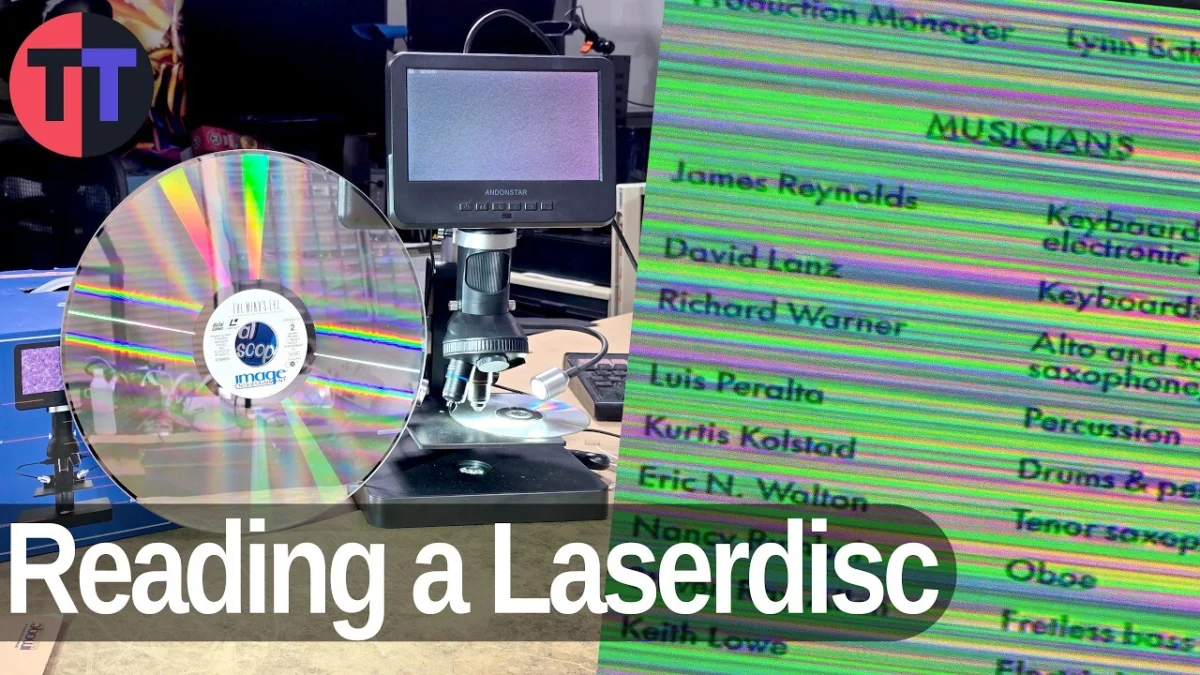
A recent video production by the technology channel Tech Tangents unexpectedly yielded a groundbreaking visual demonstration of how analog video data is physically encoded on a LaserDisc, revealing the intricate details typically invisible to the naked eye. What began as a routine demonstration of a new digital microscope, the Andonstar AD246S-P, quickly transformed into an impromptu scientific inquiry when the device astonishingly revealed legible text directly etched into the surface of a vintage LaserDisc. This discovery has provided an unparalleled visual aid for understanding the foundational mechanics of analog optical media and the degenerative process known as disc rot, offering crucial insights for media preservationists and enthusiasts alike.
The Serendipitous Discovery
The initial objective of the Tech Tangents video was to showcase the capabilities of the Andonstar AD246S-P, a high-magnification digital microscope designed for detailed inspection. However, during the course of examining a LaserDisc, the presenter, known for his deep dives into retro technology, observed distinct patterns on the disc’s surface. These patterns, under sufficient magnification, resolved into recognizable characters and segments of video information, directly correlating to the data stored on the disc. This unforeseen revelation prompted an immediate shift in the video’s focus, pivoting from a mere product review to an in-depth exploration of LaserDisc mechanics and the physical manifestation of stored data. The "happy mistake," as it was described, quickly captivated viewers and the broader retro-tech community, illustrating a fundamental principle of optical storage in a uniquely accessible manner.
A Deep Dive into LaserDisc Technology
To fully appreciate the significance of this microscopic observation, it is essential to understand the underlying technology of the LaserDisc. Introduced commercially in the late 1970s, LaserDisc was the first optical disc format for storing consumer video, predating the compact disc (CD) and digital versatile disc (DVD). Unlike its magnetic tape predecessor, VHS, and its digital successor, DVD, LaserDisc stored video and audio information in an entirely analog format, optically encoded as a series of microscopic pits and lands (flat areas) on a reflective surface.
A standard LaserDisc, typically 12 inches in diameter, consists of two single-sided aluminum discs bonded together with an adhesive layer, protected by clear plastic layers. The data track spirals from the inner circumference to the outer edge, much like a vinyl record, but is read by a laser rather than a physical stylus. The information is encoded as variations in the depth and length of the pits along this spiral track. When a low-power laser beam from the player strikes the disc, it is either reflected strongly from the flat "lands" or scattered by the "pits." A photodiode detector interprets these variations in reflected light as a modulated signal.
For video, this signal is typically frequency-modulated (FM) NTSC or PAL composite video. The video information is not stored as digital bits but as changes in the frequency of a carrier wave, with the frequency directly proportional to the video signal’s luminance and chrominance components. Audio, depending on the disc and player, could be stored in analog FM format or, in later iterations, as digital pulse-code modulation (PCM) audio. This analog encoding meant that the quality of the playback was directly tied to the physical integrity of the disc and the precision of the player’s optics, without the benefit of digital error correction common in subsequent optical formats.
The ability of the microscope to resolve actual text on the disc surface highlights the precision of this analog encoding. While not directly "reading" the video signal in a conventional sense, the microscope’s high magnification allowed for the visual discrimination of the physical patterns that represent the modulated signal. In essence, it provided a direct visual representation of the physical data structure that the player’s laser would interpret.
The Role of the Andonstar AD246S-P Microscope
The specific microscope used in this discovery, the Andonstar AD246S-P, is a digital microscope known for its high-resolution imaging and magnification capabilities, often utilized for electronics repair, coin collecting, and educational purposes. Its ability to provide clear, magnified views of micro-structures, combined with its ease of use and digital output, proved instrumental in this unexpected scientific observation. The microscope’s optics were capable of resolving features on the LaserDisc surface at a scale previously less explored for direct visual interpretation of data encoding. This demonstrates the potential for accessible microscopy tools to reveal new insights into existing technologies.
The Menace of Disc Rot: A Visual Confirmation

One of the most profound implications of this microscopic investigation is the vivid illustration it provides of "disc rot." Disc rot refers to the chemical and physical degradation of optical discs over time, leading to data loss and unplayability. For LaserDiscs, disc rot is a particularly pervasive and feared phenomenon among collectors and archivists. The bonding adhesive used between the two halves of many LaserDiscs, especially those manufactured in the 1980s and early 1990s, was susceptible to chemical reactions over decades. This degradation could manifest as delamination, where the two halves separate, or as corrosion of the aluminum reflective layer, leading to visible discoloration, bubbling, and signal dropout.
Unlike digital formats like CDs or DVDs, which employ robust error correction codes, LaserDiscs, being an analog medium, lack any form of digital correction. When the physical pits and lands degrade or the reflective layer corrodes, the encoded information is simply lost. The laser can no longer accurately read the modulated signal, resulting in visual artifacts like "speckling," color shifts, and complete picture loss, or audio distortion. The microscopic views captured by Tech Tangents serve as compelling visual evidence of this degradation process. The video effectively showcases how disc rot directly impacts the physical integrity of the data track, explaining why "digital correction" is not an option for this analog format—the information isn’t merely corrupted; it’s physically gone from the medium. This direct visual proof is invaluable for understanding the mechanisms of media decay and the urgency of preservation efforts.
Broader Implications for Media Archiving and Education
The discovery made by Tech Tangents holds significant implications for the fields of media archiving, historical technology preservation, and technical education.
For media archivists, this visual demonstration underscores the fragility of analog optical media and the unique challenges associated with its long-term preservation. While efforts often focus on digitizing content, understanding the physical degradation of original media is crucial for assessing remaining playable copies and informing best practices for storage and handling. The microscope offers a powerful diagnostic tool, potentially allowing for early detection of degradation before it becomes visibly apparent during playback. It reinforces the understanding that physical media is not eternal and requires active conservation strategies.
In technical education, this incident provides an exceptional pedagogical tool. Explaining the abstract concept of frequency modulation and how it translates into physical pits and lands on a disc can be challenging. The ability to visually observe these patterns and their degradation offers a concrete, tangible example that can greatly enhance comprehension for students and enthusiasts learning about historical data storage technologies. It bridges the gap between theoretical knowledge and practical, physical reality.
For the retro-tech community, this is more than just a curiosity. It deepens the appreciation for the engineering marvels of past eras and highlights the vulnerabilities inherent in pioneering technologies. Channels like Tech Tangents, along with RetroRGB (which actively supports creators in this space), play a vital role in keeping the history of technology alive and accessible, fostering a community of informed enthusiasts dedicated to understanding and preserving these artifacts. The collaborative and community-driven nature of these channels often leads to such unexpected breakthroughs, driven by curiosity and a passion for technology.
The Ongoing Challenge of Preservation
The LaserDisc format, despite its eventual obsolescence in the consumer market, holds a significant place in media history. It offered superior image and sound quality compared to VHS at the time and was a favored format among cinephiles and for specialized applications like educational and arcade systems (e.g., Dragon’s Lair). However, its physical bulk, high cost, and the advent of the more convenient and digitally superior DVD format led to its decline by the early 2000s.
Today, the primary challenge for LaserDisc enthusiasts and archivists is the ongoing battle against disc rot. Millions of LaserDiscs are still in existence, containing unique content, early releases of films, and rare supplementary materials that have never been digitally re-released. The visual evidence provided by the microscopic analysis serves as a stark reminder of the finite lifespan of these physical artifacts. It emphasizes the need for continued efforts in identifying, cataloging, and digitizing at-risk LaserDisc content before it is permanently lost to decay.
The discovery by Tech Tangents not only provided a fascinating look at the microscopic world of analog data but also served as a critical educational moment, illustrating the intricacies of optical storage and the relentless march of physical degradation. It underscores the enduring value of curiosity-driven exploration in understanding the technological heritage that shapes our present and future.