Indra Gunadi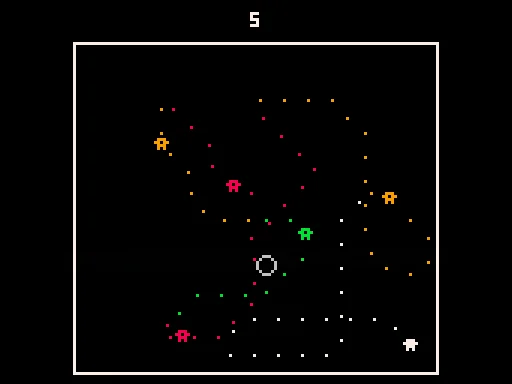
The Mechanics of Minimalist Design
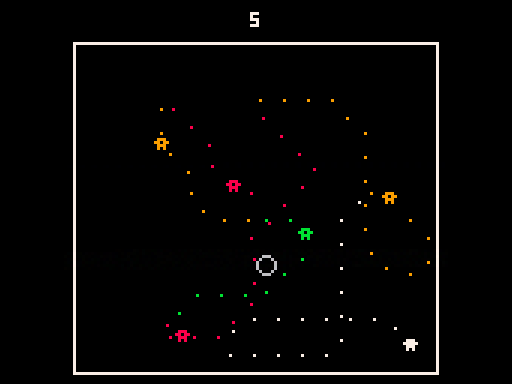
At its core, echoes is a top-down puzzle-avoidance game that mandates high levels of spatial awareness and precise player input. The player controls an avatar using the standard directional arrow keys, navigating a field where the primary objective is to collect designated items scattered across the map. However, the game introduces a persistent, escalating threat: the player’s own movement history, manifested as shadows.
Each shadow is programmed to follow a specific color-coded path, effectively tracing the player’s previous movements. The mechanical tension of the game stems from the intersection of these path-dependent obstacles. If a player touches any of these shadows, the game state resets, forcing the user to return to the beginning of the level. This "trail-avoidance" mechanic forces players to plan their routes meticulously, as every movement creates a future hazard that must be circumvented. By pressing the Z key to initiate the session, the player begins a cycle of trial and error that rewards forward-thinking and pattern recognition.
Contextualizing the PICO-1K Jam 2026
The PICO-1K Jam serves as an annual crucible for the PICO-8 community, a virtual console created by Lexaloffle Games. PICO-8 is designed to feel like a retro-computing platform, with strict limitations on screen resolution (128×128 pixels), color palette (16 colors), and sound channels. The 1K Jam, specifically, restricts developers to a "compressed" size of 1,024 bytes—a fraction of the already limited 32KB capacity of a standard PICO-8 cartridge.
The 2026 iteration of this jam has emphasized the importance of code golf—a practice where developers strive to implement complex logic using the fewest characters or bytes possible. In the context of echoes, the 1024-byte limit represents a significant engineering achievement. It requires the developer to strip away non-essential assets, such as elaborate sprites or expansive background music, in favor of highly optimized algorithms that handle collision detection and path tracking within the constraints of the platform’s Lua-based scripting environment.
Chronology of the 2026 Development Cycle
The release of echoes on September 14, 2026, occurred toward the latter half of the jam’s submission window, a strategic period often favored by developers who spend the majority of the event duration debugging and refining their code. The timeline for such projects typically follows a rigid pattern:
- Ideation (Early August 2026): Developers analyze the constraints and brainstorm mechanics that can be effectively represented through minimalist graphics.
- Prototype Phase (Mid-August 2026): Core movement and collision logic are drafted. For unikotoast, this involved establishing the path-tracking algorithm that allows shadows to "mimic" player movement.
- Optimization and Minification (Early September 2026): This is the most critical phase, where developers use tools like minifiers to reduce variable names, whitespace, and redundant logic to fit within the 1024-byte ceiling.
- Public Release and Feedback (September 14, 2026): The game is published to itch.io and the Lexaloffle BBS, allowing for immediate community testing and verification of the byte count.
Technical Analysis and Constraints
The technical hurdle for a game like echoes is the memory overhead required to track multiple paths simultaneously. In a standard game environment, recording the path of a player would require a large array of coordinates. In a 1024-byte environment, storing an extensive history of coordinates is impossible. It is highly probable that unikotoast utilized advanced mathematical abstractions or procedural generation to calculate the shadow movements rather than storing raw coordinate data.
This approach demonstrates a shift in contemporary indie game development toward "performant minimalism." While AAA studios often focus on graphical fidelity and complex physics engines, the PICO-8 community focuses on algorithmic elegance. The implication of this work for the broader software engineering field is noteworthy; it serves as a reminder that robust, engaging software does not inherently require massive resource allocation. Instead, it relies on the efficiency of the underlying logic and the clarity of the user experience.
Industry Implications and Broader Impact
The success of projects like echoes suggests that there is a sustained, if not growing, interest in low-level programming challenges. For educational institutions and hobbyist developers, these jams provide a low-barrier-to-entry environment where the fundamental concepts of computer science—such as memory management, algorithmic complexity, and state machines—are placed at the forefront.
Furthermore, the influence of these constraints can be seen in the design philosophies of modern indie titles that seek to evoke a "retro" aesthetic. By working within these artificial limitations, developers often discover gameplay loops that are fundamentally more satisfying because they cannot rely on visual spectacle to compensate for poor design. If a game is not fun in a 128×128 pixel resolution with a 1024-byte limit, it cannot be fixed with high-definition assets. Therefore, echoes serves as a validation of the core gameplay loop as the primary metric of a game’s quality.
Community Reception and Official Stance
While individual developers rarely provide formal press releases for jam entries, the collective feedback from the Lexaloffle community acts as an unofficial peer review. The community reaction to echoes has focused on the difficulty curve and the "fairness" of the shadow mechanics. In the context of jam submissions, the balance between difficulty and accessibility is a frequent topic of debate.
The developer’s decision to keep the mechanics simple—move, collect, avoid—has been lauded as a hallmark of "good jam design." By focusing on a singular mechanic rather than attempting to include multiple, half-finished features, unikotoast has ensured that echoes is functional, stable, and highly playable. This is a common point of praise in the itch.io comments section, where players often remark on the "tight" feel of the controls despite the extreme limitations of the project.
The Future of Constraint-Based Gaming
As we look toward the remainder of 2026 and into 2027, the trajectory of the PICO-8 community suggests that we will see increasingly complex games squeezed into smaller packages. The rise of sophisticated minification tools and the sharing of optimized code snippets within the Lexaloffle forums have effectively lowered the "floor" for entry while raising the "ceiling" for what is possible in 1KB.
The impact of echoes extends beyond its specific mechanics. It is a data point in the larger historical record of browser-based and engine-based indie gaming. As the digital landscape becomes increasingly bloated with high-bandwidth, high-latency applications, the existence of projects like echoes provides a necessary counter-narrative. It proves that the essence of gaming—the engagement between a human player and a set of logical rules—can be delivered in a package smaller than a single high-resolution image file.
In conclusion, echoes by unikotoast is more than just a passing entry in the PICO-1K Jam 2026; it is a demonstration of the power of constraint-driven design. By adhering to the 1024-byte limit, the developer has created a focused, challenging, and technically impressive experience that highlights the vitality of the PICO-8 community. As the game continues to be played and analyzed, it will likely serve as a benchmark for future developers looking to balance the competing demands of technical restriction and creative expression. Whether viewed through the lens of software engineering or game design, echoes stands as a testament to the fact that when resources are scarce, innovation becomes the primary currency.