
 Jia Lissa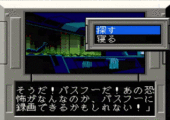
Released on July 31, 1992, for the Sega Mega CD, this graphic adventure serves as a digital adaptation of the 1991 three-part Original Video Animation (OVA) of the same name. Developed by the studio Darts and published by Hot-B Co. Ltd., the title represents a specific era of Japanese software development where multimedia expansion was a primary driver for the adoption of CD-ROM hardware. The game functions primarily as a visual novel and command-based adventure, translating the cinematic sci-fi narrative of the anime into an interactive format for home audiences. While it arrived during a period of significant technological transition in the gaming industry, its adherence to traditional adventure mechanics and its reliance on the source material’s existing assets defined its position within the Mega CD library.
Historical Context and Development Background
The early 1990s marked a pivotal moment for the Japanese animation industry, characterized by the "OVA boom." During this time, high-budget projects were produced directly for the home video market, allowing for higher production values and more mature themes than typical television broadcasts. Detonator Orgun, originally directed by Masami Ōbari, was a notable entry in the mecha genre, blending elements of cyberpunk aesthetics with cosmic horror and philosophical inquiries into evolution and identity.
Hot-B, a publisher known for diverse titles such as Steel Empire and Inindo: Way of the Ninja, sought to capitalize on the OVA’s popularity by commissioning a video game adaptation. The choice of the Mega CD platform was strategic; the peripheral’s ability to store large amounts of data and play back digital video (FMV) made it the ideal candidate for an anime-based project. At the time, Sega was positioning the Mega CD as a "multimedia" powerhouse, and titles like Detonator Orgun were intended to demonstrate the system’s ability to bridge the gap between passive viewing and interactive entertainment.
Narrative Structure and Plot Summary
The storyline of the game closely follows the events depicted in the first two episodes of the OVA series, with the concluding segments offering a preview of the final act. Set in the futuristic "City No. 5," the narrative centers on Tomoru Shindo, an ordinary university student who finds himself plagued by recurring dreams of mechanical combat. These visions are eventually revealed to be a telepathic link established by Orgun, a "Detonator" class mechanized knight belonging to the Evoluder race.
The Evoluders are a militant extraterrestrial species on a trajectory to conquer Earth. Orgun, having defected from his kind, arrives on the Moon and engages in a violent confrontation with his former comrades. Through his connection with Tomoru, Orgun seeks to warn humanity of the impending threat. The game chronicles the escalation of hostilities between Earth’s Defense Force (EDF) and the Evoluder vanguard. Players experience the story through Tomoru’s perspective as he navigates the political and military tensions of a society on the brink of interstellar war. The narrative is noted for its "slow burn" approach, focusing heavily on character development and world-building before transitioning into the high-stakes mecha combat that defines the climax of the series.
Gameplay Mechanics and Interactive Systems
Departing from the action-oriented expectations often associated with the mecha genre, Detonator Orgun is strictly a graphic adventure. It utilizes a static-screen interface supplemented by animated sequences. The gameplay loop is built around a "command-style" menu, a staple of Japanese adventure games of the 1980s and 90s. Players interact with the environment through four primary verbs:
- Look: Used to examine the surroundings, identify objects of interest, and trigger descriptive text.
- Think: An internal monologue function that allows Tomoru to process information or provides the player with hints on how to proceed.
- Talk: The primary method of advancing the plot through dialogue with non-player characters (NPCs).
- Move: Facilitates travel between different locations within City No. 5 and military installations.
Progress is gated by the successful execution of specific command sequences. Unlike Western point-and-click adventures of the same era, which often emphasized complex inventory puzzles, Detonator Orgun focuses on narrative progression through exhaustive interaction. The lack of traditional action or twitch-based combat segments means the player’s role is more akin to a director or a reader than a pilot, which was a common design philosophy for anime-licensed games on the Mega CD.
Technical Specifications: Visuals and Audio
The technical presentation of Detonator Orgun provides a case study of the limitations and strengths of the Mega CD hardware. The game’s visual identity is heavily reliant on Full Motion Video (FMV) clips lifted directly from the anime production. While these scenes provided a level of cinematic fidelity impossible on cartridge-based systems like the standard Mega Drive/Genesis, they were subject to the hardware’s color palette restrictions. The Mega CD could only display 64 colors simultaneously on screen, leading to significant dithering and pixelation in the video playback. Despite these artifacts, the game successfully captures the "cyberpunk" atmosphere of the source material, utilizing dark hues and neon accents to depict a high-tech future.
The audio department presents a more complex technical profile. The game features a soundtrack composed by Kouji Hayama, an industry veteran whose work often characterized the high-energy, synth-driven sound of the 16-bit era. The initial stages of the game utilize Red Book CD audio, providing high-fidelity music and voice acting. However, technical analysis reveals a shift in quality as the game progresses. While the opening cinematic and early chapters benefit from CD-quality sound, later portions of the game frequently revert to the YM2612 internal FM synthesis chip of the Mega Drive for background music. Furthermore, the frequency and clarity of voice acting decrease in the latter half of the experience. This inconsistency suggests a potential budgetary or storage constraint during the final stages of the game’s development, a common issue for early CD-ROM titles attempting to balance high-quality assets with limited disc space.
Chronology and Release Timeline
- 1991: The Detonator Orgun OVA series is released in Japan, consisting of three episodes: "Birth," "Pursuit," and "Decisive Battle."
- Late 1991: Hot-B announces the development of a Mega CD adaptation to coincide with the popularity of the home video release.
- July 31, 1992: Detonator Orgun is officially released on the Mega CD in Japan.
- 1992-1993: The game receives coverage in international gaming magazines (such as Electronic Gaming Monthly and Mean Machines), though no official localization for the North American or European markets is announced.
- Post-1992: Hot-B faces financial difficulties, eventually leading to a reduction in their publishing output, making Detonator Orgun one of their final high-profile licensed titles for the Sega hardware.
Market Reception and Linguistic Barriers
Upon its release, Detonator Orgun was met with a polarized reception that was largely dependent on the player’s familiarity with the source material. For fans of the OVA, the game offered an opportunity to inhabit the world of Tomoru Shindo and experience the story with added context. However, for the general gaming public, the lack of action-oriented gameplay was a point of contention.
The game’s market reach was significantly hampered by its linguistic requirements. As a text-heavy visual novel, the Japanese language barrier was insurmountable for the majority of Western players. Unlike action games where mechanics can be understood through trial and error, Detonator Orgun requires a deep understanding of the dialogue to navigate the "Think" and "Talk" menus correctly. Consequently, the title remained an import curiosity in the United States and Europe, often cited in retrospective reviews as a "lost" piece of the Mega CD’s library.
Broader Impact and Industry Implications
The release of Detonator Orgun underscores a specific trend in the early 1990s: the belief that "multimedia" was the future of the medium. The game’s reliance on FMV and CD audio was a precursor to the "interactive movie" craze that would eventually dominate the early years of the 32-bit era (Sega Saturn and PlayStation). However, the game also serves as a cautionary tale regarding production values. The inconsistent audio quality and the reliance on compressed video highlighted the gap between the marketing promises of CD-ROM technology and the actual hardware capabilities of the time.
In the broader context of anime-to-game adaptations, Detonator Orgun is representative of a period where licenses were granted liberally. While contemporary titles like Snatcher or The Space Adventure (based on Cobra) are remembered for their polished gameplay and cohesive design, Detonator Orgun is often viewed as a "niche" product. Its legacy is tied more to the history of the Mega CD and the preservation of 90s OVA culture than to innovation in game design.
Ultimately, Detonator Orgun remains a significant artifact for collectors and historians of the 16-bit era. It exemplifies the transition from the simple sprites of the 1980s to the cinematic ambitions of the 1990s. While it may not have achieved the critical acclaim of its peers, it stands as a faithful, if flawed, tribute to the Masami Ōbari classic, capturing a moment in time when the boundaries between animation and interactive software were first beginning to blur. For modern audiences, the game is a reminder of the era’s experimental nature, where developers were still discovering how to best utilize the massive storage potential of the compact disc.








