Jia Lissa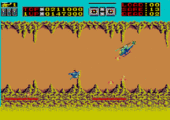
The release of Choplifter for the Sega Master System in 1986 marked a pivotal moment in the evolution of home console gaming, representing a sophisticated bridge between the burgeoning arcade industry and the domestic entertainment market. Originally conceived by Dan Gorlin and published by Brøderbund for the Apple II in 1982, the title underwent a transformative journey before arriving on Sega’s 8-bit hardware. While the original version established the fundamental mechanics of aerial rescue, it was Sega’s internal development team, under the direction of the esteemed Rikiya Nakagawa, that refined the experience for a broader audience. Nakagawa, who would later gain fame for his work on seminal titles such as Alien Syndrome and Thunder Blade, brought a distinct arcade sensibility to the project, emphasizing fluid movement, vibrant aesthetics, and a rigorous difficulty curve that became a hallmark of the Sega Master System library.
Historical Context and Development Chronology
The trajectory of Choplifter is a unique case study in cross-platform development during the mid-1980s. Following the success of the Apple II original, which was lauded for its innovative focus on rescue rather than pure destruction, Sega Enterprises USA recognized the potential for an arcade adaptation. In October 1985, Sega debuted the arcade version of Choplifter as a conversion kit, launching it alongside the high-profile motorcycle racer Hang-On. This arcade iteration was not a mere port; it was a fundamental reimagining. Nakagawa’s team implemented significant structural changes, most notably reducing the number of hostages the helicopter could carry at once from sixteen to eight. This change necessitated more frequent trips between the danger zone and the home base, thereby heightening the tension and increasing the player’s exposure to enemy fire.
By 1986, as Sega sought to establish a foothold in the North American and European home console markets against the dominant Nintendo Entertainment System (NES), Choplifter was identified as a "killer app" for the Sega Master System. The console, powered by the Zilog Z80 processor and a video display processor capable of displaying 32 simultaneous colors from a palette of 64, was uniquely suited to replicate the arcade’s visual fidelity. The Master System port was tasked with condensing the arcade experience into a 128KB ROM cartridge while maintaining the technical flourishes that set Sega’s hardware apart from its contemporaries.
Core Mechanics and Strategic Gameplay
At its core, Choplifter is a side-scrolling "shmup" (shoot ’em up) that diverges from the genre’s typical "kill everything" philosophy. The player assumes control of a combat helicopter tasked with infiltrating enemy territory to rescue 64 hostages held in various barracks and structures. The gameplay loop is divided into three distinct stages—the desert, the ocean, and the subterranean cave—which are looped twice for a total of six missions.
The rescue process is a multi-stage operation requiring precision and timing. Players must first destroy the buildings housing the prisoners, then carefully land the helicopter to allow the hostages to board. The landing mechanic is famously unforgiving; landing directly on a hostage results in an immediate casualty, a feature that adds a layer of moral and tactical weight to the pilot’s actions. Once the helicopter reaches its capacity of eight passengers, the player must navigate back to the starting base to drop them off safely.
Advancing to the subsequent stage requires a minimum of 40 successful rescues. This threshold allows for a small margin of error, but given the escalating intensity of enemy anti-air defenses, players often find themselves struggling to maintain the necessary numbers in the later, more claustrophobic environments. The game’s difficulty is primarily driven by the "momentum-based" flight controls, which require players to account for the helicopter’s weight and inertia when banking, turning, or attempting a rapid descent.
Technical Specifications and Visual Presentation
The Sega Master System version of Choplifter is frequently cited as one of the most technically proficient ports of the era. Utilizing the console’s superior color depth, the developers created distinct atmospheric identities for each level. The desert stage features bright, high-contrast oranges and yellows, while the ocean level introduces a sense of scale with a massive submarine and undulating water effects. The cave level, perhaps the most infamous of the three, utilizes dark palettes to emphasize the "suffocating" nature of the environment.
One of the standout technical achievements in this port is the implementation of parallax scrolling. By moving the background layers at a different speed than the foreground, Sega achieved a sense of depth that was often missing from NES titles of the same period. This visual trickery enhanced the immersion of flying over a vast battlefield. Additionally, the game features subtle environmental details, such as hostages jumping in frustration if the player departs prematurely or swimming toward the rescue craft in the aquatic missions.
Comparative Analysis: Arcade vs. Master System
While the Master System version was a home conversion, it introduced several elements that many enthusiasts consider improvements over the arcade original. The arcade version was notorious for its "quarter-munching" difficulty, designed to limit play sessions and maximize revenue. The home version, while still challenging, offered a more balanced progression.
The inclusion of the subterranean cave level was a significant departure from the 1982 original, introducing environmental hazards such as stalactites and narrow corridors that tested the player’s mastery of the flight engine. In the arcade and Master System versions, the cave represents the peak of the game’s difficulty. The cramped quarters force players into close-quarters combat with ground forces while simultaneously dodging ceiling-mounted hazards. This level design forced a shift in strategy from the open-air dogfights of the desert to a more methodical, "stop-and-go" style of navigation.
Cultural Impact and Industry Influence
The success of Choplifter on the Master System contributed significantly to the console’s reputation as a destination for high-quality arcade experiences. During the mid-to-late 1980s, Sega’s marketing strategy leaned heavily on the "Arcade in Your Home" concept, and Choplifter served as a primary exhibit for this claim. The game’s focus on rescue missions would later influence an entire sub-genre of vehicular action games, most notably Electronic Arts’ Strike series (Desert Strike, Jungle Strike), which expanded upon the rescue-and-resource-management loop established by Gorlin and refined by Sega.
The game also featured several "Easter eggs" that were characteristic of Sega’s playful development culture during the 80s. By destroying a specific number of enemy rockets (typically 16), players could trigger appearances by pop-culture icons like Superman or E.T. the Extra-Terrestrial. These inclusions, while minor, added a layer of mystery and "schoolyard lore" to the game, encouraging players to experiment with the environment beyond the primary objective.
Critical Assessment of Limitations
Despite its status as a classic, Choplifter is not without its historical critiques. The primary point of contention among contemporary and modern reviewers is the game’s brevity. A skilled player can complete all three primary stages in under 15 minutes. While the stages loop with increased difficulty—including a visually impressive transition to a night-time setting for the desert level—the fundamental layout remains unchanged.
The absence of traditional boss encounters is another area where the game reflects its early 80s origins. While the introduction of heavy airships and mobile SAM (Surface-to-Air Missile) launchers provides a challenge, the lack of a climactic "end-of-level" confrontation was seen by some as a missed opportunity to further extend the gameplay. The "suffocating" difficulty of the cave level also remains a polarizing topic; for some, it represents a fair test of skill, while for others, it is an exercise in trial-and-error memorization that borders on the unfair.
Broader Implications and Legacy
Choplifter remains a definitive title in the Sega Master System library, currently holding a respected position among collectors and retro-gaming historians. It serves as a reminder of an era where game design was transitioning from simple high-score chasing to objective-based narratives. The game’s legacy is defined by its ability to generate genuine tension through its mechanics—the sound of the hostages’ feet hitting the metal floor of the helicopter remains one of the most satisfying audio cues in 8-bit gaming.
In the broader context of Sega’s history, Choplifter was a foundational building block for the company’s identity. It showcased Sega’s ability to take existing intellectual property and "plus" it with superior technical execution and refined gameplay. Today, the game is frequently included in "top-tier" lists for the Master System, often cited alongside titles like Phantasy Star and Wonder Boy III: The Dragon’s Trap as a must-play experience for those seeking to understand the 8-bit era’s full potential. As a testament to its enduring appeal, the "rescue-under-fire" formula continues to be a staple in modern indie titles, proving that the core appeal of Choplifter—the hero’s journey into the heart of danger to save the innocent—is a timeless narrative in interactive entertainment.