Edi Durjana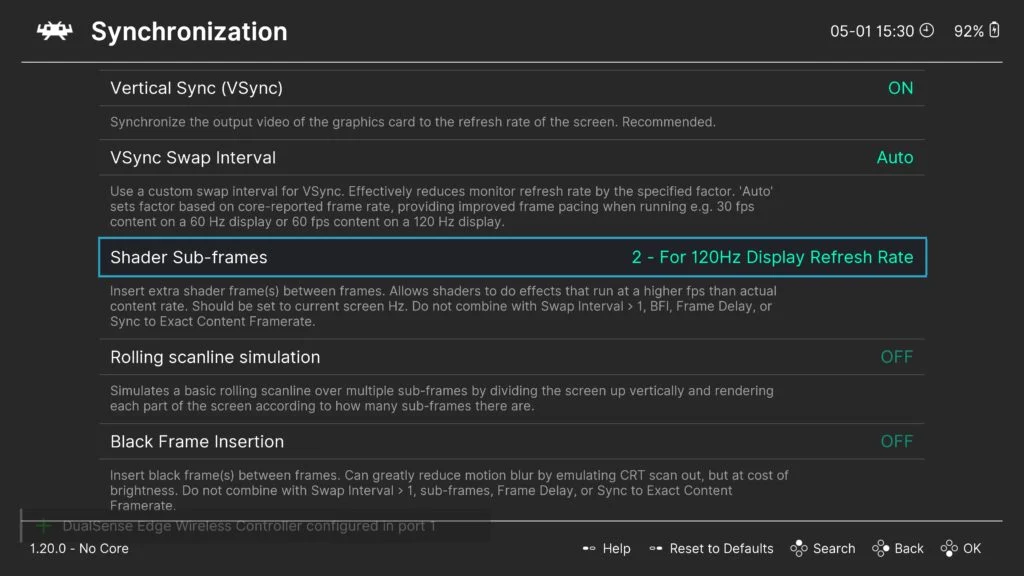
The landscape of retro video game emulation and display technology has taken a significant leap forward with the official release of a groundbreaking shader designed to drastically enhance motion clarity on modern high-refresh-rate monitors. Developed collaboratively by Mark Rejhon of BlurBusters—a leading authority on display motion blur and latency—and Timothy Lottes, renowned industry engineer and creator of the original FXAA (Fast Approximate Anti-Aliasing) and crt-lottes shaders, this new development addresses one of the most stubborn visual hurdles in modern flat-panel displays: sample-and-hold motion blur.
The innovation relies heavily on RetroArch’s recently introduced "subframe" shader capabilities. By leveraging this architecture, the shader can execute at multiples of standard content framerates, bridging the gap between legacy cathode-ray tube (CRT) monitors and contemporary high-speed liquid crystal display (LCD) and organic light-emitting diode (OLED) panels. To utilize this advanced feature, users are required to run RetroArch version 1.20.0 or a later nightly build, as previous software iterations lack the necessary underlying architecture for shader sub-frames. The initial conceptual work and testing grounds for this technology can be examined via its original Shadertoy implementation.
Understanding the Technical Genesis: BFI and Sample-and-Hold Blur
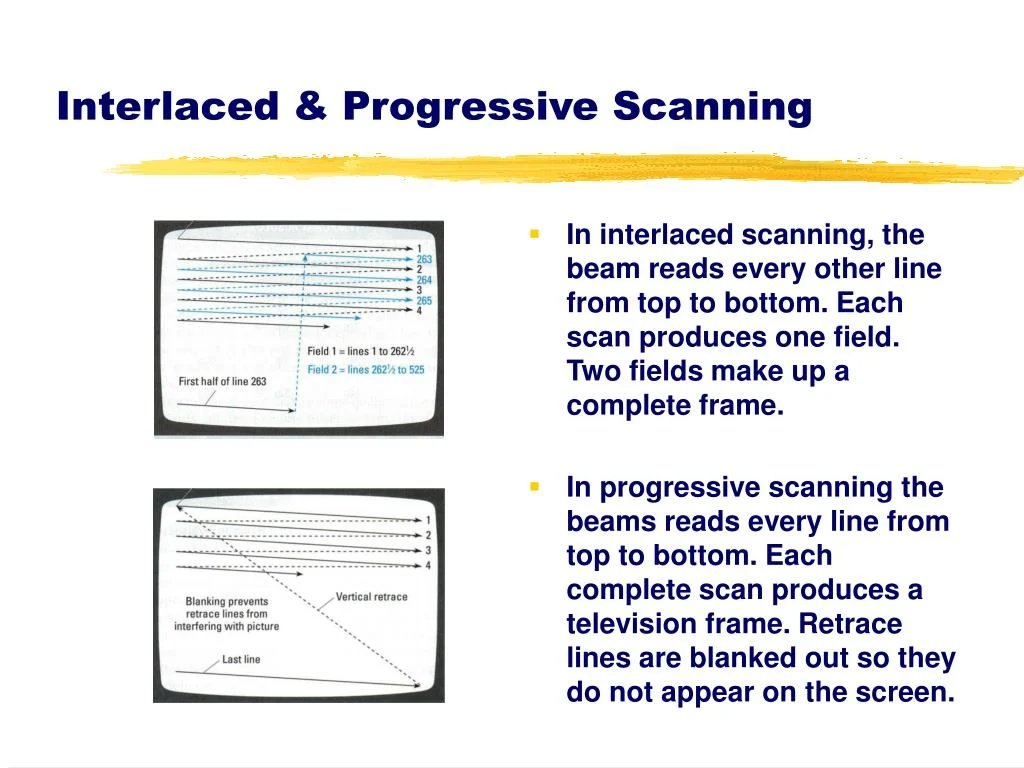
To fully appreciate the significance of this release, one must examine the fundamental differences in how legacy displays and modern panels render motion. Traditional CRT televisions and monitors produce images via a rapidly moving electron beam that excites phosphors line by line from top to bottom. Because the phosphor decay is near-instantaneous, CRTs operate effectively as impulse-type displays. This transient illumination prevents the human eye from tracking moving objects across a persistent frame, thereby eliminating motion blur naturally.
Conversely, modern LCD and OLED monitors predominantly utilize a sample-and-hold methodology. In this setup, a single video frame is displayed continuously for the entire duration of the refresh cycle—typically 16.6 milliseconds at 60 Hz. When a user tracks a moving object across the screen with their eyes, the persistence of vision causes the stationary image on the display to smear across the retina, resulting in perceived motion blur, judder, and tracking artifacts.
To combat sample-and-hold blur, display engineers previously introduced Black-Frame Insertion (BFI), a technique that inserts black frames between active image frames to mimic the transient nature of CRTs. However, traditional BFI implementations have historically suffered from critical drawbacks: severe screen flickering, drastic reductions in peak panel brightness, and high frequencies of pulse-width modulation (PWM) discomfort for sensitive users. The new collaborative shader by Rejhon and Lottes successfully bypasses these limitations by utilizing high-frequency subframe processing on modern high-refresh-rate displays, achieving unprecedented motion clarity without sacrificing visual integrity.
Step-by-Step Implementation and Configuration
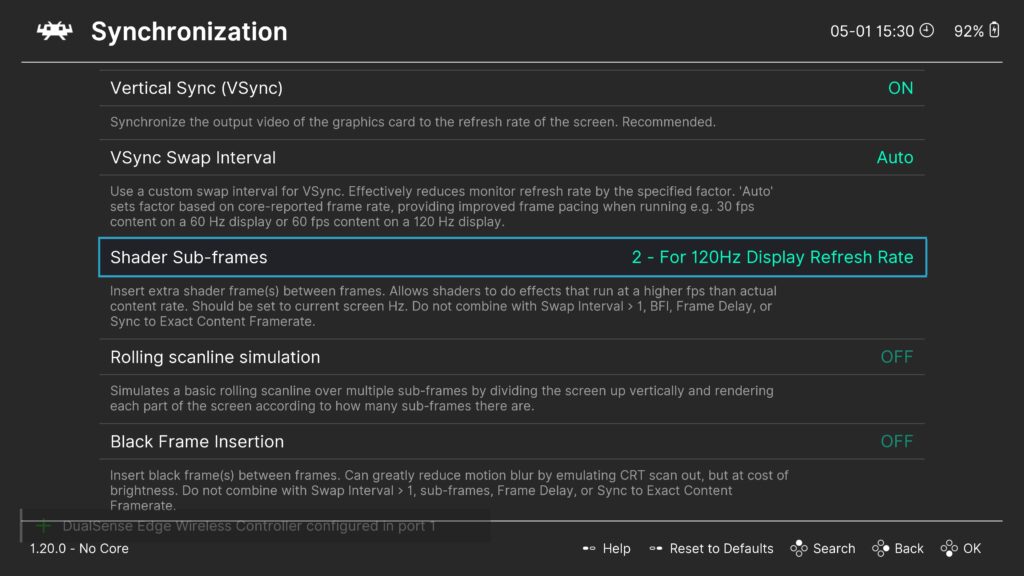
For enthusiasts equipped with high-refresh-rate monitors operating at 120 Hz or higher, integrating the shader into a RetroArch workflow involves specific configuration protocols. The preset files can be located directly within the standard directory structure under shaders_slang/presets/crt-beam-simulator.
Furthermore, the architecture of the shader allows for seamless integration with other visual enhancements. Users who prefer specific aesthetic filters can typically prepend this beam-racing shader to their existing favorite CRT shader presets without encountering compatibility conflicts.
Once activated, the shader demands precise calibration relative to the host display’s native specifications. The package includes robust runtime parameters accessible directly within the RetroArch menu system. Users can adjust gamma levels to achieve a neutral image profile, effectively eliminating unintended dark horizontal lines that can occur during subframe sequencing. Additionally, the configuration menu offers a slider to balance the perennial trade-off between peak panel brightness and maximum motion clarity. According to the developers’ recommendations, a parameter value of approximately 0.5 delivers optimal results on 120 Hz monitors running two subframes, whereas a value of approximately 0.7 is ideal for 240 Hz displays operating on four subframes.
Advantages Over Traditional Display Solutions
The engineering achievements embedded within the crt-beam-simulator shader present several distinct advantages over legacy BFI and standard motion-blur reduction techniques. Most notably, the shader simulates the physical scanning nature of a CRT electron beam—a concept known as beam-racing.
Unlike primitive BFI, which blanks the entire backlight or frame simultaneously, beam-racing selectively updates and darkens specific scanlines in synchronization with the monitor’s vertical refresh interval. This targeted modulation maintains higher average picture levels (APL), preventing the profound drop in luminance typically associated with hardware-level black frame insertion. Furthermore, because the subframe processing occurs purely within the shader pipeline at high refresh multipliers, it imposes minimal overhead on modern graphics hardware while scaling cleanly across diverse resolutions ranging from 1080p to 4K and beyond.
Addressing Hardware Variances: Panel Protection and Raster Positioning
Modern flat-panel displays vary drastically in their underlying sub-pixel architecture and electrical sensitivities. A notable technical consideration when deploying aggressive black-frame or subframe flickering techniques is the risk of image persistence and voltage accumulation within certain panel types.
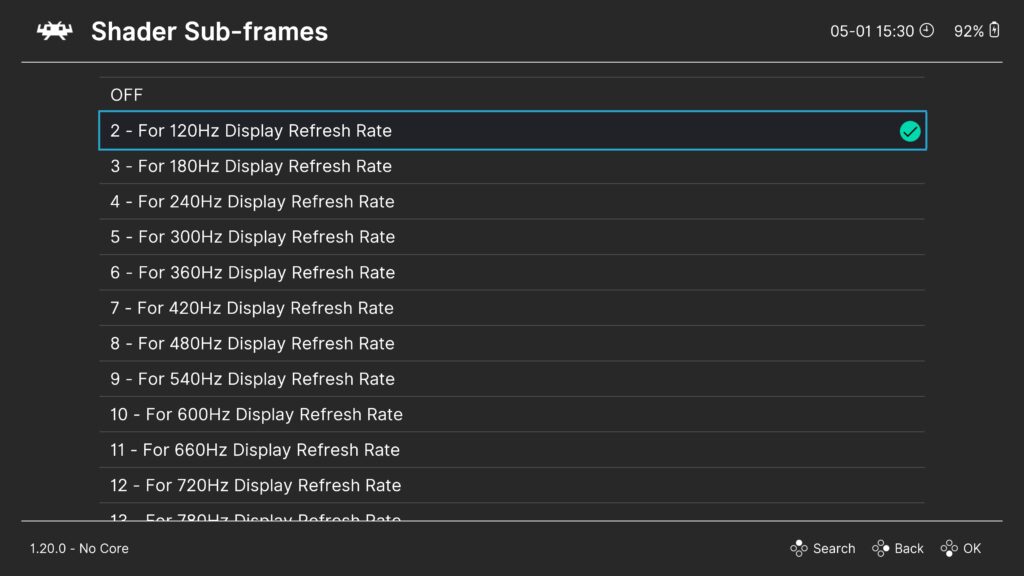
While OLED panels are fundamentally immune to voltage accumulation issues caused by flickering, certain LCD variants can experience temporary image retention if subjected to rigid, unmodulated flicker patterns—particularly when driven at odd integer multiples of standard refresh rates, such as 180 Hz. To mitigate this risk, the development team incorporated a dedicated runtime parameter enabling users to disable the cycle timing offset. Disabling this offset prevents the simulated raster line from continuously rolling upward or downward across the screen, stabilizing the display output.
Additionally, the shader includes fine-tuning parameters to adjust the physical positioning of the simulated raster line. This allows users to place any potential scanline artifacts or brightness modulation zones in the least obtrusive portion of the visible frame, tailoring the visual experience to specific monitor geometries and viewing preferences.
Community Support and Troubleshooting Resources
Recognizing the technical complexity inherent in subframe shader synchronization and high-refresh display timing, Mark Rejhon and the Libretro team have established comprehensive support infrastructure. Users encountering compatibility issues, stutter, or synchronization anomalies can access a dedicated FAQ and active troubleshooting guide hosted on the official BlurBusters GitHub repository (github.com/blurbusters/crt-beam-simulator/issues/4).
In tandem with GitHub documentation, the Libretro community has mobilized standard support vectors, including the official Libretro forums, dedicated Discord servers, and community subreddits. For visual learners and technical purists, expert commentary and demonstrations are also accessible via analytical video walkthroughs produced by industry-recognized display technology educators, offering real-world visual proof of the shader running smoothly on high-refresh OLED panels.
Industry Implications and the Future of Retro Display Simulation
The introduction of the crt-beam-simulator shader marks a watershed moment in the emulation community’s ongoing quest for authentic visual representation. For decades, software emulation accurately replicated game code, audio output, and internal rendering resolutions, yet struggled to recreate the physical viewing experience of playing on vintage hardware due to the inherent physical limitations of modern flat-panel displays.
By bridging the gap between software shaders and high-frequency hardware refresh capabilities, this development redefines what is possible outside of dedicated CRT hardware. As high-refresh-rate monitors become increasingly ubiquitous in consumer markets—with 240 Hz, 360 Hz, and even 480 Hz panels entering the mainstream—tools like the RetroArch subframe shader ensure that retro gaming preservation continues to evolve in tandem with display engineering, offering enthusiasts the crispness of modern hardware combined with the authentic motion clarity of yesterday’s analog displays.