 Hartono Sudibyo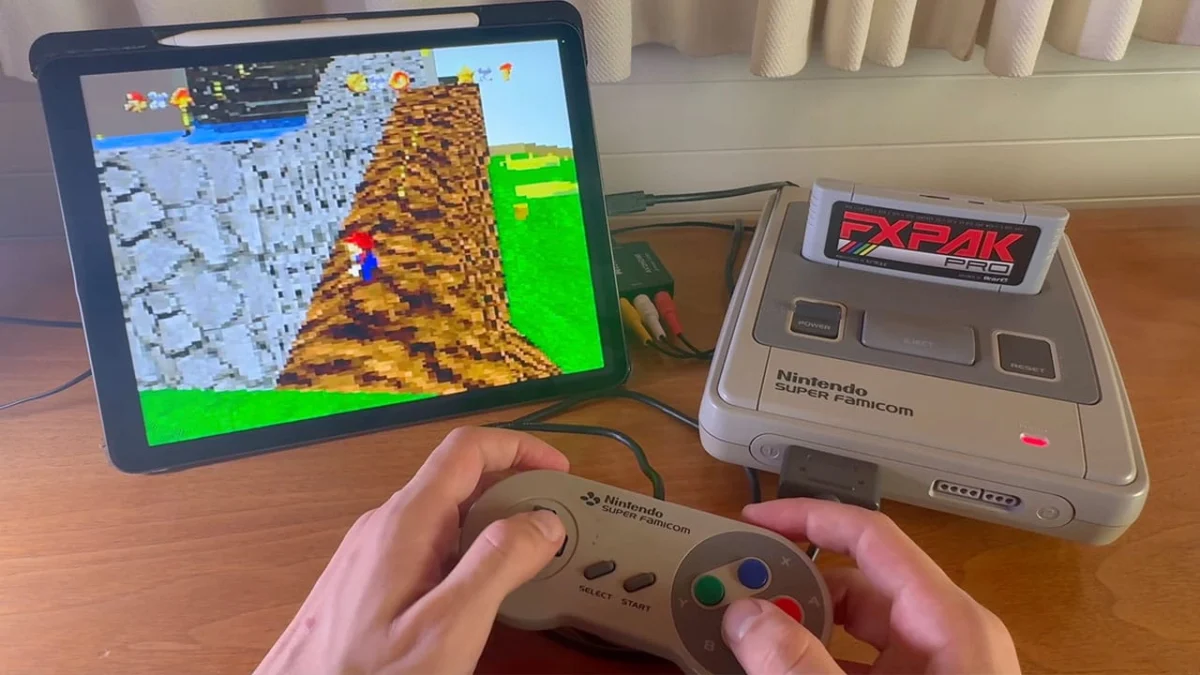
The intersection of retro video game preservation, community-driven reverse engineering, and hardware modification has yielded one of the most astonishing fan projects in recent gaming history. Independent developer and hardware modder known as Game of Tobi has successfully ported Super Mario 64—the quintessential 1996 defining title for the Nintendo 64—onto the 16-bit architecture of the Super Nintendo Entertainment System (SNES). Utilizing the computational muscle of the historic Super FX coprocessor chip, this technical tour de force proves that a 3D polygonal Mario adventure could, theoretically, have existed years before the Nintendo 64 ever hit store shelves.
The achievement bridges a historical gap that many gaming historians and enthusiasts have pondered for nearly three decades: what would have happened if Nintendo had leaned into 3D polygon technology during the peak of the 16-bit era? By leveraging the original source code and graphical assets of Super Mario 64, the developer has bypassed standard emulation to create a native, hardware-dependent experience that runs on genuine SNES consoles, provided players utilize modern flash cartridge technology such as the FX Pack Pro.
Main Facts and Technological Breakdown
At its core, the project is a masterclass in optimization and creative hardware exploitation. Super Mario 64 was originally designed for the Nintendo 64, a powerhouse of its time featuring a 64-bit RISC CPU capable of rendering complex 3D environments, handling advanced texture filtering, and processing vast amounts of data simultaneously.
By contrast, the Super Nintendo Entertainment System is fundamentally a 16-bit machine designed for 2D sprite manipulation and tile-based backgrounds. However, Nintendo’s partnership with Argonaut Games in the early 1990s birthed the Super FX chip—officially known as the Mathematical Argonaut Rotation I.O. chip. This custom RISC coprocessor was integrated directly into game cartridges to offload heavy geometric calculations from the SNES CPU, famously making 3D polygonal graphics possible in titles like Star Fox (Starglider), Stunt Race FX, and Vortex.
Game of Tobi’s adaptation of Super Mario 64 pushes the Super FX chip further than any commercial release ever did. Operating within an extraordinarily constrained environment of just 2MB of memory, the developer faced immense technical hurdles. Rendering 3D polygons on a 16-bit system without modern graphics accelerators required unorthodox rendering pipelines, including painting frames from back to front to manage depth sorting and pixel drawing within the strict hardware limitations.
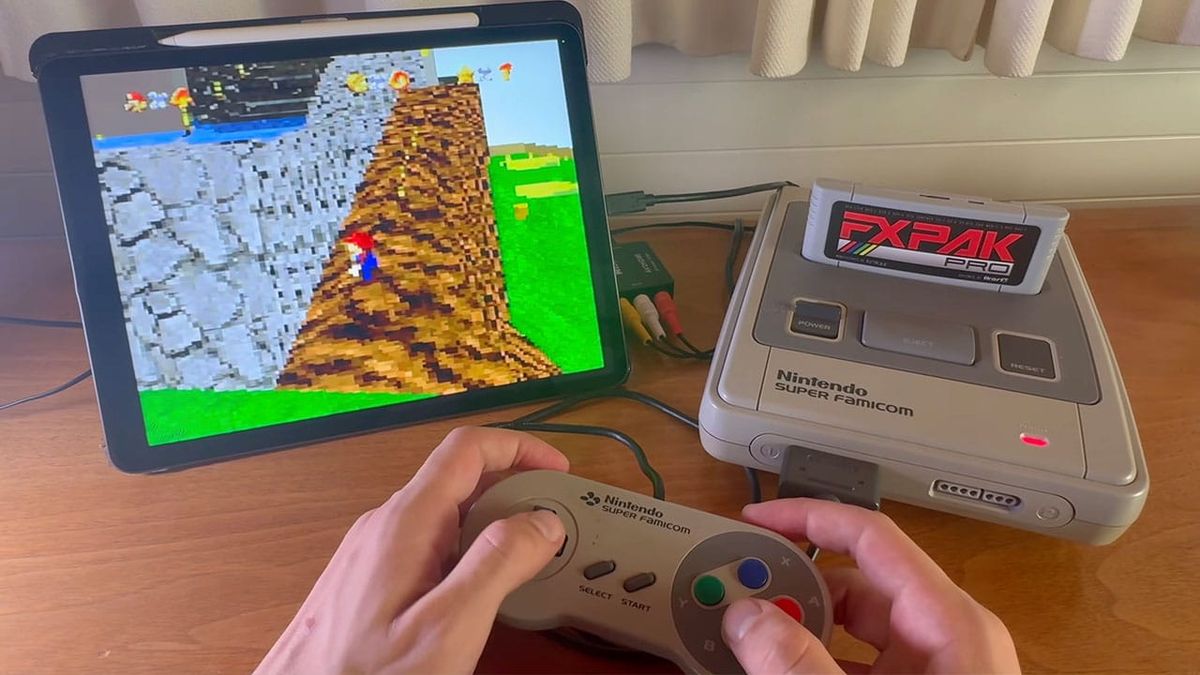
While the resulting gameplay exhibits a degree of visual jitter and frame-rate fluctuation inherent to pushing hardware past its intended boundaries, the core mechanics remain intact. Mario’s complete movement suite—including running, jumping, diving, and long-jumping—functions correctly within the ported levels. The visual fidelity aligns closely with what a high-end 1995 or 1996 Super FX title would have produced, bearing a striking aesthetic resemblance to the primitive 3D polygon experiments of the era, albeit with the instantly recognizable character models of Super Mario 64.
Historical Context and Chronology
To understand the significance of this SNES port, one must examine the transitional era of the mid-1990s. Prior to the development of the Nintendo 64 (codenamed Project Reality), Nintendo and its hardware partners were actively exploring ways to extend the lifespan of the SNES as rival systems like the Sega Saturn and Sony PlayStation loomed on the horizon.
The Super FX chip was conceived precisely for this purpose. Jez San and his team at Argonaut Games pitched the technology to Nintendo after demonstrating that the humble 16-bit SNES could render 3D vector graphics if equipped with an auxiliary processor. The chip debuted to widespread critical acclaim with Star Fox in 1993, captivating consumers who had previously only associated home consoles with flat, two-dimensional sprites.
Rumors and internal design documents from the era have frequently suggested that Nintendo toyed with various prototypes for 3D platforming concepts on the SNES before shifting all resources to the Ultra 64 / Nintendo 64 hardware. Among retro gaming circles, the notion of a "Super FX Mario" has long been a subject of intense speculation and folklore.
Game of Tobi’s recent endeavor effectively transforms these speculative whispers into a playable reality. This project follows the developer’s previous, highly ambitious attempt to run Super Mario 64 on Nintendo’s portable hardware, the Game Boy Advance. While the GBA port demonstrated remarkable ingenuity, the architectural limitations of the handheld made a fully realized version exceptionally difficult to execute. Applying those lessons to the SNES—a console already equipped with a dedicated 3D math coprocessor—proved to be a far more viable, albeit still monumental, undertaking.
Community Reaction and Technical Implications
The retro gaming community has responded to the release of the project’s demonstration footage with overwhelming enthusiasm. Independent software development for discontinued hardware platforms has seen a massive renaissance in recent years, driven by advancements in reverse engineering, community-created decompilation projects, and the widespread availability of high-capacity flash cartridges.

Developers and hardware preservationists view projects like this not merely as novelties, but as profound explorations of historical computing limits. By reverse-engineering modern source code to run on decades-old silicon, programmers demonstrate the elasticity of vintage hardware. The technical implications extend into the realms of game preservation and education, highlighting how algorithmic efficiency can compensate for stark hardware deficiencies.
Industry analysts note that while such fan projects operate strictly within a gray legal area regarding copyright and the use of original game assets, major corporate publishers generally tolerate non-commercial, educational, and preservation-focused homebrew development. Nintendo, historically protective of its intellectual property, has not issued an official statement regarding this specific mod, maintaining its standard silence on fan-driven software modifications unless commercial distribution or trademark infringement occurs.
Broader Impact on the Retro Homebrew Scene
The successful adaptation of a seminal 3D title onto 16-bit architecture raises intriguing questions about what might have been possible had semiconductor technology evolved differently in the early 1990s. It serves as a tangible artifact of counterfactual technological history—a physical demonstration of software running where it mathematically and architecturally should not have been able to go.
As Game of Tobi continues to refine the project, final preparations are being made to release a playable ROM file to the public, allowing enthusiasts with genuine SNES hardware and flash cartridges such as the FX Pack Pro to experience the port firsthand. While playing through extended sessions may induce nostalgic eye strain reminiscent of staring into early virtual reality visors, the accomplishment stands as a monumental achievement in console modification.
The ongoing evolution of the retro homebrew scene ensures that the boundaries of legacy systems will continue to be tested. Projects that bridge disparate hardware generations remind the global gaming community of the ingenuity inherent in programming, proving that human creativity often outlasts the official commercial lifespans of the machines we grew up with.