Farhan hamdan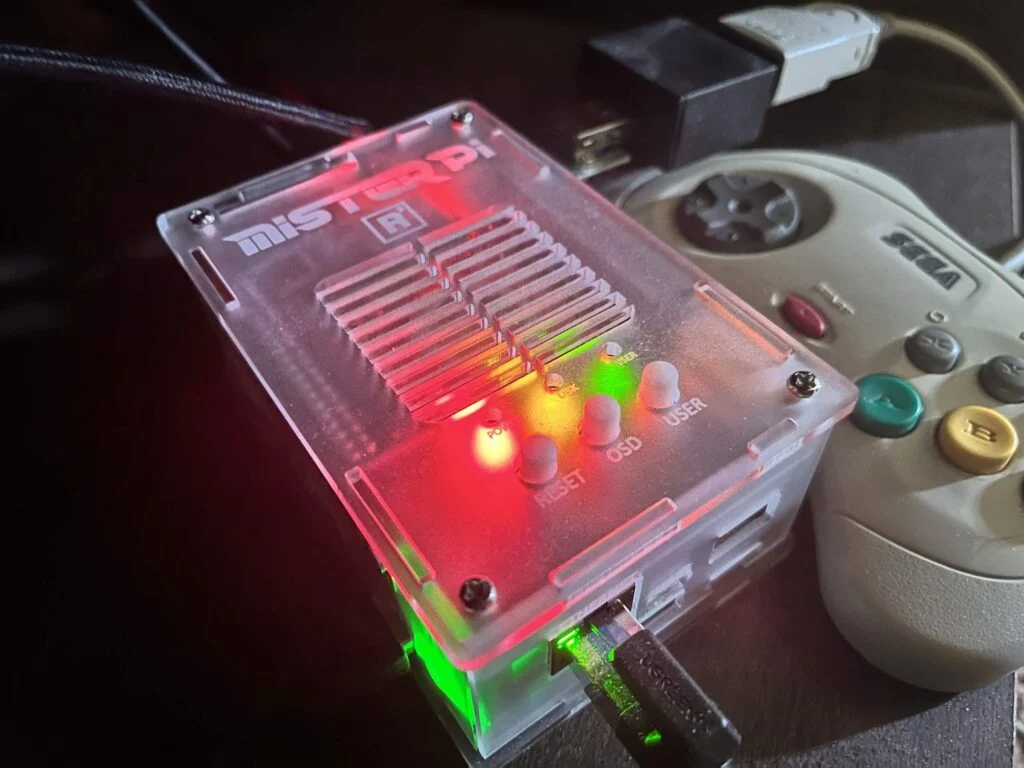
Recent advancements in the Saturn MiSTer core, unveiled this past Thursday, mark a significant triumph for retro gaming enthusiasts and a testament to the perseverance of its lead developer, Sergiy "SRG320" Dvodnenko. These updates, currently accessible via the "unstable nightlies" channel on the MiSTer Discord server, introduce crucial compilation optimizations that resolve previous months of severe development hurdles, alongside a charmingly authentic new feature: the FPGA device’s onboard LEDs now precisely mimic the power and disc read lights of an original Sega Saturn console. While the LED functionality might seem a minor aesthetic addition, its successful implementation underscores the meticulous effort required to integrate new features within the MiSTer’s increasingly constrained hardware environment.
Understanding the MiSTer Platform and Its Unique Challenges
To fully appreciate the scope of these developments, it’s essential to understand the MiSTer FPGA platform. MiSTer stands for "MiSTer is System Too," and it represents a revolutionary approach to retro gaming preservation. At its heart lies a Field-Programmable Gate Array (FPGA) – specifically, the Terasic DE-10 Nano, which incorporates an Intel Cyclone V System-on-Chip (SoC). Unlike software emulators that simulate a console’s behavior, FPGA-based systems like MiSTer physically reconfigure their internal circuitry to become the original hardware. This "physical emulation" offers unparalleled accuracy, minimizing latency and replicating the intricate timings of vintage systems with fidelity often indistinguishable from the original consoles.
The DE-10 Nano, while powerful, possesses finite resources, particularly its Adaptive Logic Modules (ALMs). ALMs are the fundamental building blocks of an FPGA, responsible for implementing digital logic functions. As console cores become more complex and strive for greater accuracy, they consume more ALMs. The Sega Saturn, with its notoriously intricate architecture featuring dual Hitachi SH-2 CPUs, multiple Video Display Processors (VDPs), and a complex System Control Unit (SCU), has proven to be one of the most challenging consoles to accurately replicate on the MiSTer. Its complexity pushes the DE-10 Nano to its absolute limits, making every ALM a precious commodity.
A Chronology of Development and the Recent Crisis

Sergiy Dvodnenko first released a playable public build of the Saturn core in May 2022, marking a significant milestone for the MiSTer community. Its maturity and robust performance led to its inclusion in the main MiSTer branch in October 2023, making it readily available to all MiSTer users without manual installation. Over the subsequent months, Dvodnenko diligently continued to refine the core, delivering updates that incrementally enhanced performance and addressed bugs. For instance, an update on March 20, 2026, notably improved the performance of 3D fighters on single RAM MiSTer setups, showcasing continuous optimization efforts.
However, the relentless pursuit of accuracy and feature parity eventually led to a critical bottleneck. Throughout March and early April 2026, the Saturn core’s increasing complexity pushed the DE-10 Nano’s ALM utilization to near-maximum capacity. This saturation triggered severe compilation difficulties within the Intel Quartus Prime software, the integrated development environment used to translate the core’s hardware description language into a usable FPGA configuration file (.RBF).
The community experienced firsthand the gravity of the situation. Users like TheJesusFish documented their struggles on the MiSTer Discord server, reporting instances of "100 compilations" with minimal success rates. "The Saturn core is not well," TheJesusFish lamented, sharing a screenshot of numerous failed build attempts, with only "seed 6" proving victorious. Zet-sensei, a close collaborator and tester for Dvodnenko, vividly conveyed the intensity of the compilation process, stating, "It’s quite difficult, indeed. My computer wants to die." This sentiment underscored the immense computational strain and time investment required for each attempt.
By April 1, 2026, the resource usage reached alarming levels. Zet-sensei reported that the single RAM core was consuming an astonishing 99% of the DE-10 Nano’s ALMs, with the dual RAM core trailing closely at 98%. These figures were corroborated by other community members, such as birdybro, who posted screenshots showing similar ALM saturation, commenting, "This is honestly really shocking that this even compiles, simply stunning." The situation became so precarious that Dvodnenko issued stark warnings: "There isn’t any free space. Rather, I need to free up some space to improve the compilation. If I can’t find a way to free up space, I’ll have to remove some features." This prompted consternation among users, who feared the loss of anticipated functionalities like analog shoulder button support for modern controllers or cheat support for games. "It seems like you don’t realize how serious the situation is," Dvodnenko replied to one such query, "It may even be necessary to remove features that have already been added." Zet-sensei concisely summarized the predicament: "We are in a dire situation."
The update released on April 3 proved to be the breaking point, rendering both dual and single RAM nightly builds consistently uncompilable. Attempts by community members, including Zet-sensei, to manually build the core by making compromises, such as removing the VDP1 Blur mesh option, were largely unsuccessful for the single RAM version. "I give up for the single RAM one," he conceded at the time.
The Breakthrough: Optimization and the Path to Stability

In the face of these formidable challenges, Sergiy Dvodnenko embarked on an intensive period of optimization. Zet-sensei praised his dedication, noting, "In short, SRG320 worked tirelessly on it; it was exhausting for him." The latest set of updates reflects Dvodnenko’s success in meticulously refining the core’s logic and resource allocation. While specific technical details of every optimization are complex, they generally involve restructuring modules, simplifying logic paths, and improving memory management to reduce the core’s overall ALM footprint without compromising accuracy or performance. This delicate balance is the hallmark of expert FPGA development.
The optimizations have significantly eased the compilation process, making it feasible once again to generate stable builds for both single and dual RAM MiSTer setups. The distinction between these builds is crucial: MiSTers equipped with dual RAM chips can offload certain functions to the extra memory, freeing up the onboard ALMs and allowing for slightly more robust or feature-rich implementations of demanding cores like the Saturn. For users, this means greater stability and a smoother experience when updating their MiSTer.
These cutting-edge updates are first deployed to the "unstable nightlies" channel on the MiSTer Discord server. This channel serves as a vital testing ground where dedicated community members can download and test the latest, unverified builds. This iterative development and community feedback loop are integral to the MiSTer ecosystem, allowing developers to quickly identify and address issues before integrating updates into the more stable "main" branch, which is accessed by running the "update_all" script.
The Aesthetic and Functional Touch: LED Mimicry
Amidst the intense battle against resource constraints, an unexpected feature emerged from a casual Discord conversation: the MiSTer’s onboard LEDs now mimic the behavior of a Sega Saturn. The idea originated from Kanel, a MiSTer Discord member, who posed an "off-hand question" about the possibility of the Saturn core’s LEDs mirroring the PlayStation core’s disc access indicator. While many in the community initially dismissed the request as superfluous, citing the core’s already packed state, it captured Dvodnenko’s attention. "I haven’t really looked into how LEDs work," he admitted, "In fact, yesterday was the first time I’d ever paid attention to LEDs in all the years I’ve been using MiSTer."
Within a week, Dvodnenko, despite the core’s critical resource limitations, successfully implemented the functionality. The MiSTer’s red LED now simulates the power light of a Model 1 Saturn, while the yellow LED replicates the disc read indicator. Furthermore, a novel green LED function was added to signal when data is being saved, providing valuable visual feedback. This seemingly minor aesthetic touch has practical benefits, as noted by Zakk, another MiSTer Discord member: "Sometimes it’s nice to know if the thing is accessing data, or is it just frozen." Kanel, the originator of the request, humorously declared his intent to "keep receipts," promising to "charge you with one coin; half for SRG320 and half for moral compensation" should anyone ever use the LED indicators for troubleshooting, underscoring the playful yet impactful nature of community-driven features.

The Near Loss of Dual Light Gun Support
The crisis of resource exhaustion brought several features to the brink of removal, none more debated than the dual virtual light gun support. Dvodnenko, desperate to free up ALMs, directly questioned the community: "How necessary is support of two virtual light guns?" This immediately sparked "consternation" among users who cherished playing arcade classics like Virtua Cop 1 & 2 and House of the Dead with two light guns.
ElectronAsh, the original architect of the MiSTer’s light gun code, weighed in on the discussion. While acknowledging the light gun logic as a "small bit of code," he also conceded that "133 ALMs (roughly 351 Logic Elements in old-skool Cyclone speak) is still a fair bit, for what it’s doing." He suggested that more efficient ways to generate the crosshair might exist. Dvodnenko clarified his intention, not to remove the feature entirely, but to optimize it by combining two identical light gun modules into one, thereby sharing hardware resources like horizontal/vertical counters and calculations. This approach aimed to achieve the same functionality with a reduced ALM footprint.
Approximately a month later, dual light gun functionality remains intact within the core. It received a crucial optimization to "reset the registers to prevent using BRAM as a shift register," a technical refinement that likely freed up valuable ALMs. This incident highlights the granular, painstaking process of optimization required for such complex cores, where every single ALM is scrutinized and fought for.
Broader Implications and Future Outlook
The recent updates to the Saturn MiSTer core are more than just bug fixes and new features; they represent a significant victory in the ongoing battle against hardware limitations in FPGA-based retro gaming. Dvodnenko’s tireless work exemplifies the dedication required to push the DE-10 Nano to its absolute limits, delivering an authentic Sega Saturn experience.

The experience of the Saturn core illustrates the intricate art of FPGA development: balancing uncompromising accuracy with the finite resources of the target hardware. It underscores that while the MiSTer is incredibly versatile, there is a ceiling to the complexity it can emulate on its current platform. This situation naturally raises questions about the feasibility of even more demanding future cores, such as the Nintendo 64 or Dreamcast, on the existing DE-10 Nano hardware. Developers working on such projects will face similar, if not greater, resource constraints.
The MiSTer community plays an indispensable role in this ecosystem, providing crucial feedback, testing, and direct interaction with developers through platforms like Discord. This collaborative environment accelerates development and ensures that the cores meet user expectations. Furthermore, the financial support provided through platforms like Dvodnenko’s Patreon is vital, enabling developers to dedicate their time and expertise to these labor-intensive projects.
In conclusion, the Saturn MiSTer core’s journey, from its initial release to overcoming a severe compilation crisis and even integrating seemingly minor aesthetic features like LED mimicry, is a testament to the ingenuity and dedication of its developer and the vibrant community that supports it. These updates not only enhance the user experience but also solidify the MiSTer’s position as a premier platform for hardware-accurate retro game preservation, continually pushing the boundaries of what’s possible with current FPGA technology. Enthusiasts can now, once more, fully enjoy the Sega Saturn core, celebrating both its functional improvements and the delightful authenticity it now offers.