
 Jia Lissa
The global amusement industry of 1980 stands at a historic crossroads, transitioning from the electromechanical era to the digital revolution defined by the silicon chip. At the forefront of this evolution is Sega Enterprises, Ltd., a firm that has spent the last six years integrating into the vast corporate ecosystem of the American conglomerate Gulf & Western (G&W) Corporation. In an expansive dialogue originally published in the August 15, 1980, issue of the Japanese trade publication Game Machine, Hayao Nakayama, Sega’s Executive Vice President and Representative Director, provided a comprehensive overview of the company’s strategic trajectory, financial health, and the increasingly complex relationship between its Japanese and American divisions. Nakayama, who oversees marketing and holds a pivotal role in the company’s leadership under President David Rosen, detailed a vision where television-based gaming becomes the primary driver of revenue, accounting for the vast majority of the group’s development resources.
The Corporate Architecture: Sega’s Integration with Gulf & Western
To understand Sega’s position in 1980, one must analyze its unique standing as a bridge between Japanese manufacturing prowess and American capital. Since 1974, Sega has operated under the umbrella of Gulf & Western, a New York-based powerhouse that currently ranks 52nd among U.S. corporations. With annual sales of approximately $5.3 billion and a declared income of $230 million, G&W provides Sega with a level of financial stability and industrial reach rare in the nascent video game industry. While G&W is a diversified giant with interests ranging from automotive components to energy and household appliances—and famously owns Paramount Pictures—Nakayama clarified that Sega’s functional structure is designed to maximize international synergy.
Technically, Sega in Japan is a "grandchild company" of G&W. The hierarchy begins with Gulf & Western owning Sega of America (Sega Enterprises Inc.), which in turn owns the Tokyo-headquartered Sega of Japan (Sega Enterprises Ltd.). This structure facilitated the strategic acquisition of Gremlin Industries in 1976 and 1979, as well as the acquisition of Esco Trading in Japan. This dual-continental presence allows for a unique exchange of technology and market data. Nakayama noted that while both Sega of Japan and Gremlin develop and manufacture products independently, they function as mutual distributors. Sega handles the Japanese market, while Gremlin manages the United States, effectively creating a global pincer movement in the arcade sector.

Financial Performance and Operational Expansion
The fiscal year ending in April 1979 marked a period of robust growth for Sega’s Japanese operations. The company reported sales of 24 billion yen, yielding a declared income of 5.37 billion yen. This financial success has allowed the company to expand its workforce to 1,200 employees and establish a dense network of three branch offices, four sales offices, and 89 operational offices across Japan, including hubs in Sapporo, Osaka, and Fukuoka.
A distinctive characteristic of Sega, and indeed many major Japanese amusement firms of this era, is its dual identity as both a manufacturer and an operator. Nakayama addressed the inherent tensions in this model, acknowledging that while the company prioritizes its role as a manufacturer, its history is rooted in operation. By maintaining a large-scale presence in game centers, Sega gains immediate, first-hand data on player behavior and machine reliability. This "operator mindset" informs their manufacturing process, ensuring that products are durable and profitable for third-party buyers. The company’s operational philosophy focuses on leveraging economies of scale to provide consistent service across a diverse portfolio of locations, ranging from traditional arcades to the newly launched "Sega Center" chains and "PJ Pizzazz" pizza restaurants in the United States.
The Strategic Pivot to TV Games and Hardware Form Factors
The most significant strategic shift detailed by Nakayama is the decision to allocate 70% to 80% of Sega’s R&D efforts toward television-based game machines. This pivot reflects a global trend where the novelty and visual stimulation of digital displays are rapidly eclipsing traditional mechanical amusements. While some critics within the industry have expressed concern over an over-reliance on visual content, Nakayama argued that the entertainment value provided by software-driven games is the industry’s most potent asset.
The hardware landscape in 1980 is currently dominated by the "table-type" cabinet, particularly in Japan. Following the massive success of titles like Head-On, the market demanded machines that could fit into the social fabric of Japanese coffee shops and small venues. However, Nakayama signaled that the company has not abandoned the "upright" cabinet. While table-type games focus almost entirely on the screen, upright cabinets offer higher "added value" through more elaborate cabinet art and physical presence. Sega’s approach remains flexible; they continue to experiment with conversions and trade-ins to help operators manage the high turnover of popular software.

International Market Disparities: The Case of Carnival and Mini Monaco
One of the more intriguing revelations from Nakayama involves the unpredictable nature of international game appeal. Despite the close cooperation between Sega and Gremlin, a hit in one region does not guarantee success in another. Mini Monaco, for instance, was a commercial failure in Japan but became a significant hit in the United States and Europe. Nakayama attributed this to the American market’s sudden appreciation for smaller, more efficient cabinets and the enduring popularity of two-player competitive racing.
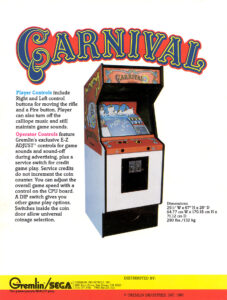
Similarly, the game Carnival—the first to feature a distinct bonus round—received a lukewarm reception in Japan but outperformed major titles like Missile Command in the U.S. market. These disparities highlight the "confusing factors" of global consumer psychology, prompting Sega to refine its Idea Exchange Seminars (IES) with Gremlin to better understand regional nuances. Despite the dominance of TV games, Nakayama emphasized that Sega remains committed to traditional categories, including pinball (utilizing hardware from Williams and Stern) and medal games, which are undergoing a process of optimization and cost reduction to assist struggling operators.
The Legal Battle Against "Copycats" and Intellectual Property
The 1980s have brought a new challenge to the amusement industry: the rampant copying and modification of successful game boards. Nakayama took a firm stance on this issue, noting that the "Space Invaders" boom of the late 1970s created a culture where demand outstripped supply, leading many to view copying as a necessary evil. However, with the market now stabilized, Sega is leading the charge to establish and enforce intellectual property rights.
The legal landscape is shifting. While specific copyrights for TV games are still being codified in Japanese law, trademarks and unfair competition laws are being used with increasing frequency. Nakayama highlighted a pivotal case in the United States where Sega/Gremlin successfully sued Exidy over the game Head-On. This victory has empowered manufacturers to confront counterfeiters directly. Nakayama warned that while Sega is developing more sophisticated hardware that is harder to copy, these security measures increase production costs. He argued that it is in the best interest of operators to support original manufacturers, as the proliferation of "copy products" ultimately drives up the price of legitimate hardware.
Chronology of Key Events Leading to 1980
- 1965: Sega Enterprises is formed through the merger of Service Games and Rosen Enterprises.
- 1974: Gulf & Western acquires Sega, integrating it into its Leisure Time group.
- 1976: Sega of America acquires Gremlin Industries, a pioneer in microprocessor-based gaming.
- 1979 (April): Sega of Japan records its most successful fiscal year to date, with 24 billion yen in sales.
- 1979 (Late): The "Invader" craze begins to cool, shifting market focus toward color games and varied gameplay mechanics.
- 1980 (August): Hayao Nakayama outlines the future of the Sega/Gremlin partnership, prioritizing software over mechanical hardware.
Analysis of Implications for the Decade Ahead
The insights provided by Nakayama in 1980 serve as a roadmap for Sega’s eventual transition into the home console market. By focusing on software-driven TV games and establishing a robust global distribution network, Sega is positioning itself as a primary rival to Atari and Midway. The emphasis on "high-quality machines that sell well, even if they are expensive" suggests a move toward the "premium" arcade experience that would later define the mid-to-late 1980s with titles like Hang-On and OutRun.
Furthermore, the aggressive stance on intellectual property and the professionalization of the distributor network signal the end of the "wild west" era of the 1970s arcade. As Sega continues to leverage the financial might of Gulf & Western and the creative synergy of its US-Japan pipeline, it is clear that the company views itself not just as a manufacturer of toys, but as a sophisticated global media entity. Nakayama’s leadership, characterized by a balance of operational pragmatism and forward-looking technological investment, remains the driving force behind Sega’s ambition to lead the electronic entertainment industry into the 1980s and beyond.








