Jia Lissa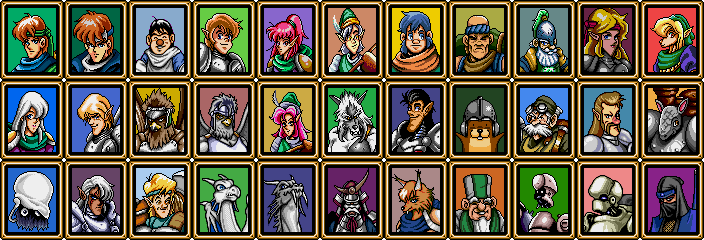
Following the commercial success of Shining in the Darkness in March 1991, the Japanese development studio Climax established itself as a pivotal partner for Sega. While fans and industry analysts anticipated a traditional dungeon-crawling sequel, the development team, led by Hiroyuki Takahashi, pivoted toward a more ambitious project that would redefine the role-playing game (RPG) landscape on the Mega Drive. This transition resulted in the birth of Shining Force, a title that did not merely expand the lore of its predecessor but fundamentally altered the mechanics of console-based strategy. The game’s development serves as a case study in technical innovation, creative world-building, and the often-volatile relationship between independent studios and corporate publishers during the 16-bit era.
The Strategic Formation of Sonic Co., Ltd.
By the early 1990s, the North American RPG market was a burgeoning sector, largely overshadowed by action and sports titles. Sega of Japan, recognizing the untapped potential of the genre, sought to challenge Nintendo’s dominance by investing in more complex narratives and larger storage capacities. Previous titles like Phantasy Star II and III had pushed the hardware, but Climax’s debut had proven that high-quality production could drive overseas sales.
To facilitate a higher output of RPGs, Takahashi proposed a specialized development unit. This led to the June 1991 founding of Sonic Co., Ltd., a joint venture between Sega (holding an 85 percent stake), Climax (6.25 percent), and Takahashi himself (4 percent). Named after Sega’s burgeoning mascot to mirror Nintendo’s character-themed affiliates, Sonic Co. was tasked with software planning, market research, and production management. The unit aimed to streamline development by recruiting specialists from the manga and publishing industries, including Director Kenji Orimo, whose background in serialization helped infuse the studio with a distinct narrative flair.
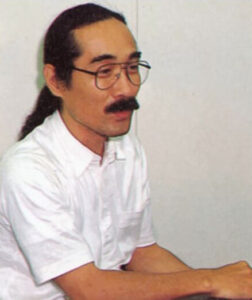
Reimagining the Strategy Genre: The Takahashi Vision
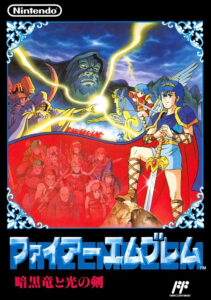
The conceptual roots of Shining Force predated Climax’s formation. Takahashi had long harbored a desire to create a strategy game that possessed the narrative weight of Enix’s Dragon Quest series. He found contemporary strategy titles, including Nintendo’s Fire Emblem, to be rhythmically flawed and overly reliant on board-game mechanics. "The tempo of that title was so bad that it wasn’t something I even wanted to play," Takahashi noted in a 1992 interview, clarifying that Fire Emblem had zero influence on his design philosophy.
His inspiration instead came from the 1988 PC88 title Silver Ghost, which utilized real-time management of multiple characters. Takahashi sought to evolve the "monotony" of turn-based combat by introducing the concept of spatial distance. By incorporating formations, terrain advantages, and varying movement ranges, he transformed combat from a simple exchange of actions into a complex tactical simulation. This shift was not initially met with universal acclaim within Climax; several team members, including directors Orimo and Yasuhiro Taguchi, expressed skepticism regarding the strategy genre’s appeal. However, as the prototype integrated traditional RPG elements—such as town exploration and character interaction—the team aligned behind the vision of a "Strategy-RPG" hybrid.
Technical Innovation and the 12-Megabit Frontier
As the project transitioned from a potential Game Gear title to a Mega Drive flagship in March 1991, the technical demands escalated. Takahashi’s refusal to compromise on battle animations created a significant memory crisis. While most Mega Drive cartridges of the era hovered around four to eight megabits, Shining Force eventually required 12 megabits—the largest size for any game on the platform at that time.
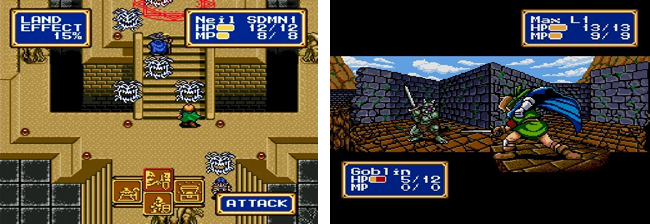
The primary consumer of this data was the game’s cinematic battle system. Unlike standard strategy games that used small, static sprites, Shining Force featured large, fully animated characters and enemies. To achieve realistic movement without reusing sprites for different orientations, every frame was drawn from multiple angles. When the initial calculations suggested the animations alone would require 40 megabits, the programming team, led by Yoshinori Tagawa, developed sophisticated compression routines. These proprietary tools brought data files down to 22 percent of their original size, allowing the 29 distinct battle maps and over 30 playable characters to fit within the 12-megabit limit.
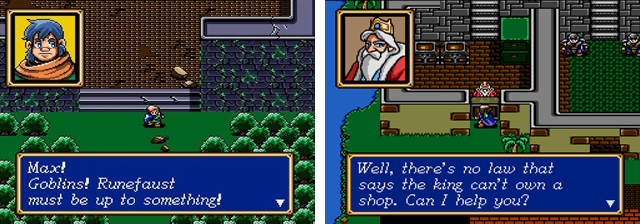
Further innovation was found in the enemy AI. Takahashi demanded a system where enemies could "think" and act within a one-second window. The resulting routines utilized a mixed-turn system based on an "agility" stat rather than a fixed phase-based system, creating a more dynamic and unpredictable battlefield. This "Columbus’s Egg" approach to programming ensured that combat felt fluid and responsive, a rarity for early 1990s consoles.
World-Building and the Lore of Rune
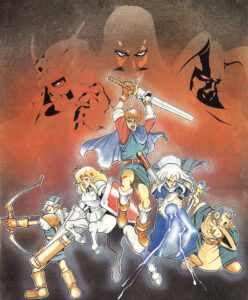
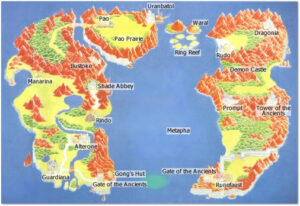
Scenario writer Yoshitaka Tamaki and freelancer Masaki Wachi were tasked with expanding the "Shining" universe. While Shining in the Darkness was a localized dungeon crawler, Shining Force was conceived as a prequel set on the continents of East and West Rune. The narrative introduced a sophisticated blend of medieval fantasy and "lost technology," featuring ancient robots and flying machines alongside knights and sorcerers.
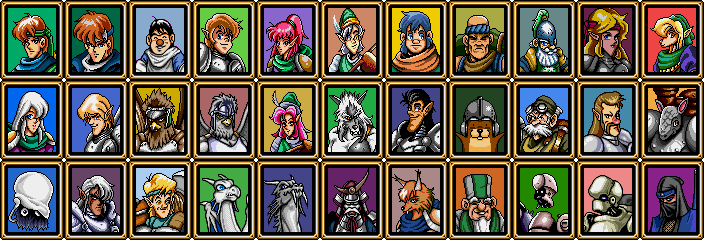
The game’s protagonist, Max, remained a silent hero in the tradition of Japanese RPGs, but the supporting cast was unprecedented in its diversity. Tamaki designed over 30 recruits across ten races, including centaurs, birdmen, and "wolflings" like the fan-favorite Zylo. The character "promotion" system added a layer of progression that encouraged players to "grind" for experience, as reaching level ten allowed characters to evolve into more powerful classes with updated visual designs.
A notable inclusion was the character Jogurt, a hamster-like creature that began as a programming placeholder using staff photos. The character eventually became a permanent fixture and an "inside joke" within Climax, embodying the studio’s culture of creative spontaneity.
The Fracture: Studio Autonomy vs. Corporate Management
Despite the creative success of Shining Force, the relationship between Climax and Sega began to deteriorate during production. Takahashi later lamented that changes in Sega’s management structure led to a culture focused more on profit margins than developer creativity. The budgets for both Shining in the Darkness and Shining Force were reportedly minimal, barely covering the costs of the ambitious 12-megabit production.
Takahashi stated in a 2010 retrospective that as Sega grew, Climax was increasingly viewed as a "small, unruly subsidiary." This tension eventually led to the studio being sidelined from Sega’s primary business lines. The "crunch" period for Shining Force was particularly grueling; the team was denied the standard two-month window for debugging, forcing them to submit the final ROM a month early. Developers reported working 100-hour weeks, with many living in the office to meet the December 1991 deadline for the 1992 Winter Consumer Electronics Show (CES).
Release, Reception, and Market Performance
Shining Force debuted in Japan on March 27, 1992, followed by a Western release nearly a year later. While it was hailed by critics for its accessibility and visual splendor, its commercial performance was complex. Producer Yoichi Shimozato later estimated global sales at just under 200,000 copies—a figure that seems low given the game’s enduring legacy. Analysts suggest several factors for this:
- Genre Ambiguity: The shift from dungeon crawling to strategy may have alienated fans of the first game.
- Niche Market: In 1992, strategy games were still considered a difficult sell to North American console gamers.
- Subtle Continuity: The links between the first and second games were lore-based rather than direct, potentially causing the titles to be viewed as unrelated.
However, the game’s critical standing only grew over time. It is now frequently cited as one of the greatest RPGs of the 16-bit era and has been featured in numerous "Greatest of All Time" lists and Sega compilations.

Broader Impact and Industry Implications
The legacy of Shining Force extends far beyond its initial sales figures. It established a blueprint for the "Strategy-RPG" sub-genre, proving that complex tactical systems could be paired with engaging, character-driven narratives. The game spawned a franchise that spanned the Game Gear, Sega CD, and Saturn, culminating in the massive Shining Force III trilogy.
The technical hurdles overcome by Climax—specifically in data compression and AI—set new standards for the Mega Drive hardware. Furthermore, the game’s aesthetic, which balanced Western fantasy tropes with Japanese manga influences, helped bridge the cultural gap for RPGs in the early 1990s.
Today, Shining Force remains a cornerstone of Sega’s intellectual property. Although the relationship between Takahashi’s team and Sega eventually dissolved—leading to the Dreamcast becoming the only major Sega platform without a Shining entry—the original 1992 masterpiece continues to be the benchmark by which all subsequent entries in the series are measured. It stands as a testament to a period of industry history where technical constraints were met with radical innovation and where a small, "unruly" studio could fundamentally change the way players experienced a digital world.