Jia Lissa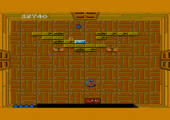
Released in 1987 for the Sega Mark III, Woody Pop: Shinjinrui no Block Kuzugi represents a pivotal moment in the evolution of home console peripherals and the competitive landscape of the 8-bit era. Developed and published by Sega Enterprises, the title was a direct response to the burgeoning popularity of block-breaking games in the arcade, most notably Taito’s Arkanoid. As the final game released on the "Sega My Card" format for the system, Woody Pop attempted to leverage specialized hardware to provide a level of precision that standard digital controllers could not match. However, despite its technical ambitions and the inclusion of a dedicated paddle controller, the game remains a complex study in the challenges of adapting arcade-style mechanics to home television standards and the limitations of 1980s hardware design.
The Technological Context of the Paddle Controller
The history of the "block-breaker" genre is inextricably linked to the development of specialized input devices. Beginning with Atari’s Breakout in the 1970s, the genre relied on paddle controllers—devices utilizing potentiometers to regulate voltage. Unlike the digital buttons of a standard directional pad, which operate on a binary "on/off" principle, a potentiometer offers a continuous range of input. This allows for fluid, high-precision movement of the on-screen paddle, or "Vaus," to intercept a bouncing projectile.
During the second generation of home consoles, the Atari 2600 popularized this input method, bundling paddle controllers with the system to support titles such as Kaboom!, Astroblast, and Super Breakout. As the industry transitioned into the third generation, dominated by the Nintendo Entertainment System (NES) and the Sega Mark III/Master System, the industry moved toward standardized cross-directional pads. While these controllers were more versatile for platforming and action games, they were fundamentally ill-suited for the rapid, granular movements required by block-breakers.
Taito addressed this discrepancy by bundling a proprietary paddle controller with the Famicom release of Arkanoid in Japan. Sega, seeking to maintain its reputation for arcade-quality experiences at home, followed suit in 1987. The company released two distinct paddle controller packages: Woody Pop on a Sega My Card and Alex Kidd BMX Trial on a 1Mb Gold Cartridge. These peripherals were intended to bridge the gap between the tactile precision of the arcade and the convenience of the home console.
Market Positioning and Competitive Landscape
The 1987 release of Woody Pop occurred during a period of intense competition between Sega and Nintendo. While Nintendo’s Famicom held a dominant market share, Sega’s Mark III offered superior graphical capabilities and a direct pipeline to Sega’s prolific arcade division. However, Sega faced a strategic dilemma: few of its high-profile arcade hits utilized paddle controls.
The decision to develop the Sega Paddle Controller was an attempt to capture the market share of Arkanoid enthusiasts. In Japan, Taito’s Arkanoid and its sequel, Arkanoid II, were significant successes. Sega’s response was to create a library of seven games that supported their paddle peripheral. These included Woody Pop, Alex Kidd BMX Trial, Megumi Rescue, and the port of the high-speed racer Chase H.Q. Of these, four were exclusive to the paddle controller, meaning they could not be played with a standard control pad.
In the Western market, this peripheral-heavy strategy was largely abandoned. The Sega Paddle Controller was never officially released in North America or Europe, and the Western NES version of Arkanoid saw limited distribution of its specific controller. Consequently, the "paddle generation" of the 1980s remained a predominantly Japanese phenomenon, leaving Woody Pop as a regional artifact of Sega’s hardware experimentation.
Gameplay Mechanics and Narrative Framework
Woody Pop: Shinjinrui no Block Kuzugi, which translates roughly to "Woody Pop: New Generation Block Breaker," eschews the sterile, sci-fi aesthetic of Arkanoid in favor of a character-driven narrative. The player assumes the role of Woody, a "Wood Spirit," who must navigate the "Bizarre Mansion" to rescue his friend, Gumball. This transition to a "cute-em-up" style aesthetic was a common trend in 1980s Japanese game design, aiming to broaden the appeal of mechanical genres to a younger demographic.
The core gameplay involves deflecting a ball to destroy layers of bricks. However, Sega introduced several structural innovations to differentiate Woody Pop from its predecessors:
- Branching Paths: Upon clearing a stage, players are often presented with a choice of exits. This branching level structure was a significant departure from the linear progression of Arkanoid, providing replayability and allowing players to navigate through different wings of the mansion. Each path offers varying point bonuses, theoretically tied to the difficulty of the subsequent room.
- Visual Feedback: Unlike Arkanoid, where multi-hit bricks showed no damage until they disappeared, Woody Pop introduced visible cracking on bricks. This provided players with immediate feedback on their progress within a level.
- Power-Up Synergies: The game features a variety of power-ups contained in bubbles dropped by "crystal bricks." Standard items include the "Glue" (allowing the paddle to catch the ball), "Flames" (allowing the ball to pass through bricks), and "Multi-ball." Notably, Woody Pop allows for the combination of certain items, such as the flame ball and the glue, creating unique strategic advantages.
- The Laser/Shot Ability: Similar to the iconic laser power-up in Arkanoid, Woody can obtain a shot ability that allows him to destroy bricks directly, bypassing the need for the ball.
Technical Analysis of Design Failures
Despite these innovations, Woody Pop is frequently cited by historians and retro-gaming critics for several fundamental design flaws. These issues largely stem from the transition of the genre from a vertical arcade orientation to a horizontal home television display.
Aspect Ratio and Field of Play
Arcade block-breakers were typically housed in cabinets with "tate" (vertical) monitors. This provided a narrow, tall playfield that minimized the horizontal distance the paddle needed to travel. Woody Pop, designed for a 4:3 television screen, features a playfield that is wider and shorter. This forces the player to cover significantly more horizontal ground. When the ball speed increases—a standard mechanic in the genre—the increased width of the screen makes it physically difficult for the player to react in time, even with the precision of a paddle controller.
Visual Palette and Presentation
The aesthetic choices in Woody Pop have also faced criticism. The "Bizarre Mansion" theme relies heavily on shades of brown, orange, and dark earth tones, reflecting the wood-paneling trends of the 1980s. This color palette often clashes with the vibrant, neon colors of the bricks, leading to visual fatigue. Furthermore, the character sprite for Woody is relatively small and lacks detail due to the hardware limitations of the Mark III, making it difficult for the player to connect with the protagonist’s on-screen reactions.
Level Obstacles and "Warp Holes"
Sega attempted to increase difficulty by introducing indestructible obstacles and moving elements, such as toy trains, in the lower half of the screen. These elements often result in "cheap" deaths, where the ball reflects off an obstacle and into the pit before the player can realistically reposition the paddle. Additionally, the inclusion of "warp holes" can lead to tedious gameplay loops. If a ball enters a secluded area of the screen via a warp, the player loses control over the ball’s trajectory until it eventually bounces back into the main field, a process that can take a significant amount of time.
Audio Engineering and Sound Design
The auditory experience of Woody Pop is distinct, though not necessarily in a positive sense. Rather than a traditional melodic soundtrack, the game’s "music" is composed of a series of percussive sound effects and rhythmic "bloops" synchronized with the movement of the ball and the destruction of bricks. While this was an experimental approach to dynamic audio, it resulted in a soundscape that many players found grating. The lack of a cohesive musical score was a missed opportunity to utilize the Mark III’s sound chip, which was capable of much more sophisticated compositions.
Historical Impact and Legacy
Woody Pop stands as a "missing link" in the evolution of the block-breaking genre. It sits between the rigid structure of the early 1980s and the more experimental, RPG-lite block breakers of the modern era, such as Wizorb. While it did not achieve the legendary status of Arkanoid, its existence highlights Sega’s willingness to experiment with hardware to enhance gameplay.
The game’s primary legacy is its role as an entry point for the Sega Paddle Controller. For many Japanese collectors in the late 1980s, Woody Pop was the most accessible and affordable way to acquire the peripheral. The controller itself would eventually become a sought-after item for enthusiasts looking to play the superior Megumi Rescue or the home port of Chase H.Q.
In summary, Woody Pop: Shinjinrui no Block Kuzugi is a title defined by its contradictions. It offered innovative features like branching paths and item stacking, yet it was hampered by a fundamental misunderstanding of how aspect ratio affects the mechanics of a block-breaking game. It remains a fascinating example of the "peripheral wars" of the 8-bit era—a time when hardware manufacturers believed that specialized controllers were the key to bringing the arcade experience into the living room. For the modern historian, it serves as a reminder that even with the best input device, the core principles of level design and visual clarity remain the most critical components of a successful video game.