Cecilia Chamidah Nur
The release of the TrimUI Brick Pro marks a strategic hardware iteration for the emulation handheld market, arriving less than a year after the debut of its predecessor. While the "Pro" moniker in consumer electronics typically signals a significant leap in computational performance, the TrimUI Brick Pro serves as an exercise in refinement and ergonomics rather than a processing upgrade. By maintaining the Allwinner A133 Plus architecture while significantly altering the physical form factor, TrimUI is positioning this device as a comfort-focused alternative to the original ultra-portable design.
Chronology of the TrimUI Brick Series
The emulation handheld sector has seen rapid growth over the past 24 months, with TrimUI carving out a specific niche for budget-conscious consumers. The initial TrimUI Brick launched in 2024, characterized by its compact, Game Boy-inspired footprint. It was praised for its build quality but criticized for its limited interface options, specifically the lack of analogue sticks, which rendered titles from the sixth-generation console era—specifically the Nintendo 64 and Sega Dreamcast—functionally difficult to play.
Following the market feedback from the initial release, TrimUI initiated development on the "Pro" model. The objective was clear: address the ergonomic limitations of the original without moving into the higher-cost bracket occupied by manufacturers like Anbernic or Retroid. The development cycle culminated in the current iteration, which aims to provide a more mature play experience while remaining under the $100 price point, a critical threshold for consumer adoption in this category.
Technical Specifications and Hardware Analysis
The TrimUI Brick Pro utilizes the Allwinner A133p 1.8GHz chipset paired with a PowerVR GE8300 GPU, the same silicon powering the original Brick. This architecture is firmly established as a mid-range solution for retro gaming.
Core Hardware Metrics:
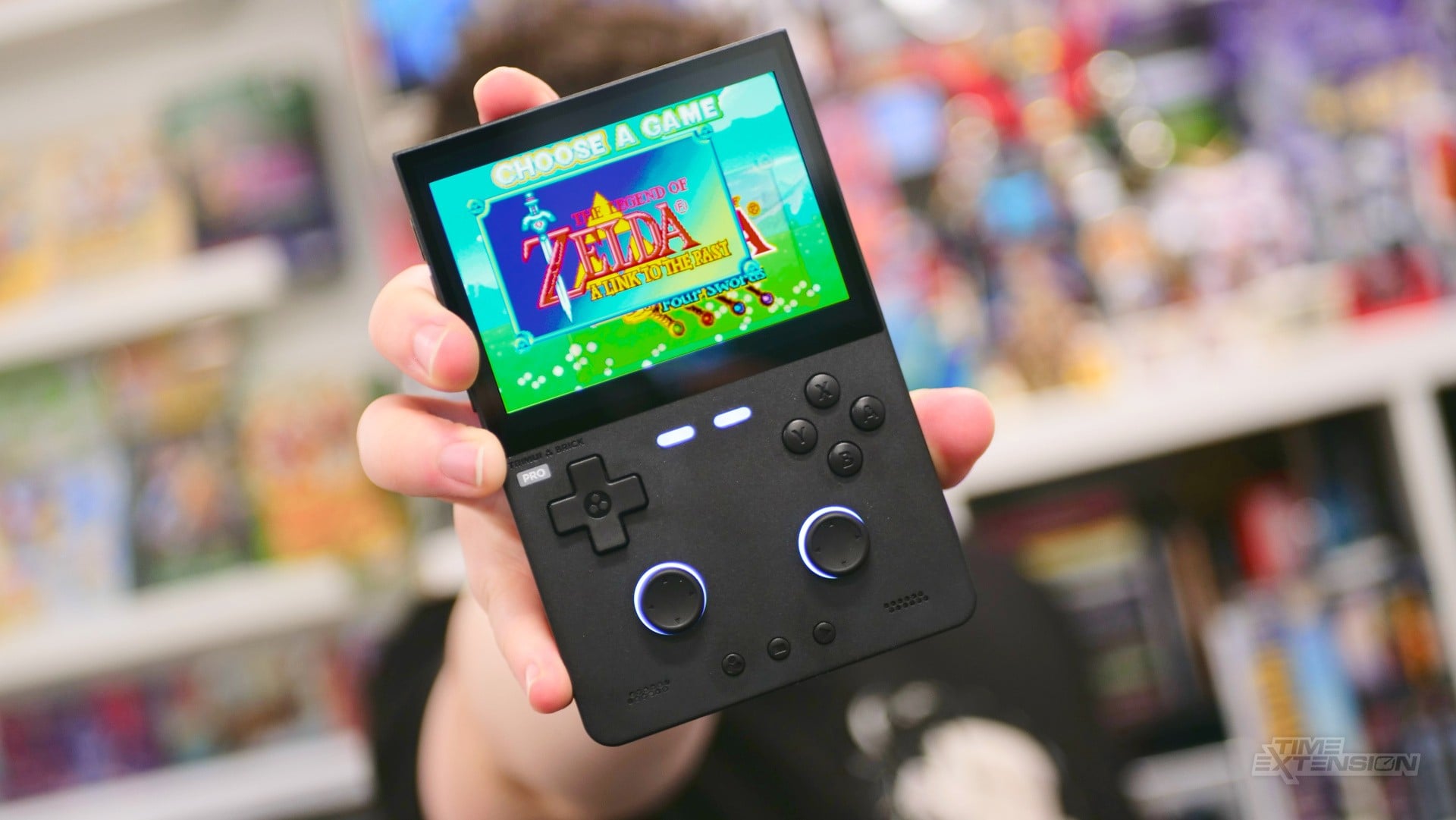
- Display: 3.95-inch IPS, 1024×768 resolution, 324ppi, fully laminated.
- Memory: 1GB LPDDR3 RAM with 8GB eMMC internal storage.
- Battery: 5000mAh Lithium Polymer, providing an estimated 5–10 hours of gameplay.
- Connectivity: Dual USB-C ports (bottom and top edge), 3.5mm headphone jack, and MicroSD card expansion up to 1TB.
- Weight: 236 grams.
The most substantial upgrade is the screen transition from the 3.2-inch panel of the previous model to a 3.95-inch display. While the resolution remains consistent, the increased surface area improves text readability and visual clarity in high-density games. The inclusion of dual Hall Effect analogue sticks is the defining hardware change. Hall Effect sensors, which utilize magnetic fields to detect input, offer superior durability and precision compared to traditional potentiometer-based sticks, effectively mitigating the common "stick drift" issue prevalent in lower-cost controllers.
Ergonomics and Build Quality
The chassis of the Brick Pro has been redesigned to accommodate the larger screen and the new input layout. The device features a robust plastic shell reinforced by a metal panel on the rear, intended to manage heat dissipation and provide structural rigidity.
TrimUI has integrated modular design elements, such as swappable in-line shoulder buttons, allowing for minor customization. The addition of LED lighting around the analogue stick bases and the perimeter of the device suggests a design philosophy oriented toward the enthusiast market, while the high-quality D-pad ensures that 2D-focused titles remain the primary focus of the user experience. The increase in battery capacity to 5000mAh is a direct response to the demands of longer play sessions, bringing the device in line with modern expectations for portable endurance.
Software Ecosystem and User Accessibility
The Brick Pro runs on a Linux 4.9-based operating system. Historically, TrimUI has prioritized a "plug-and-play" user interface. By avoiding the complexities often found in custom Android-based emulation frontends, the device remains accessible to users with limited technical knowledge.
In testing environments, the software environment remains stable, handling legacy systems—NES, SNES, Sega Genesis, GBA, and PS1—with high fidelity. The performance threshold remains the same as the original model; the A133p processor is not intended for the computational demands of the PlayStation 2 or GameCube. Consequently, the software experience is optimized specifically for 8-bit, 16-bit, and early 32-bit/64-bit emulation. The simplicity of the interface allows for immediate startup and configuration, which remains a key differentiator for the brand.
Market Implications and Competitive Positioning
The entry of the TrimUI Brick Pro into the market creates a clear delineation within the company’s product lineup. The original Brick remains a viable option for those who prioritize extreme portability, while the Pro model caters to users who prioritize ergonomics and analogue controls.

Industry analysts note that this strategy is common among boutique handheld manufacturers, who often release "iterative" updates to maximize the lifecycle of existing chipsets. By keeping the processing power constant and focusing on physical improvements, TrimUI avoids the rising costs associated with integrating newer, more powerful chips (such as the Unisoc T618 or T820). This maintains the device’s retail price below the $100 mark, ensuring it remains competitive against entry-level devices from larger competitors.
The implications for the broader market are significant: consumers are increasingly prioritizing build quality and screen technology over raw clock speeds for retro-emulation purposes. With the inclusion of hall-effect sensors, TrimUI has effectively signaled that high-end features are becoming the standard, even at the budget end of the spectrum.
Summary of Performance Expectations
Prospective users should manage expectations regarding the emulation ceiling. The TrimUI Brick Pro is not a "next-generation" device; it is a refined version of a platform that has already proven its capability for classic gaming. The value proposition is anchored in the display quality, the improved control interface, and the ease of use.
While the device offers minor aesthetic updates, such as the LED lighting and the metal backplate, these are secondary to the primary achievement of the device: providing a comfortable, reliable platform for emulating the core libraries of the 1990s and early 2000s. As the market for retro-gaming hardware continues to mature, the focus on user comfort and long-term hardware reliability, as demonstrated by the Brick Pro, will likely become the primary metric by which new devices are measured.
The TrimUI Brick Pro is currently available through authorized distributors, and its performance metrics suggest it will likely serve as the definitive iteration of the A133p-based handheld series. For those currently utilizing the original model, the upgrade offers a more comfortable and precise experience, provided the user understands the hardware limitations inherent in the retained chipset.