 Vera Clarissa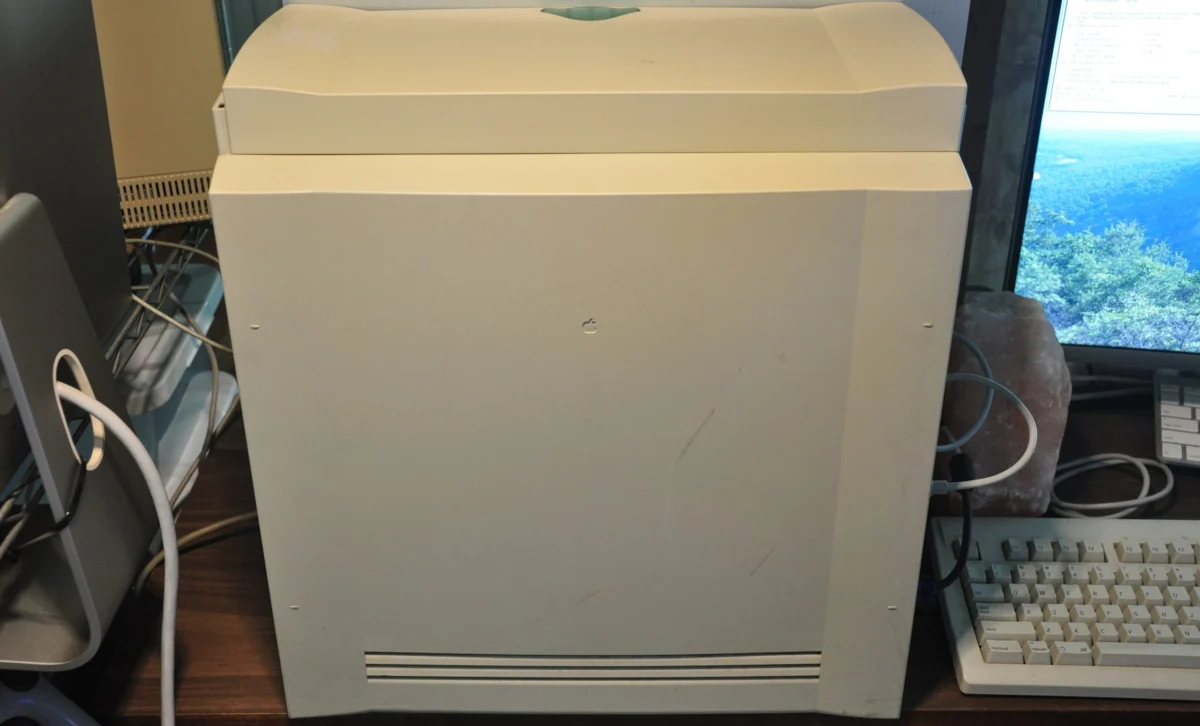
The Power Macintosh 9600 stands as a significant artifact of Apple’s mid-1990s hardware evolution, representing the pinnacle of the "PowerPC" era before the company’s dramatic pivot toward the G3 and G4 architectures. Recently recovered and analyzed following the VCF Midwest exhibition, this specific unit—a 9600/300 model—serves as a primary case study for the longevity of high-end professional computing gear. Originally released in August 1997, the 9600 was positioned as the flagship tower for high-end digital publishing, video editing, and pre-press work. Its design, characterized by an expansive internal chassis and a slide-out logic board, offered a level of expandability that remained unparalleled for years.
A Chronology of the Power Mac 9600
The Power Macintosh 9600 was introduced by Apple on August 5, 1997, as part of a strategic effort to bolster performance in the professional market. It arrived alongside the 9600/350, both of which utilized the Tanzania motherboard architecture. This was a transitional period for Apple; the company was struggling with a complex product lineup and the looming shadow of financial instability. The 9600 series was intended to bridge the gap until the introduction of the Power Mac G3 "Blue and White" series.

Market availability was relatively short-lived. By March 17, 1998, Apple had discontinued the 9600, signaling the company’s move toward a more streamlined product catalog under the nascent leadership of Steve Jobs. Because of this brief production window, the machine remains a rarity in the vintage computing landscape. The unit in question, recovered from VCF Midwest, has remained in a highly modified state, featuring long-term upgrades that provide a window into the "Mac upgrade culture" of the late 1990s and early 2000s.
Technical Specifications and Legacy Upgrades
The 9600/300 was originally shipped with a 300 MHz PowerPC 604e processor. However, the recovered unit features a significant upgrade: a Newer Technology MaxPowr G3 processor card clocked at 445 MHz. This card represents a popular aftermarket solution from the era, designed to extend the utility of the PowerPC 604e-based systems by transitioning them to the more efficient PowerPC 750 (G3) architecture.
The internal configuration of this machine highlights the modularity of the 1990s desktop. Key modifications include:

- Storage and Interface: A Sonnet Tempo Ultra ATA/133 PCI card, which bypassed the limited internal SCSI bus to support modern IDE/ATA hard drives. This allowed users to move away from expensive, low-capacity SCSI drives in favor of more affordable, higher-density storage.
- Networking: A D-Link DFE-530TX+ 10/100 Ethernet card, which replaced or augmented the original onboard networking, ensuring the machine could interact with modern LANs.
- Graphics and Multimedia: The system retains a dual-card graphics setup—an ATI 3D Rage II and an ATI Rage LT Pro—supplemented by a Lucent-based USB and FireWire PCI combo card. These additions were essential for users attempting to drag legacy hardware into the early 2000s, where USB peripherals were rapidly becoming the industry standard.
- SCSI Connectivity: An ATTO Express PCI SCSI controller remains present, reflecting the workstation’s original intent as a high-performance input/output machine for digital media professionals.
The Economics of Memory in the 1990s
One of the most striking aspects of the Power Mac 9600’s history is its memory architecture. During its prime, RAM costs were significantly higher than they are today. A fully maxed-out Power Mac 9600 could cost the equivalent of a small vehicle in 1997 dollars. The machine in question reports approximately 1.18 GB of RAM, a staggering figure for the era.
Industry experts, including Dan Bashur, note that the 128 MB DIMMs required to reach these capacities were not even available when the 9600 was first launched. The complexity of the memory bank—composed of a mix of 128 MB, 64 MB, and 16 MB modules—illustrates the lengths to which professionals went to keep these machines relevant. The use of EDO (Extended Data Out) memory at 60ns was the gold standard for latency at the time. The current memory configuration, while functionally impressive, highlights the technical hurdles of the 9600’s memory controller, which could be sensitive to unmatched DIMM pairs and specific module timings.
Restoration and Maintenance Challenges
The primary challenge in restoring this machine lies in the degradation of its plastic chassis. Like many Apple products from this period, the 9600 utilized flame-retardant additives in its ABS plastic. Exposure to UV light and ambient heat causes these additives to oxidize, resulting in the characteristic yellowing or "browning" of the Apple Platinum aesthetic. Restoration enthusiasts frequently employ a process known as "retrobriting," which involves a chemical treatment to reverse the oxidation of the bromine-based flame retardants.

Beyond cosmetics, the mechanical state of the machine is remarkably preserved. The decision to maintain this unit as a dedicated Mac OS 9 workstation is a strategic choice for vintage computing enthusiasts. While the temptation to install Mac OS X Tiger exists, the hardware limitations of the PCI bus—which offers a restricted 25W power envelope—make modern graphics card adaptations risky and often bandwidth-inefficient.
The Role of OS 9 in Modern Preservation
The decision to utilize Mac OS 9 as the primary environment is based on both historical accuracy and performance. OS 9 is the final iteration of the "Classic" Mac OS, providing a highly responsive experience on G3 hardware. It serves as an ideal platform for legacy software like Adobe Photoshop 5.5, which remains fully functional on this hardware.
For those interested in maintaining such a system, the integration of an SSD via an IDE-to-SD or IDE-to-mSATA adapter remains the most viable path forward. While traditional mechanical drives were the standard, they are now the most likely point of failure. Solid-state alternatives provide a necessary boost in reliability, though enthusiasts note that boot times on such machines are inherently governed by the firmware and memory-check processes that were standard in the late 1990s.

Broader Implications for Vintage Computing
The Power Mac 9600 represents a bridge between two distinct eras of computing. For users who came of age during the 1995–2001 period, these machines were the "unattainable" hardware that powered the creative industries. Unlike the home-market PCs of the same era—such as the Compaq Presario or the HP Pavilion—the 9600 was a professional-grade tool.
The collaborative effort to document and maintain these machines, led by groups like the Low End Mac community, serves a vital role in preserving the history of human-computer interaction. By documenting the specific upgrade paths—from processor cards to SCSI controllers—these enthusiasts are creating a knowledge base that ensures this hardware remains operational for future generations.
The 9600/300 is not merely a collection of vintage chips and circuit boards; it is a testament to a time when modularity was a primary design principle. The machine’s ability to accept a G3 upgrade, a modern ATA controller, and an abundance of RAM transformed it from a 1997 relic into a viable workstation for years beyond its intended lifecycle. As we look back at the trajectory of the personal computer, the Power Mac 9600 stands as an example of how high-quality engineering can defy the rapid obsolescence cycles that define the modern technology market. The ongoing project to restore this unit to its full potential serves as a reminder that the value of such hardware is not in its raw processing power, but in the history it continues to provide.