Farhan hamdan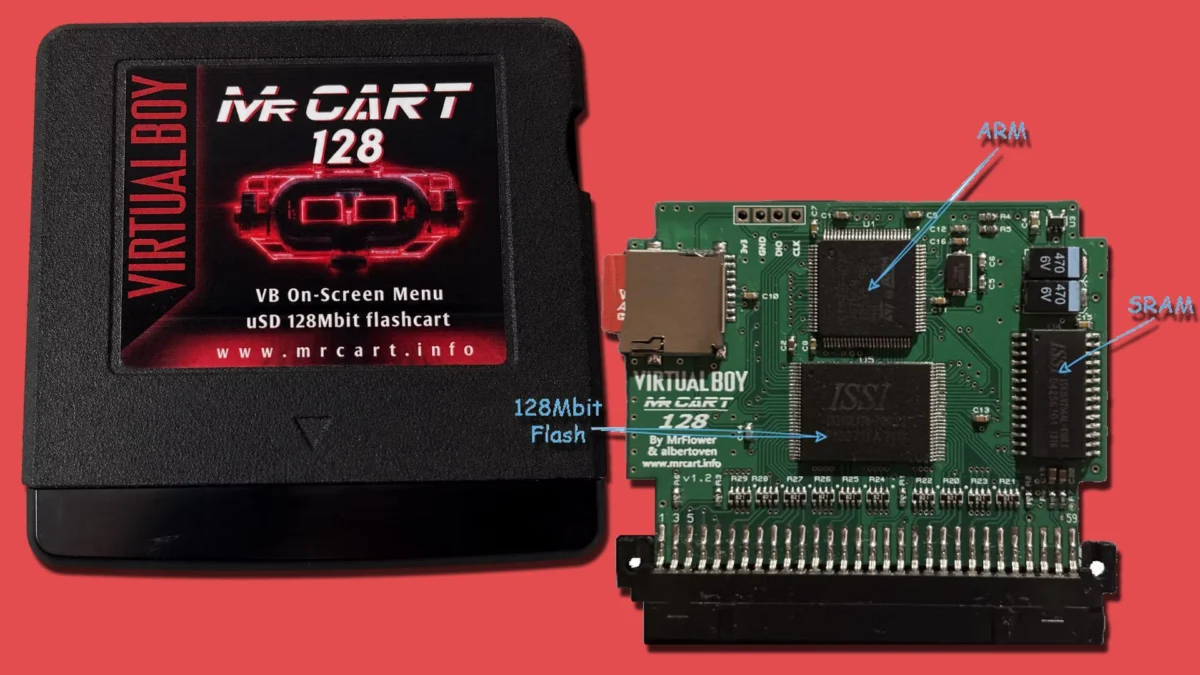
The retro gaming community has received a major technological development with the official opening of pre-orders for the MrCart 128, a next-generation flash cartridge and hardware expansion designed specifically for the notoriously obscure Nintendo Virtual Boy. Spearheaded by hardware developer Kevin Mellott in collaboration with original creator Mr Flower, this new iteration significantly expands the capabilities of Nintendo’s 1995 stereoscopic tabletop console. Priced at $235 and offered in custom black or red shell colorways, the MrCart 128 is slated to begin shipping to global consumers before the conclusion of the calendar year.
This release arrives at a time of sustained enthusiasm within the niche retro hardware modification and homebrew development spheres. By moving beyond traditional ROM storage limitations and introducing novel expansion capabilities, the MrCart 128 represents a technical leap that could fundamentally alter how developers approach software design for the discontinued platform.
Evolution of the Hardware: From 32 Mbit to 128 Mbit
The original MrCart established itself as a reliable staple for enthusiasts seeking to run backup libraries and homebrew software on original Virtual Boy hardware without relying on original, increasingly scarce media cartridges. However, as the homebrew scene matured, developers quickly pushed against the technical boundaries of the original hardware architecture.
The primary physical and operational upgrade of the MrCart 128 lies in its quadrupled flash memory capacity. While the standard legacy model provided 32 Mbit (4 MB) of storage, the new iteration boasts a robust 128 Mbit (16 MB) capacity. This expansion accommodates larger, more ambitious software projects, complex texture streaming, and comprehensive multi-game libraries loaded onto a single microSD card.
Furthermore, data transfer speeds have seen a marked improvement, with game flashing operating up to three times faster than previous iterations. The introduction of native subfolder support further streamlines user navigation, allowing collectors to neatly organize expansive ROM libraries directly on the menu interface. Despite these advanced upgrades, current hardware alternatives—such as the legacy MrCart and Stone Age Gamer’s HyperBoy32+ featuring an e-ink label—remain commercially available for consumers seeking immediate fulfillment without entering a pre-order queue.
The ESSound Innovation: Redefining Virtual Boy Audio
While expanded memory and faster flash times provide notable quality-of-life improvements, the defining engineering achievement of the MrCart 128 is the integration of ESSound. This proprietary hardware addition introduces an entirely new audio processing capability to the Virtual Boy by utilizing the console’s rarely tapped Expansion (ES) address space.
Historically, the Virtual Boy relied exclusively on its internal Virtual Sound Unit (VSU), which, while capable of producing distinct chiptune-style audio, was heavily constrained by channel limitations and primitive sound generation parameters. The ESSound system bypasses these native limitations by functioning as an independent, secondary audio stream powered by the cartridge hardware.
Through the new expansion interface, homebrew applications and modified software can stream high-quality, pre-recorded MP3 music and uncompressed WAV sound effects in true stereo directly from the onboard microSD card. This audio stream operates concurrently with the console’s native VSU output, giving developers a hybrid soundscape. Software can dynamically control playback variables, including looping tracks, volume scaling, and stereo balance adjustments, via a streamlined command interface.
Industry analysts and technical commentators note that this capability effectively eliminates one of the platform’s most persistent historical bottlenecks. Developers are no longer restricted to synthesized bleeps and limited waveform channels, opening the door for atmospheric orchestral scores, digitized human speech, cinematic voice acting, and complex sound design that were previously considered impossible on the native 1995 hardware.

Background Context and Historical Significance of the Virtual Boy
To fully understand the significance of the MrCart 128 and its accompanying audio architecture, it is necessary to examine the commercial trajectory of the Nintendo Virtual Boy. Released in Japan in July 1995 and in North America in August 1995, the console was marketed as the first portable system capable of displaying true 3D graphics using a pair of red-and-black LED arrays.
Conceived under the direction of legendary Nintendo engineer Gunpei Yokoi, the system suffered from a combination of high retail pricing, an uncomfortable ergonomic design that required tabletop mounting, motion sickness concerns among users, and a monochromatic visual palette dictated by cost and technology constraints at the time. Facing weak market adoption and mounting pressure from corporate leadership following Yokoi’s departure, Nintendo quietly discontinued the Virtual Boy in 1996, resulting in a remarkably sparse official software library consisting of only 22 games globally.
In the decades following its commercial failure, the Virtual Boy transitioned from a notorious marketplace misstep into a highly sought-after collectible. A dedicated community of hardware preservationists, reverse-engineers, and independent developers gradually emerged. Because the official library is so small—and many original cartridges command high prices on the secondary market—flash cartridges like the MrCart series became essential tools for preserving software history, translating unreleased Japanese titles, and fostering a vibrant homebrew development ecosystem.
Chronology of Development and Market Reception
The lifecycle of modern Virtual Boy flash technology has evolved steadily over the past decade. Early hardware solutions were often experimental, bulky, or limited in availability due to the small scale of component manufacturing.
- 2010s: Early flash solutions and basic backup units emerged from individual hobbyists, largely restricted to simple single-game programming or expensive, custom-built printed circuit boards.
- Early 2020s: The introduction of the original MrCart by Mr Flower, distributed via partners such as Kevin Mellott and Retro Onyx, standardized a reliable multi-game solution with a 32 Mbit capacity, stabilizing the homebrew scene.
- Mid-2020s: As homebrew programmers developed larger games and resource-intensive projects, the demand for expanded memory addressing became critical. Concurrently, experiments with auxiliary hardware modules laid the groundwork for external processing.
- Late 2026: Kevin Mellott and Mr Flower formally announce and open pre-orders for the MrCart 128, introducing the 128 Mbit architecture alongside the revolutionary ESSound expansion audio interface. Shipments are scheduled to reach consumers before the end of the year.
Market analysts monitoring the retro gaming accessories sector observe that hardware modifications for discontinued eighth- and ninth-generation legacy consoles continue to demonstrate strong economic viability. Despite the niche appeal of the Virtual Boy, specialized products engineered by community developers frequently sell out initial production runs rapidly, driven by passionate collectors willing to invest in premium hardware enhancements.
Broader Impact and Technical Implications for Homebrew Developers
The release of the MrCart 128 carries significant implications for the future of Virtual Boy software development. Historically, homebrew projects were forced to optimize relentlessly to fit within restrictive memory parameters and utilize the limited audio channels of the VSU.
By quadrupling the available ROM space, developers can now port larger scale projects, incorporate extensive asset libraries, and implement deeper narrative structures into their software. More importantly, the integration of the ESSound expansion architecture establishes a new technical benchmark for what third-party hardware can achieve when interfaced with legacy systems through standardized expansion ports.
While the requirement for specialized cartridge hardware means that ESSound-enabled games will only function on consoles equipped with a MrCart 128 or compatible expansion-aware devices, the development community has largely embraced the standard. Several prominent homebrew groups have already signaled intentions to update existing software or build new titles specifically designed to leverage the expanded stereo audio and memory capabilities.
As pre-orders progress toward their fulfillment window, the MrCart 128 stands as a testament to the dedication of the retro gaming community, proving that even the most commercially unsuccessful hardware platforms of the 1990s can find new life through modern engineering and continued preservation efforts.