Jia Lissa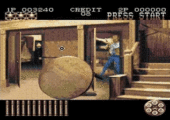
Released in 1994 for the Sega CD, Lethal Enforcers II: Gun Fighters serves as the definitive home conversion of Konami’s popular arcade light gun shooter. While its predecessor, the original Lethal Enforcers, redefined the genre with its use of digitized sprites and a modern-day police setting, this sequel transports players back to the American frontier of 1873. The transition from the urban landscapes of the 1990s to the lawless Old West marked a significant thematic shift for the franchise, aiming to capture the cinematic essence of classic Western films while maintaining the high-intensity gameplay that made the first title a commercial success in both arcades and home markets.
Historical Context and Development
The early 1990s represented a period of significant transition for the video game industry, characterized by the move toward digitized graphics and the implementation of content rating systems. The original Lethal Enforcers was at the center of a national debate regarding video game violence, often cited alongside titles like Mortal Kombat and Night Trap during the 1993 Congressional hearings. In response to this scrutiny, the industry established the Video Rating Council (VRC) for Sega platforms and eventually the ESRB.
Interestingly, while the first game carried an MA-17 rating due to its realistic depictions of modern gun violence, Lethal Enforcers II: Gun Fighters was granted an MA-13 rating. Analysts suggest this change was likely due to the historical setting, which distanced the violence from contemporary reality, and the replacement of modern firearms with period-accurate weaponry. Developed and published by Konami, the game utilized the Konami GX arcade hardware for its original release before being ported to the Genesis and Sega CD. The Sega CD version, in particular, was marketed as the premium home experience due to the storage capacity of the CD-ROM format, which allowed for superior audio fidelity compared to the standard cartridge-based version.
Technical Hardware and Peripheral Integration
A defining characteristic of the Lethal Enforcers series is its reliance on light gun technology. On the Sega CD, the game was designed to be played with the Konami Justifier, a revolver-style peripheral that mimicked the feel of the arcade’s hardware. For optimal performance, the Justifier requires a Cathode Ray Tube (CRT) television, as the technology relies on the timing of the electron beam scanning the screen—a method that is incompatible with modern LCD, LED, or OLED displays.
From a control standpoint, the Justifier offers a level of precision that a standard directional pad cannot replicate. In professional assessments of the port, the use of a standard controller is frequently cited as a significant disadvantage due to the speed and frequency of enemy spawns. The Sega CD version also supports a two-player cooperative mode, though this requires a specific setup: the first Justifier (blue) connects to the console, while a second Justifier (pink) must be daisy-chained to the first. This hardware configuration was a unique solution to the Sega Genesis’s limited controller ports and remains a notable piece of peripheral history.
Visual and Auditory Performance Data
When comparing the Sega CD version of Lethal Enforcers II: Gun Fighters to its arcade counterpart and the standard Genesis port, the results are a study in the technical limitations of the era. The Sega CD hardware shared the same VDP (Video Display Processor) as the Genesis, meaning the game was restricted to a simultaneous palette of 64 colors from a total of 512. This limitation results in a visuals that appear somewhat muted and "dithered" compared to the vibrant 32-bit colors of the arcade hardware.
However, the Sega CD version distinguishes itself through its audio. By utilizing Redbook CD audio, Konami provided a soundtrack and sound effect library that significantly outperformed the FM synthesis of the Genesis cartridge. The audio package includes:
- Full CD-quality musical arrangements that evoke the "Spaghetti Western" style.
- Crystal-clear voice samples for the "innocents" and the "outlaws."
- Enhanced percussion and foley effects for gunfire and explosions.
This auditory upgrade provides a more immersive experience, bridging the gap between the home console and the arcade cabinet in a way that the visual presentation could not.
Chronological Stage Progression and Gameplay Mechanics
The gameplay loop of Lethal Enforcers II: Gun Fighters follows a strict "shoot or be shot" philosophy. Players are tasked with neutralizing bandits while avoiding civilian casualties, such as "ladies of the evening" or bankers. The game is structured across five primary stages, interspersed with bonus rounds designed to test the player’s speed and accuracy.
Stage 1: The Bank Robbery
The narrative begins with a high-stakes heist in progress. Players must clear the town square and enter the bank to stop the robbers. The stage concludes with a confrontation against a boss positioned in a fortified covered wagon. This encounter introduces a dual-task mechanic where the player must shoot incoming cannonballs while simultaneously targeting the boss.
Stage 2: The Stagecoach Pursuit
The action moves to the open trail, featuring enemies on horseback and a moving stagecoach. This stage emphasizes lateral movement and rapid target acquisition. The boss of this level utilizes environmental hazards, throwing barrels at the player. Upon the boss’s defeat, the game transitions to the first bonus stage—a saloon bottle-shooting gallery that requires the player to clear all targets within 15 seconds.
Stage 3: The Saloon Shootout
Returning to a more confined environment, the third stage takes place inside a bustling saloon. The threats here are more varied, including bandits armed with knives and hatchets alongside traditional gunmen. The stage ends with a classic Western trope: a quick-draw duel against three elite gunfighters in the middle of the street.
Stage 4: The Great Train Robbery
This stage takes place on a moving locomotive, beginning at the caboose and working forward toward the engine. The verticality and shifting background of the train cars increase the difficulty of maintaining accuracy. The boss is a demolition expert who hurls dynamite, requiring the player to intercept explosives in mid-air. A second bonus stage follows, involving a bottle-toss challenge.
Stage 5: The OK Mine Company
The final mission leads players into the depths of a gold mine. This stage is notable for its departure from semi-realism, introducing a supernatural element in the final encounter. The main antagonist summons skeletal warriors that throw knives and their own heads at the player. Defeating the boss requires sustained fire on his person while ignoring the secondary skeletons, who serve as distractions rather than targets with health bars.
Scoring and Rank Classification
The difficulty of Lethal Enforcers II: Gun Fighters is markedly higher than the original game. Enemies possess faster "draw" times, meaning they fire their weapons shortly after appearing on the screen. To compensate for this increased challenge, the Sega CD version provides players with nine continues, as opposed to the five typically found in the first title.
Performance is measured by an accuracy percentage at the end of each stage. Unlike the first game, which enforced a minimum accuracy requirement to progress, the sequel allows players to continue regardless of their score, provided they have remaining lives. The ranking system is categorized as follows:
- 59% and below: Posse
- 60% – 69%: Deputy
- 70% – 79%: Sheriff
- 80% – 89%: Deputy Marshal
- 90% and above: U.S. Marshal
Points are heavily deducted for shooting "innocents," and hitting a civilian results in the immediate loss of a life, making trigger discipline as vital as speed.
Arsenal and Power-Up Systems
Players begin each life with a standard six-shooter. However, the environment contains hidden weapon upgrades that can be revealed by shooting specific objects like signs, vases, or crates. These power-ups are temporary but provide a significant tactical advantage:
- Dual Pistols: Increases fire rate and magazine capacity.
- Rifles and Shotguns: Provide wider hit detection or higher damage.
- Gatling Guns: Allows for rapid, automatic fire.
- Cannons and .50 Caliber Sharps: High-impact weapons for boss encounters.
Strategic use of these weapons is essential for managing the "bullet sponges"—enemies that require multiple hits to neutralize—who appear more frequently in the later stages of the game.
Industry Impact and Legacy
Lethal Enforcers II: Gun Fighters remains a significant title in the history of light gun shooters and the Sega CD library. It represents the peak of the digitized sprite era before the industry shifted toward fully 3D rendered environments in the mid-to-late 1990s with titles like Time Crisis and Virtua Cop.
The game’s legacy is also tied to the hardware it requires. As CRT televisions have become obsolete, the ability to play Lethal Enforcers II in its intended format has become a niche pursuit for retro-gaming enthusiasts. While the game was later released in compilations for the PlayStation and other platforms, the Sega CD version is often remembered for its unique blend of high-quality Redbook audio and the tactile experience of the Justifier peripheral. It stands as a testament to Konami’s ability to adapt its arcade successes for a home audience, providing a challenging, cinematic experience that defined the light gun genre for a generation of console gamers.