Jia Lissa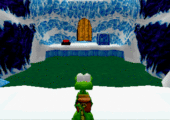
Croc: Legend of the Gobbos, developed by the British studio Argonaut Software and published by Fox Interactive in 1997, stands as a pivotal artifact in the transition from two-dimensional to three-dimensional gaming. Released during a volatile period for the industry, the title arrived at a time when developers were still grappling with the fundamental physics and control schemes required for navigating polygonal environments. While often overshadowed by contemporary giants like Super Mario 64 and Crash Bandicoot, the history of Croc provides significant insight into the technical challenges and corporate maneuvers that defined the 32-bit era of home consoles.
The Genesis of a Mascot: The Argonaut and Nintendo Partnership
The origins of Croc: Legend of the Gobbos are inextricably linked to the technological partnership between Argonaut Software and Nintendo. In the early 1990s, Argonaut founder Jez San and his team worked closely with Nintendo to develop the Super FX chip, a custom RISC processor that allowed the Super Nintendo Entertainment System (SNES) to render polygons. This collaboration birthed Star Fox, a landmark title that demonstrated the viability of 3D graphics on home hardware.
Following the success of Star Fox, Argonaut pitched a 3D platforming/racing hybrid to Nintendo, featuring the character Yoshi. This prototype was intended to be one of the first fully realized 3D platformers. However, Nintendo ultimately rejected the proposal. Industry analysts and historians note that Nintendo was likely already developing Super Mario 64 in-house and was hesitant to allow a third-party developer to take the lead on a project involving their primary intellectual properties. The collapse of this deal led Argonaut to repurpose their technology and concepts into an original IP, which eventually became Croc.
Technical Specifications and Gameplay Mechanics
Croc: Legend of the Gobbos was built on a proprietary engine that emphasized segmented, room-based level design. Unlike the open-world expanses of Super Mario 64, Croc utilized a series of interconnected environments separated by doors. This design choice allowed the developers to push more detail into smaller areas, which was a necessary compromise given the hardware limitations of the Sony PlayStation and Sega Saturn.
The game features a specific control scheme commonly referred to as "tank controls." In this configuration, the player rotates the character on a central axis rather than moving them in a direct relationship to the camera’s perspective. While this was a standard convention for early 3D titles like Resident Evil and Tomb Raider, it was increasingly viewed as cumbersome for the high-speed precision required in platformers. Despite this, the game was a commercial success, eventually selling over three million copies on the PlayStation alone, earning it a "Greatest Hits" designation.
The gameplay loop centers on the rescue of Gobbos—small, furry creatures that were the titular character’s adoptive family. Each level contains six Gobbos, five of which are hidden throughout the environment, while the sixth is locked behind a challenge room. Collecting these creatures, along with colored gems and keys, remains the primary objective, establishing the "collectathon" tropes that would dominate the genre for the next decade.
Historical Timeline and Industry Context
The release of Croc occurred during the peak of the "mascot platformer" craze. To understand its impact, one must view it within the chronology of the late 1990s:
- 1993: Argonaut and Nintendo release Star Fox, proving 3D capabilities on consoles.
- 1995: Argonaut pitches the 3D Yoshi game to Nintendo; the project is rejected.
- 1996: Super Mario 64 (Nintendo 64) and Crash Bandicoot (PlayStation) are released, setting the gold standard for 3D movement.
- September 1997: Croc: Legend of the Gobbos launches on PlayStation, followed by the Sega Saturn and PC versions.
- 1998: Spyro the Dragon and Banjo-Kazooie are released, introducing more fluid analog controls and larger open worlds.
- 1999: Croc 2 is released, attempting to refine the mechanics of the original.
- 2024–2025: A high-definition remaster is announced and released, bringing the title to modern platforms with updated control options.
Platform Disparity: The Sega Saturn and PlayStation Divide
While Croc was a multi-platform release, the differences between the PlayStation and Sega Saturn versions highlight the difficulties of third-party development during the mid-90s. The PlayStation version was the lead platform, benefiting from the console’s superior transparency effects and triangle-based rendering.
The Sega Saturn version, however, faced several technical hurdles. The Saturn’s architecture used quadrilaterals rather than triangles, making ports from the PlayStation notoriously difficult. This version of Croc suffered from a darker color palette and lower-resolution textures. Most notably, a peculiar software bug existed where booting the game directly with the disc in the tray could cause character geometry—such as Croc’s snout—to disappear entirely. To avoid this, players were required to boot the game from the Saturn’s internal BIOS menu. Despite these flaws, the Saturn version was one of the few high-quality 3D platformers available on the system, which lacked a dedicated 3D Sonic the Hedgehog title.
Audio Design and Cultural Reception
One of the most enduring elements of Croc: Legend of the Gobbos is its soundtrack, composed by Justin Scharvona, Karin Griffin, and Simon Gosling. The music utilized a distinctive blend of mariachi-style brass, upbeat percussion, and whimsical melodies that helped define the game’s identity. In an era where many games were moving toward cinematic or orchestral scores, Croc’s music maintained a cartoonish, high-energy atmosphere that resonated with younger audiences.
Critical reception at the time of release was generally positive, with reviewers praising the graphics and the charm of the protagonist. However, as the 3D platformer genre evolved rapidly between 1997 and 1999, retrospective analysis became more critical of the game’s "tank controls" and the lack of a dynamic camera. Modern critics often view Croc as a "stepping stone" game—one that proved 3D platforming was viable for third-party developers but was quickly surpassed by more sophisticated control paradigms.
The 2025 Remaster and Modern Preservation
In a significant move for video game preservation, a remaster of Croc: Legend of the Gobbos was announced for a 2025 release. This project, led by a reformed Argonaut Games, aims to bring the title to modern systems including the Nintendo Switch, PlayStation 5, and Xbox Series X/S.
The remaster is designed to address the primary criticisms of the original release. It includes a "Croc Control" mode, which replaces the legacy tank controls with modern, omnidirectional analog movement. This update is crucial for the game’s viability in the current market, as modern players are often unaccustomed to the rigid movement patterns of the early 3D era. Furthermore, the remaster includes the "Gobbopedia," a digital museum featuring development assets, interviews, and historical context, signaling a shift in how the industry treats its classic, non-AAA catalog.
Broader Impact and Implications for the Industry
The legacy of Croc: Legend of the Gobbos is found in its role as a pioneer for independent and third-party 3D development. By successfully launching a 3D platformer without the direct support of Nintendo or Sony’s internal teams, Argonaut Software demonstrated that the technical barriers to 3D entry were surmountable.
The game’s success also reinforced the importance of character-driven branding in the 1990s. Croc was one of dozens of "animal with attitude" protagonists that emerged in the wake of Sonic the Hedgehog, but unlike many of its forgotten peers, Croc’s technical pedigree and intelligent level design allowed it to endure. The "room-based" design philosophy seen in Croc influenced various other titles of the era, providing a blueprint for how to manage limited hardware resources while maintaining visual fidelity.
In conclusion, Croc: Legend of the Gobbos represents a unique moment in gaming history where experimental design and corporate competition collided. Its transition from a rejected Yoshi prototype to a multi-million-selling original franchise is a testament to the resilience and technical prowess of Argonaut Software. As the 2025 remaster introduces the title to a new generation, the game serves as a vital reminder of the "leap of faith" required by developers during the industry’s most significant technological transition. Through its intelligent level design and memorable aesthetic, Croc remains a definitive example of the 32-bit era’s creative ambition.