Jia Lissa
Following the massive critical and commercial success of Shining in the Darkness and the strategic depth offered by Shining Force, the developers at Climax Entertainment found themselves at a crossroads in 1991. While the Shining series was rapidly becoming a cornerstone of Sega’s role-playing game portfolio, co-founder Kan Naito sought to push the technical boundaries of the Mega Drive hardware beyond the traditional first-person dungeon crawler or top-down tactical grid. The result of this ambition was Landstalker, a title that would eventually abandon its series roots to become a standalone icon of the 16-bit era. This transition was marked by the development of the Diamond-Shaped Dimension System (DDS520), an engine that attempted to simulate a fully realized three-dimensional world through an isometric perspective, forever altering the landscape of action-adventure games on Sega consoles.
Technical Genesis: From Corridors to Dioramas
The conceptual origins of Landstalker were rooted in Kan Naito’s long-standing obsession with 3D environments. Having worked on early 3D maze titles for the PC-6001 and the MSX, Naito felt that the movement in Shining in the Darkness—while revolutionary for its time—was too restrictive, confined to ninety-degree turns and claustrophobic hallways. His vision for a new project involved verticality, diagonal movement, and a sense of tangible depth.
The inspiration for the game’s unique perspective famously came to Naito while he was observing traffic and pedestrians from his tenth-floor apartment window. The oblique angle provided a comprehensive view of the world that felt both cinematic and immersive, reminiscent of the Indiana Jones films that the development team frequently cited as a tonal touchstone. However, implementing this "electronic diorama" on the Mega Drive presented a significant engineering hurdle. At the time, isometric games like Solstice on the NES were often restricted to single-screen rooms because the oblique geometry was notoriously inefficient for Video Random Access Memory (VRAM) management.

To overcome these limitations, Naito spent nearly a year developing the DDS520 engine. The system utilized diamond-shaped panels measuring 64×64 pixels as the basic building blocks of the game world. By representing these diamonds as vectors—objects defined by attributes rather than raw pixel data—Naito was able to optimize processing speeds. This allowed the Mega Drive to calculate character height and object priority in real-time, enabling the protagonist to walk behind buildings or beneath platforms with consistent visual logic.
The Diamond-Shaped Dimension System (DDS520) and Development Chronology
Development began in earnest in early 1991, with Naito working in isolation on the core engine while other team members, including creative director Kenji Orimo and graphic designer Yoshitaka Tamaki, were still finalizing Shining Force. By the autumn of 1991, the engine had evolved from a crude prototype into a robust system capable of handling 520 maps—a number that would eventually balloon to 850 by the time the game went gold.
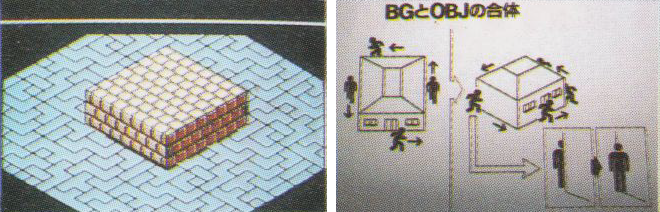
To manage this massive expansion, the team utilized a proprietary graphics tool named Mirage III. This software allowed designers to create 3D wireframes of dungeons and towns, ensuring that the height data and character collision were perfectly aligned with the hand-drawn art. The development process was famously grueling, characterized by "training camps" held at the Yomiuri Land Hotel. During these multi-day sessions, the staff worked twenty-four hours a day in shifts, stopping only for meals or brief visits to the nearby amusement park to clear their heads.
A critical addition to the team during this period was Yasuhiro Ohori, who joined as external production staff. Ohori, a veteran of the Japanese fanzine scene and a former collaborator with Pokémon creator Satoshi Tajiri, brought a fresh perspective to the game’s dungeon design. Under his influence, the team began visiting arcades to study the movement patterns of Capcom’s fighting games, which directly informed how enemies in Landstalker would approach and attack the player diagonally.

Artistic Shift: The Nigel and Friday Dynamic
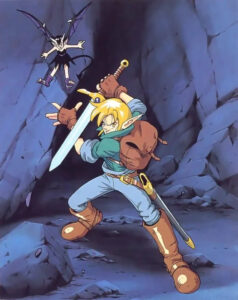
While the engine was being refined, Yoshitaka Tamaki was tasked with creating a protagonist who felt like a "free-spirited adventurer." His initial sketches included a "cat Gandalf" wizard, but the team ultimately settled on Nigel (Lyle in Japan), a forest elf who worked as a professional treasure hunter. This choice was a deliberate move away from the "chosen one" tropes of the Shining series. Nigel was portrayed as a romantic and a wit, driven by the pursuit of wealth rather than the salvation of the world.
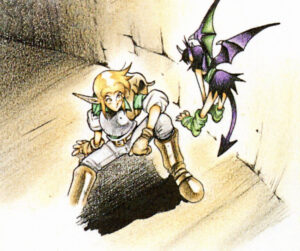
To provide a narrative counterpoint to Nigel’s stoicism, Tamaki created Friday, a tiny nymph who becomes Nigel’s guide and healer. Friday served a functional purpose in the gameplay: the primary healing item, the Eke Eke plant, was toxic to Nigel if consumed directly, requiring Friday to use the plant as a component for her magic. This partnership became the emotional core of the game, separating it from Nintendo’s The Legend of Zelda, which many critics initially viewed as its primary competitor.

The world of Mercator Island was further populated by a cast of memorable rivals and villains. Tamaki drew inspiration from the anime Lupin III for the character of Kayla, a voluptuous mercenary who, along with her bumbling henchmen Wally and Ink, served as Nigel’s recurring foil. The inclusion of Princess Lara (Loria) and the Duke of Mercator added layers of political intrigue to what began as a simple treasure hunt, resulting in a narrative that many contemporary reviewers praised for its maturity and humor.
The Soundtrack of Motoaki Takenouchi
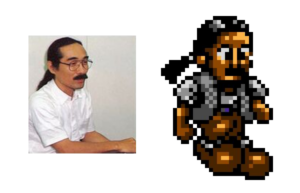
The audio landscape of Landstalker was crafted by Motoaki Takenouchi, a protégé of the legendary Dragon Quest composer Koichi Sugiyama. Takenouchi was tasked with creating a score that matched the game’s cinematic ambitions. For the first time in his career, he had access to a development environment that allowed him to fine-tune the Mega Drive’s FM synthesis chip to its limit.

Takenouchi’s score was characterized by a blend of orchestral arrangements and rhythmic, driving beats. He famously went against standard data-compression practices for "A Ballad for Princess Loria," a two-minute piano piece played during an in-game event. Takenouchi insisted that the player should be able to set the controller down and simply listen to the music, treating the game as a medium for performance. The final soundtrack consisted of 40 tracks, a significant number for a 16-bit title, which helped define the game’s high-adventure atmosphere.
The Brand Divorce: From Shining Rogue to Landstalker
One of the most debated aspects of Landstalker’s history is its separation from the Shining franchise. Internal documents and early press materials identified the project under various working titles, including Hero Lancelot, Shining Spirit, and Shining Rogue. Early concept art explicitly linked the game to Shining in the Darkness, with Nigel being the same species as the character Pyra, and the antagonists Ink and Wally being based on enemies from the first game.
However, by the time Kan Naito presented the game at the Tokyo Prince Hotel on June 11, 1992, the title had been officially changed to Landstalker. Naito stated that the game’s gameplay was so distinct from the turn-based nature of its predecessors that it deserved to stand as its own intellectual property. Some industry insiders, including composer Motoaki Takenouchi, hinted at "internal frictions" within Climax that may have contributed to the split. This divergence eventually saw co-founder Hiroyuki Takahashi focus on the Shining series through Sonic! Software Planning (later Camelot), while Naito took full control of Climax to pursue further isometric projects.
Release, Reception, and Market Impact
Landstalker was released in Japan on October 30, 1992, and was an immediate success, selling approximately 35,000 units in its first week. Critics lauded the game for its visual depth and challenging puzzles, though some noted that the isometric perspective made precision platforming difficult—a side effect of Naito’s decision to omit character shadows to preserve processing power.
The game’s international release in 1993 cemented its status as a cult classic. It proved that the Mega Drive could handle complex, pseudo-3D environments without the need for additional hardware like the Sega CD or the 32X. The 16Mb ROM size was considered massive at the time, and the sheer volume of content—850 maps and nearly 150 scripted events—set a new standard for action-RPGs on the platform.
Legacy and the End of Climax
Despite its success, Landstalker never received a direct sequel. Climax produced a spiritual successor, Dark Savior, for the Sega Saturn in 1996, which utilized the same isometric philosophy but failed to capture the same charm. A spinoff for the Super Famicom, Lady Stalker, was released in 1995 but remained a Japanese exclusive.

In 2005, Naito attempted to revive the franchise with a full 3D remake for the PlayStation Portable (PSP). A demo was showcased at the Tokyo Game Show, featuring Nigel and Friday in a modern engine, but the project was ultimately canceled for undisclosed reasons. Climax Entertainment eventually ceased operations in 2014, ending a thirty-year run as one of Japan’s most innovative independent developers.
Today, Landstalker remains a staple of Sega’s retro collections, appearing on the Wii Virtual Console, Steam, and the Mega Drive Mini. Its legacy lies in its refusal to play it safe, opting instead to build an entirely new way of seeing and interacting with a 16-bit world. For fans of the genre, the island of Mercator stands as a monument to a time when technical limitations were merely puzzles waiting to be solved by the right geometry.