Jia Lissa
The landscape of the 16-bit era was defined by rapid experimentation, yet few titles pushed the technical boundaries of the Sega Mega Drive as aggressively as Landstalker: The Treasures of King Nole. Released in 1992 by Climax Entertainment, the title represented a radical departure from the studio’s established success with the Shining series. By eschewing traditional first-person dungeon crawling and turn-based strategy in favor of a complex, isometric pseudo-3D environment, Climax Entertainment sought to redefine the action-RPG genre. The project was not merely a software development effort but a rigorous engineering challenge that required the creation of proprietary technology to simulate three-dimensional space on hardware never designed to support it.
The Strategic Pivot of Climax Entertainment
Following the commercial success of Shining in the Darkness, Climax Entertainment found itself at a crossroads. The studio’s co-founders, Hiroyuki Takahashi and Kan Naito, recognized the need for a more robust infrastructure to handle increasingly ambitious projects. In June 1991, this led to the formation of Sonic Co., Ltd., a joint venture with Sega. This partnership was designed to streamline the RPG development process by recruiting specialists from diverse fields, including marketing, illustration, and narrative design.
While Takahashi focused on the development of Shining Force, Kan Naito began conceptualizing a project that would fulfill his long-standing obsession with 3D geometry. Naito, a programmer with a background in PC-6001 development, felt constrained by the "claustrophobic corridors" of first-person dungeon crawlers. He envisioned a world where players could move diagonally and vertically with a tangible sense of height and depth. This vision eventually coalesced into what Naito termed an "electronic diorama world," a concept that would become the foundation of Landstalker.

Engineering the Diamond-Shaped Dimension System (DDS520)
The primary obstacle to Naito’s vision was the Sega Mega Drive’s hardware architecture. The console was designed for horizontal and vertical tile-based scrolling; it possessed no native support for the oblique angles required for an isometric perspective. To overcome this, Naito spent over a year developing the Diamond-Shaped Dimension System 520 (DDS520).
The DDS520 engine utilized diamond-shaped panels measuring 64×64 pixels as the basic unit of the game’s floor surface. Unlike standard 2D maps, these panels had to account for "thickness" and vertical stacking. Naito had to implement complex mathematical formulas to handle object priority—ensuring that the protagonist, Nigel (known as Lyle in Japan), would correctly appear behind a wall or on top of a platform.
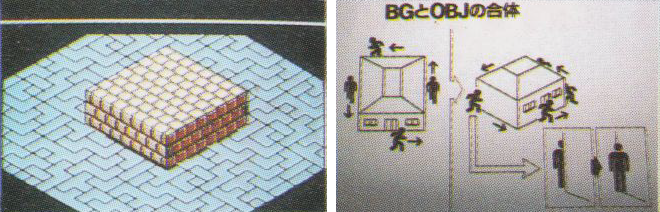
Technical data indicates that the engine was extremely resource-intensive. To maintain a playable frame rate, Naito developed vector-based formulas to represent the diamonds, reducing the processing load on the Mega Drive’s Motorola 68000 CPU. The "520" in the engine’s name originally referred to the planned number of maps, though the final product would eventually balloon to 850 individual maps, equivalent in scale to the Tokyo Dome if laid out on a single monitor.
Narrative Architecture and the "Flexible Scenario" Method
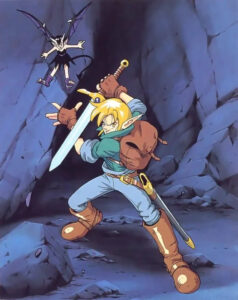
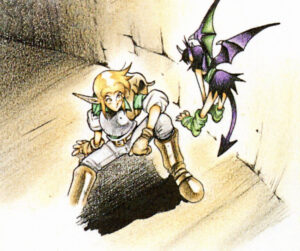
While the technical foundation was being laid, Yoshitaka Tamaki, the game’s graphic designer and writer, was tasked with creating a protagonist that fit an "Indiana Jones" archetype. Tamaki’s early sketches moved away from the traditional high-fantasy hero, settling on Nigel, a forest elf and professional treasure hunter. To provide a mechanical and narrative foil, Tamaki introduced Friday, a small nymph who served as Nigel’s guide and a gameplay mechanic for revival.

The development of the game’s world, Mercator Island, followed what Director Kenji Orimo called the "flexible scenario method." Rather than adhering to a rigid script, the narrative evolved based on the physical maps created by the design team. For instance, the inclusion of Princess Lara was a late-stage decision prompted by a map designer creating a tall tower that required an occupant. This iterative process allowed the world to feel more organic, as characters were often added to populate specific geographical features or architectural structures.
The Role of External Expertise and Matrix Software
A critical turning point in development occurred in the autumn of 1991 with the arrival of Yasuhiro Ohori as external production staff. Ohori, who would later co-found Matrix Software and create the PlayStation classic Alundra, brought a wealth of experience in puzzle design and arcade-style combat.

Ohori’s influence shifted the project toward a more balanced blend of action and platforming. He famously led the staff on "Arcade Game Research" trips to study Capcom’s fantasy fighting games, specifically focusing on monster movement patterns. This research was vital for adapting combat to a diagonal grid. To test spatial relationships and character movement within the 3D environments, the team used a low-tech but effective tool: transparent plastic wrap placed over large-scale grid blueprints, allowing them to manually simulate Nigel’s movement across the isometric terrain.
The "Shining Rogue" Controversy and Internal Friction
One of the most enduring mysteries surrounding Landstalker is its relationship with the Shining series. Internal documents and statements from staff, including sound effects programmer Yasuhiro Taguchi, suggest the game was originally titled Shining Rogue. Early concept art by Tamaki explicitly linked the game to Shining in the Darkness, featuring enemies like the "Chestbeak" and "Kromeball."

However, by the time the game was officially unveiled in June 1992, all references to the Shining series had been removed. Statements from composer Motoaki Takenouchi hinted at "internal frictions" within Climax Entertainment, suggesting a divergence in philosophy between the teams led by Naito and Takahashi. This separation resulted in Landstalker being positioned as a standalone franchise, a move that allowed Naito to lean further into the platforming and puzzle elements that defined the game’s identity.
Auditory Innovation: Motoaki Takenouchi’s Score
The soundtrack for Landstalker, composed by Motoaki Takenouchi, played a significant role in establishing the game’s cinematic atmosphere. A protégé of Dragon Quest composer Koichi Sugiyama, Takenouchi sought to push the Mega Drive’s Yamaha YM2612 sound chip beyond its typical metallic output.
Takenouchi utilized a "music order form" system to coordinate tracks with specific scenarios. He intentionally mixed orchestral arrangements with rhythmic elements, creating a unique soundscape that emphasized the game’s adventurous tone. Notably, for "A Ballad for Princess Loria," Takenouchi reproduced a live piano performance without data compression to ensure the emotional weight of the two-minute in-game event was preserved.
Market Reception and the Legacy of Isometric Design
Upon its release on October 30, 1992, Landstalker was a commercial and critical success in Japan, moving approximately 35,000 units in its first week. Critics praised the depth of its puzzles and the visual fidelity of the DDS520 engine, though some players noted the inherent difficulty of diagonal platforming without a dedicated shadow system to indicate depth.
The game’s legacy is multifaceted. While it never received a direct sequel, its DNA is visible in several follow-up projects:
- Dark Savior (1996): A spiritual successor on the Sega Saturn that utilized a similar isometric perspective.
- Alundra (1997): Developed by Yasuhiro Ohori’s Matrix Software, this title is widely considered the true heir to Landstalker’s puzzle-heavy action-RPG throne.
- Ladystalker (1995): A spinoff for the Super Famicom that adapted the isometric style for Nintendo’s hardware, albeit with modified mechanics.
In 2005, a full 3D remake was announced for the PlayStation Portable (PSP), but the project was eventually canceled, leaving the original 16-bit masterpiece as the definitive version of Nigel’s journey.

Broader Implications for the Industry
The development of Landstalker serves as a case study in the transition from 2D to 3D gaming. It demonstrated that through sophisticated software engineering, developers could transcend the hardware limitations of their era. The DDS520 engine was a precursor to the 32-bit era’s focus on spatial awareness and verticality.
Furthermore, the eventual split between Naito and Takahashi, leading to the formation of Camelot Software Planning, underscored a growing trend in the 1990s: the fragmentation of small, highly talented studios into specialized entities. While Climax Entertainment ceased operations in 2014, Landstalker remains a high-water mark for the Mega Drive library, frequently cited in retrospectives for its uncompromising vision and technical audacity. The game’s continued presence on modern digital storefronts and "mini" consoles ensures that Nigel and Friday’s quest for the treasures of King Nole remains accessible to a new generation of RPG enthusiasts.