Jia Lissa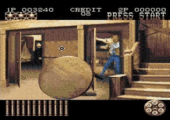
Lethal Enforcers II: Gun Fighters represents a significant milestone in the evolution of the light gun genre, serving as the 1994 successor to Konami’s groundbreaking and controversial 1993 title, Lethal Enforcers. Developed and published by Konami, the sequel transitioned the franchise from the gritty, modern-day urban environments of its predecessor to the unforgiving landscape of the American Old West in 1873. While the fundamental gameplay loop—neutralizing hostile combatants while sparing innocent bystanders—remains intact, the shift in setting, technical execution, and regulatory reception marked a distinct chapter in the history of 16-bit era gaming.
Historical Context and the Regulatory Landscape
The release of the original Lethal Enforcers in 1993 occurred during a period of intense scrutiny regarding video game violence. Alongside titles such as Mortal Kombat and Night Trap, the original game’s use of digitized photographic sprites and realistic firearms became a focal point for United States Congressional hearings. Consequently, the first game carried an MA-17 rating under the Sega Video Rating Council (VRC).
By the time Lethal Enforcers II: Gun Fighters reached home consoles in 1994, Konami opted for a stylized historical setting. This shift from modern "cop-and-robber" scenarios to a "Western" motif seemingly mitigated some of the parental and political concerns of the era. Despite maintaining the core mechanic of shooting human-shaped targets, the sequel was granted an MA-13 rating. This adjustment reflected a broader industry trend where historical or fantasy-based violence was often perceived as less influential on youth than contemporary realistic depictions.
Hardware Integration and the Justifier Peripheral
A defining characteristic of the Lethal Enforcers series on the Sega CD and Genesis platforms was its reliance on the Konami Justifier. This proprietary light gun peripheral was designed to replicate the tactile experience of the arcade original. For the Sega CD version of Lethal Enforcers II, the Justifier remains the optimal method of engagement.
The technology behind the Justifier relies on cathode-ray tube (CRT) timing. The peripheral detects the light from the television’s electron beam to determine the coordinates of the shot. As a result, modern liquid crystal displays (LCD) and light-emitting diode (LED) televisions are incompatible with the original hardware, creating a technological barrier for contemporary collectors. In a professional review of the game’s mechanics, the Justifier demonstrates high levels of accuracy and responsiveness, which are essential given the increased projectile speed and enemy density compared to the first title. While the game supports the standard three-button Genesis controller, the experience is significantly hampered by the slow movement of the on-screen reticle, which often fails to keep pace with the rapid-fire demands of the later stages.
Technical Specifications: Sega CD vs. Genesis
While Lethal Enforcers II: Gun Fighters was released on both the standard Sega Genesis cartridge and the Sega CD add-on, the latter version is widely considered the superior port due to the expanded storage capacity of the CD-ROM format.
The Sega CD’s primary advantage lies in its Pulse Code Modulation (PCM) audio chip. While the Genesis version relied on FM synthesis and heavily compressed voice samples, the Sega CD version features Red Book audio, providing high-fidelity music and crystal-clear voice acting. The soundscape of the 1873 frontier—ranging from the thunderous report of a Gatling gun to the frantic shouts of stagecoach drivers—is rendered with a clarity that rivals the arcade cabinet.
Graphically, however, the Sega CD version remains constrained by the Genesis hardware’s limited color palette. The system’s ability to display only 64 colors simultaneously on screen results in a visual presentation that is noticeably more "dithered" and muted than the arcade’s 256-color display. The digitized sprites, while impressive for the time, lack the sharpness of their arcade counterparts, though the Sega CD’s ability to stream data allowed for smoother transitions between cinematic sequences.
Chronology of Gameplay: A Five-Stage Campaign
The narrative and gameplay progression of Lethal Enforcers II is divided into five distinct stages, each culminating in a complex boss encounter.
Stage 1: The Bank Robbery
The game opens with a classic Western trope: a high-stakes bank heist in progress. Players must navigate the interior of the bank, clearing out outlaws while avoiding bank tellers and patrons. The stage concludes with a confrontation against a boss positioned within a reinforced covered wagon. This encounter introduces a dual-task mechanic where the player must shoot incoming cannonballs out of the air while simultaneously landing shots on the boss. In a two-player cooperative setting, tactical division of labor—where one player focuses on defense and the other on offense—is the most effective strategy.
Stage 2: The Stagecoach Rescue
The second stage shifts the action to a high-speed pursuit. Players must defend a stagecoach and a wagon from mounted bandits. This level emphasizes lateral movement and tracking targets across a moving background. The boss encounter features a villain who utilizes environmental hazards, throwing barrels at the player. The physics-based destruction of the barrels requires precise timing to prevent damage.
Stage 3: The Saloon and the Quick Draw
Moving into the town’s social hub, the third stage requires players to clear a multi-level saloon. The difficulty spikes here due to the presence of "ladies of the evening" who frequently pop into the line of fire, necessitating high-speed target identification. The stage ends not with a traditional health-bar boss, but with a "Quick Draw" duel against three gunmen, testing the player’s raw reaction time.
Stage 4: The Great Train Robbery
The fourth stage takes place on a moving locomotive. Players start at the rear caboose and fight their way toward the engine. The verticality of the train cars and the narrow field of view increase the difficulty. The boss is a demolition expert who hurls sticks of dynamite. Success in this stage depends on the player’s ability to prioritize the destruction of explosives before they reach the foreground.
Stage 5: The OK Mine Company
The final stage leads the player into the subterranean depths of a gold mine. This level departs slightly from the grounded realism of the earlier stages, introducing more frantic and supernatural elements. The final antagonist summons skeletal warriors who use their own heads as projectiles. Strategic analysis of this encounter reveals that shooting the minions is a secondary objective; the player must maintain focus on the main antagonist to deplete his life bar and trigger the final cinematic sequence.
Combat Mechanics and the Ranking System
Konami implemented several mechanical changes in the sequel to differentiate it from the original. Most notably, the "minimum accuracy" requirement found in the first game—which forced players to restart a level if they fell below a certain hit percentage—was removed.
To compensate for the removal of this barrier, the enemy AI was significantly enhanced. Enemies in Lethal Enforcers II feature faster "draw" times, meaning the window between an enemy appearing on screen and firing their weapon is considerably shorter. Furthermore, the game introduces "tougher" enemies who require multiple hits to neutralize. This necessitates a "double-tap" strategy, increasing the consumption of ammunition and the frequency of reloads (performed by shooting off-screen).
The game also features a sophisticated weapon upgrade system. By shooting environmental objects such as lanterns, crates, and signs, players can obtain:
- Dual Pistols: Increased rate of fire.
- Rifles and 50-Caliber Sharps: Higher damage and accuracy.
- Shotguns: A wider spread for clearing groups.
- Gatling Guns: Automatic fire capabilities.
- Cannons: High-impact explosive rounds.
At the conclusion of the campaign, players are evaluated based on their performance. The ranking system serves as the primary metric for player skill, categorized as follows:
- U.S. Marshal: 90% accuracy or higher.
- Deputy Marshal: 80-89% accuracy.
- Sheriff: 70-79% accuracy.
- Deputy: 60-69% accuracy.
- Posse: 59% accuracy and under.
Industry Impact and Legacy
Lethal Enforcers II: Gun Fighters stands as a testament to the peak of the 2D digitized light gun era. Shortly after its release, the industry began a rapid transition toward 3D polygonal graphics, led by titles like Sega’s Virtua Cop and Namco’s Time Crisis. These newer titles offered dynamic camera angles and cover systems that made the static, "gallery-style" shooting of Lethal Enforcers appear dated.
However, within the context of the Sega CD library, Lethal Enforcers II remains a high-water mark for arcade-to-home conversions. It successfully utilized the CD format to bridge the gap between the audio-visual limitations of home consoles and the premium experience of the arcade. For historians of the medium, the game represents the end of an era—a final, polished stand for the digitized sprite aesthetic that defined early 90s gaming. Its legacy persists among retro gaming enthusiasts who maintain CRT televisions specifically to experience the precision of the Justifier and the unforgiving challenge of Konami’s vision of the American West.