Jia Lissa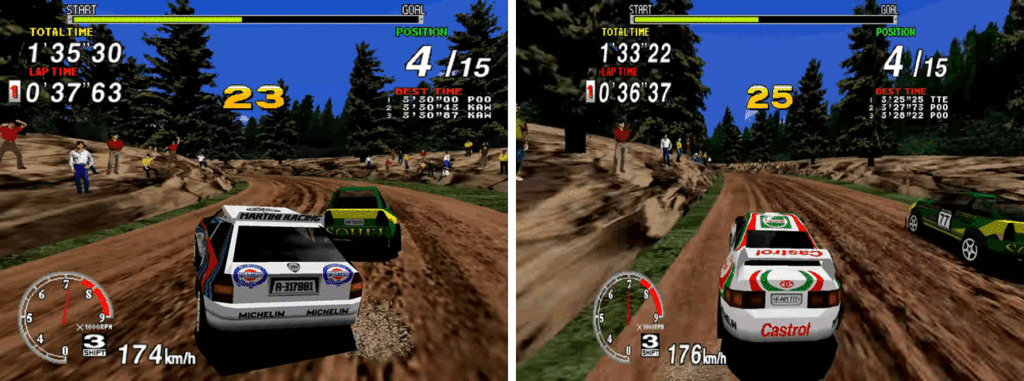
During the 1990s, the video game industry was defined by high-stakes rivalries, most notably the console war between Sega and Nintendo. However, a parallel conflict was unfolding in the arcade sector, where Sega and Namco were locked in a fierce technological arms race to define the future of 3D racing. While Namco’s Ridge Racer and Sega’s Daytona USA established the baseline for high-speed urban and stock car racing, it was the 1995 release of Sega Rally Championship that fundamentally altered the trajectory of the genre. By introducing complex surface physics and a distinct European aesthetic, Sega Rally Championship became a landmark title that leveraged the cutting-edge Model 2 arcade hardware to create an experience that was both technically revolutionary and emotionally resonant.
The Genesis of 3D Innovation at Sega
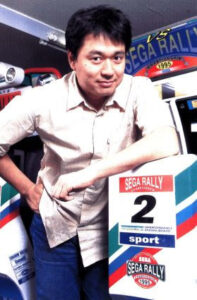
The transition from 2D sprites to 3D polygons in the early 1990s represented a seismic shift for arcade developers. Sega, aiming to maintain its dominance in the coin-op market, invested heavily in internal research and development. This era saw the rise of Tetsuya Mizuguchi, a visionary producer whose entry into the company was marked by an unconventional ambition. Mizuguchi joined Sega in 1989 after a bold pitch to R&D head Hisashi Suzuki, claiming that the future of entertainment lay in 3D computer graphics (CG) and virtual reality (VR).
Mizuguchi’s early work focused on large-scale "taikan" or "body sensation" games, specifically the AS-1 Simulator. This project served as a training ground for Sega’s high-end 3D studio, which Mizuguchi dubbed the "Emotion Design Lab." His goal was to move beyond mere technical proficiency and create games that could evoke the same emotional response as cinema. To achieve this, Mizuguchi secured a massive budget of approximately 100 million yen ($1,000,000) for Silicon Graphics workstations and Softimage software, a significant investment for a team led by a producer with no prior programming experience.
The Convergence of Talent: Sasaki and the Model 2 Board
The development of Sega Rally Championship was catalyzed by the arrival of the Model 2 arcade board. A collaboration between Sega and GE Aerospace, the Model 2 was a technological marvel capable of pushing 500,000 polygons per second—nearly triple the capacity of the previous Model 1 hardware. It introduced advanced features such as texture filtering, anti-aliasing, and trilinear filtering, allowing for unprecedented visual fidelity.
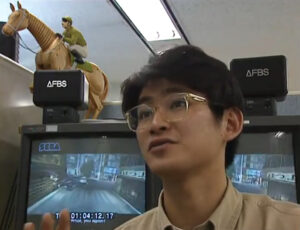
To lead the project, Mizuguchi recruited Kenji Sasaki, who had recently departed Namco after directing the genre-defining Ridge Racer. Sasaki brought a wealth of experience in 3D data creation but initially harbored reservations about returning to the racing genre. He felt the market was becoming saturated following the success of Daytona USA. However, the potential of the Model 2 board and the opportunity to work within Sega’s larger, better-resourced development environment eventually won him over. Sasaki was joined by Sohei Yamamoto, an AM3 veteran and "genius-level" programmer whose technical expertise was essential in taming the "temperamental" Model 2 hardware.
From California to Kenya: A Shift in Concept
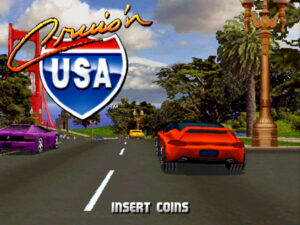
The project was initially conceived under the working title Rally California, with a design inspired by cross-country racers like OutRun and Cannonball Run. However, the announcement of Midway’s Cruis’n USA forced the team to pivot. Recognizing that a direct competitor was already targeting the American cross-country niche, Mizuguchi and Sasaki decided to focus on World Rally Championship (WRC) racing, a sport that was immensely popular in Europe but relatively underserved in the Japanese and American arcade markets.
To ensure authenticity, the team embarked on a two-week, 1,200-mile research trip across the United States, from Mexico City to Yosemite National Park. This journey was critical for capturing the "dry air" and immense scale of the Western landscapes, which the Japanese designers had previously struggled to replicate from photographs alone. The team took over 4,000 photos and extensive video footage, which served as the primary reference for the game’s textures and track layouts.
Technical Ingenuity and Hardware Constraints
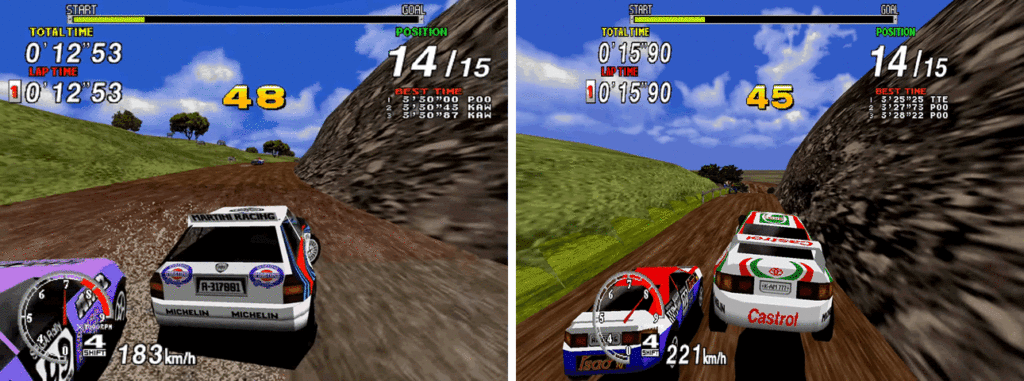
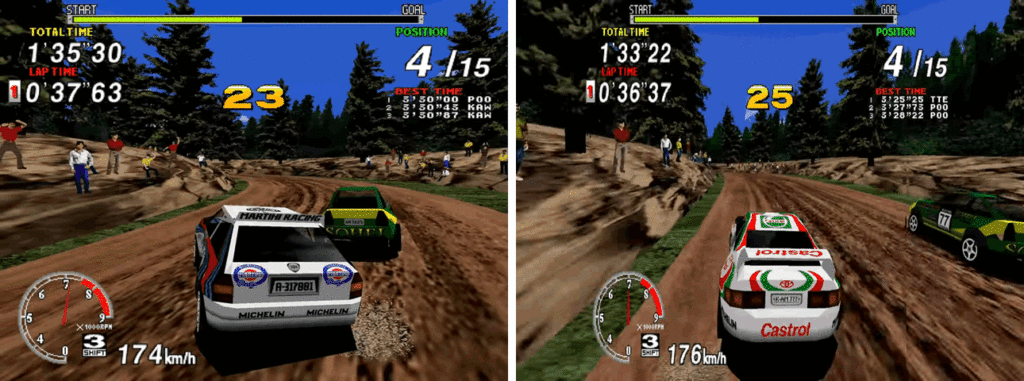
Despite the power of the Model 2, the team faced significant hurdles. The hardware did not support Gouraud shading, which made rendering smooth curves on car bodies difficult. To circumvent this, the team used clever texturing techniques to create the illusion of roundness on flat polygons. For instance, the tires on the Lancia Delta and Toyota Celica were actually octagons, but they appeared perfectly circular in motion due to the applied textures.
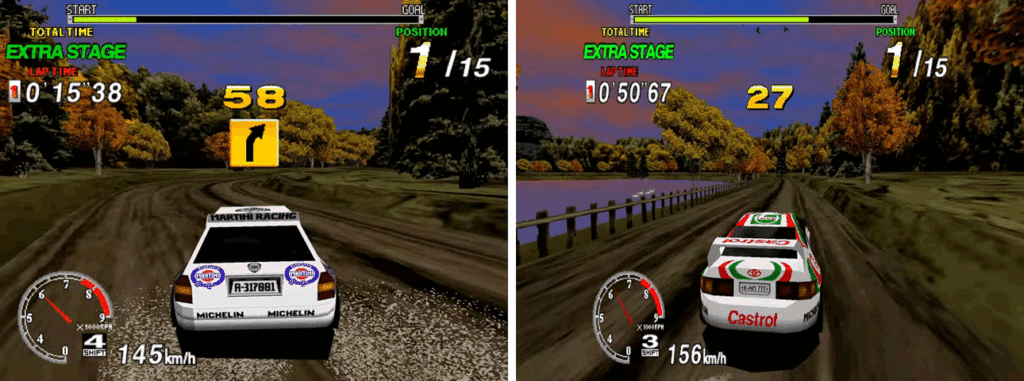
The core gameplay innovation of Sega Rally Championship was its emphasis on surface physics. Unlike previous racers that treated all tracks as uniform surfaces, Sega Rally simulated the differences between asphalt, gravel, and mud. This necessitated the development of a sophisticated drifting mechanic. Kenji Sasaki designed the handling to be accessible yet deep, allowing players to utilize real-world techniques like gear drifting and weight shifting to navigate tight corners.
Licensing and Realism: Securing the Legends
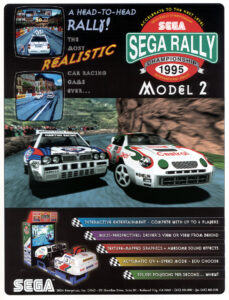
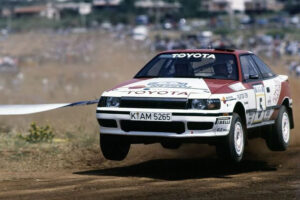
Sega Rally Championship is often cited as the first video game to feature officially licensed vehicles. Mizuguchi was determined to include the Toyota Celica ST205 and the Lancia Delta HF Integrale, two icons of the WRC. Securing these licenses was a grueling process; Toyota initially dismissed the video game industry as having no publicity value. However, upon seeing the 3D rendered models and the fidelity of the simulation, Toyota’s management relented.
To capture the audio profile of these machines, the team visited the Maruwa Autoland Nasu dirt track. Composer Tomoyuki Kawamura recorded engine idles, revs, and exhaust notes from WRC-spec cars. Mizuguchi himself participated in the test drives, even crashing a rally-prepped Celica while attempting a high-speed drift. This firsthand experience was vital in translating the physical sensation of rally racing into the arcade cabinet’s force-feedback steering wheel and the "Active Shock Generator" (ASG) seat vibration system.
The Iconic Soundscape of Takenobu Mitsuyoshi
The game’s audio identity was further cemented by Takenobu Mitsuyoshi, the composer behind Daytona USA. Mitsuyoshi’s contribution included the now-legendary "Game Over, YEAH!" jingle. He utilized the Model 2’s improved sampling capabilities to record full vocal phrases rather than the fragmented segments used in previous titles. This jingle became a cultural touchstone for arcade gamers, turning a moment of failure into a memorable and positive experience. The soundtrack, a blend of high-energy rock and synth-fusion, perfectly complemented the frantic pace of the off-road stages.
Arcade Variants and the "Special Stage" Attraction
Sega Rally Championship was released in several cabinet formats, including the standard upright, the Twin unit, and the high-end Deluxe version. The Deluxe cabinet featured a miniature Celica shell that pitched and rolled, providing a rudimentary motion simulation.
However, the most ambitious iteration was the Special Stage version, exclusive to Sega’s Shinjuku Joypolis. This attraction utilized full-sized Toyota Celica cars mounted on a six-axis motion base, the first of its kind for a Sega attraction. The windshield was replaced with a projection screen, creating an immersive simulator that reacted to every player input. While the Shinjuku Joypolis closed in 2000 and no Special Stage units are known to survive, the technology pioneered for the ride influenced future Sega simulators, including Sega Touring Car Championship Special.
Legacy and Impact on the Racing Genre
Upon its release in February 1995, Sega Rally Championship was an immediate success, selling approximately 12,000 units in Japan. Its popularity ensured a high-profile port to the Sega Saturn in 1996. While the Saturn version required compromises in resolution and frame rate, it was praised for its near-perfect recreation of the arcade handling. The home version added a Time Attack mode and a secret unlockable car, the Lancia Stratos, which further extended the game’s longevity.
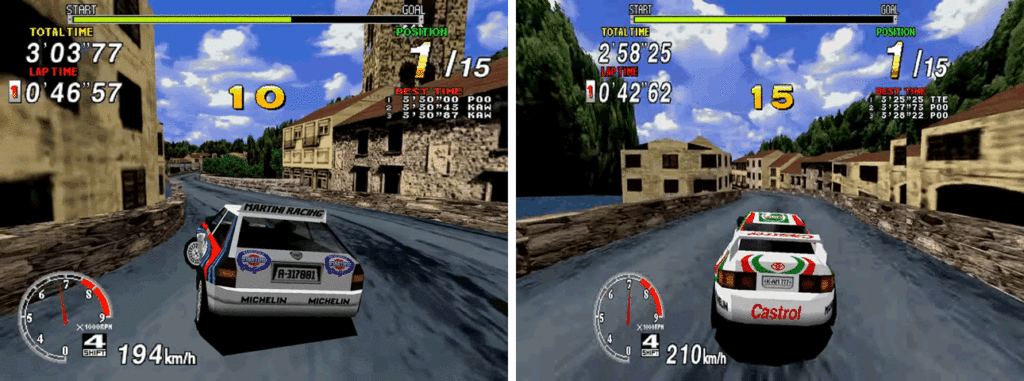
The impact of Sega Rally extended beyond Sega’s own ecosystem. Guy Wilday, the producer of the original Colin McRae Rally at Codemasters, noted that the car handling in Sega Rally served as the foundational benchmark for their own simulation. The game’s focus on surface-specific physics and accessible drifting became the blueprint for the modern rally sub-genre.
Conclusion and Analysis of the "Mizuguchi Method"
The success of Sega Rally Championship validated Tetsuya Mizuguchi’s philosophy of "Emotion Design." By blending technical excellence with a deep appreciation for the atmosphere and culture of the sport, AM3 created a title that transcended the typical arcade experience. It was not merely a game about speed; it was a game about the tactile relationship between the driver, the machine, and the terrain.
For Mizuguchi, the project served as a springboard for a career defined by innovation. He would go on to form AM Annex (later United Game Artists), where he developed avant-garde titles like Rez and Space Channel 5. However, Sega Rally Championship remains his most commercially significant contribution to the arcade landscape. It proved that a young, inexperienced team could challenge the industry’s established giants by prioritizing research, camaraderie, and a willingness to embrace the emotional potential of technology. Three decades later, the game’s enduring popularity in retro-gaming circles and its influence on modern racing titles confirm its status as a masterpiece of 3D game design.