
 Jia Lissa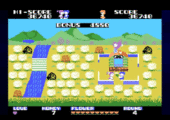
Sega Enterprises’ 1985 release of Girl’s Garden for the SG-1000 console represents a pivotal moment in the early history of home console development, marking the professional debut of Yuji Naka, the visionary programmer who would later create Sonic the Hedgehog. Released during an era when the home video game market was still recovering from the 1983 industry crash in the West and facing stiff competition from Nintendo’s Famicom in Japan, Girl’s Garden stood out as a technically ambitious and thematically unique title. It was specifically commissioned by Sega management to broaden the appeal of their first home console by targeting a female demographic, a strategic move that was relatively rare in the mid-1980s.
The game centers on a young protagonist named Papri, who must navigate a series of outdoor environments to collect flowers for her love interest, Minto. This narrative framework serves as the backdrop for a sophisticated action-puzzle experience that pushed the limited hardware of the SG-1000 to its absolute boundaries. Through its innovative use of visual storytelling, technical graphical feats, and a multi-layered soundtrack, Girl’s Garden established a blueprint for the high-quality internal development that would eventually define Sega’s golden era.
Technical Innovation and Hardware Utilization
At the time of the development of Girl’s Garden, the SG-1000 utilized the Texas Instruments TMS9918A Video Display Processor (VDP), a chip also found in the ColecoVision and MSX computers. This hardware was notoriously restrictive, particularly regarding sprite handling and color palettes. The system was limited to a single color per sprite, and placing more than four sprites on a single horizontal line would cause significant flickering.
Despite these constraints, the development team, led by Yuji Naka and programmer Hiroshi Kawaguchi, implemented several advanced techniques. Most notable among these was the inclusion of parallax scrolling. By manipulating the background tiles and the scroll rate of different screen elements, the developers created an illusion of depth—a feature rarely seen on 8-bit hardware prior to the mid-to-late 1980s. The clouds in the background move at a different speed than the foreground elements, providing a sense of scale and movement that was far ahead of contemporary titles like Donkey Kong or Pitfall!.
Furthermore, the game utilizes a specialized mode of the VDP to handle "Challenging Stages." In these segments, the system displays sprites at four times their standard size. While this increased the hitbox and difficulty for the player, it demonstrated a mastery of the hardware’s registers that few other SG-1000 developers had achieved. The visual fidelity of the title screen, which features multi-colored sprites and complex tile-based artwork, served as a technical showcase for Sega’s internal capabilities.
Gameplay Mechanics and Narrative Strategy
The core loop of Girl’s Garden involves Papri collecting exactly ten blooming flowers within a strict time limit to win the affection of Minto. The game introduces a rivalry mechanic in the form of Cocco, another girl who is also pursuing Minto. This conflict is visualized through a progress bar at the bottom of the screen: as time passes, Minto is shown walking away from Papri and toward Cocco. If the player fails to deliver the flowers before Minto reaches Cocco, the round is lost.
The flowers themselves go through a six-stage growth cycle. Players must harvest them only when they are in full bloom. Harvesting a wilted flower or a budding one results in a penalty, often reducing the player’s current flower count by half. This requires the player to manage both their movement and their timing, adding a layer of strategy to the basic navigation.
Environmental hazards include bears that patrol the garden, water hazards, and bees. While the bees occasionally drop helpful items like extra lives or instant-complete bouquets, they can also drop skulls that act as traps. The bears serve as the primary antagonists; they can be distracted by honey pots that Papri drops, but their movement patterns become increasingly aggressive in later stages. The loss of life is handled with a degree of character-driven animation—Papri bursts into tears—which provided a more emotive experience than the abstract "death" animations of the era.
Chronology of Development and Release
The development of Girl’s Garden began in late 1984. Sega, seeking to differentiate its software library from the arcade-heavy ports that dominated the SG-1000, tasked its new recruits with creating something "cute" and "appealing to girls."
- Late 1984: Yuji Naka joins Sega and is assigned to the project. Hiroshi Kawaguchi, who would later become a legendary composer for titles like After Burner and OutRun, is assigned as a programmer.
- Early 1985: The game undergoes internal testing. Sega executives are reportedly impressed by the technical polish, particularly the scrolling effects and the music.
- February 1985: Girl’s Garden is officially released on the SG-1000 in Japan.
- 1985-1986: The game is ported to the Sega Mark III (the Japanese successor to the SG-1000), though it maintains the original’s technical specifications, leading to a slightly darker color palette on the newer hardware.
- 2016: The game receives a modern revival as part of the "Sega 3D Reprint Archives 3: Final Stage" for the Nintendo 3DS, marking one of the few times the title has been officially re-released in a digital format.
Historical Context: The Debut of Industry Icons
The significance of Girl’s Garden is amplified by the subsequent careers of its creators. Yuji Naka’s work on this title was his first step toward becoming one of the most influential figures in the industry. His ability to extract high performance from limited hardware, a trait evident in Girl’s Garden, would later allow him to create the high-speed scrolling of Sonic the Hedgehog on the Sega Genesis.
Hiroshi Kawaguchi’s involvement is also noteworthy. While he is primarily known as a composer, his role as a programmer on this project gave him a deep understanding of the hardware’s sound chips. This knowledge eventually translated into the iconic soundtracks of Sega’s 1980s arcade hits. The music in Girl’s Garden, composed by Tohru Nakabayashi and Katsuhiro Hayashi, includes a digital rendition of Felix Mendelssohn’s "Wedding March," showcasing an early commitment to melodic, high-quality game audio.
Market Analysis and Industry Implications
Girl’s Garden was part of a broader industry trend in the mid-80s to identify and capture the "non-gamer" market. In the United States, companies like Activision and Sierra were experimenting with "Hi-Res Adventure" games and educational titles, but in Japan, the focus remained on action-oriented gameplay with "kawaii" (cute) aesthetics.
By modern standards, the game’s premise—a girl fighting for a boy’s attention—might be seen through a different cultural lens, but in 1985, it represented a significant expansion of gaming themes. It moved away from the "space marine" or "martial artist" tropes that defined the arcade era. The success of Girl’s Garden internally at Sega proved that there was a market for character-driven, narrative-lite experiences on home consoles.
The game also highlighted the transition of Sega from a hardware-first company to a software powerhouse. While the SG-1000 was ultimately outsold by the Nintendo Famicom, games like Girl’s Garden demonstrated that Sega’s internal R&D (Research and Development) teams were capable of matching or exceeding the technical quality of Nintendo’s first-party titles.
Legacy and Modern Reception
Decades after its release, Girl’s Garden is regarded by retro gaming historians as a "hidden gem" of the 8-bit era. It serves as a case study in how creative constraints can lead to technical breakthroughs. The game’s legacy is preserved not just through its connection to Yuji Naka, but as a testament to the creativity of Sega’s early development culture.
For collectors and enthusiasts, the original SG-1000 cartridge remains a sought-after item. Its inclusion in the Nintendo 3DS Sega Archives brought the game to a Western audience for the first time officially, allowing a new generation to experience the origins of Sega’s design philosophy. The game’s blend of charm, technical sophistication, and historical importance ensures its place in the annals of video game history.
In conclusion, Girl’s Garden was more than a simple "girls’ game." It was a sophisticated technical achievement that introduced the world to some of the most talented creators in the medium. It proved that the SG-1000, despite its limitations, could deliver experiences filled with personality and polish, setting the stage for Sega’s eventual rise as a global leader in the video game industry.








