Jia Lissa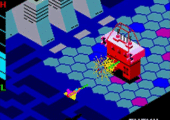
Released in 1982 by Sega, Zaxxon stands as a seminal achievement in the history of the shoot ’em up (shmup) genre, marking the first time a video game successfully utilized axonometric projection to create a three-dimensional play environment. Developed and published by Sega, with distribution in North America handled by Gremlin Industries, the title broke away from the traditional vertical and side-scrolling constraints of the era. By introducing an isometric perspective, Zaxxon provided a simulated 3D flight experience that required players to manage not only their horizontal and vertical positioning but also their altitude. This technical innovation, while visually stunning for the early 1980s, introduced a level of mechanical complexity and difficulty that challenged even the most seasoned arcade enthusiasts.
Technical Innovation and the Isometric Shift
The primary differentiator for Zaxxon was its visual presentation. In an era dominated by flat, two-dimensional planes—exemplified by titles such as Defender, Galaxian, and Stargate—Zaxxon utilized a fixed 45-degree angle to provide a sense of depth. This "isometric" viewpoint allowed the game to render shadows on the ground, which served as a critical visual cue for players to determine their ship’s height relative to obstacles and enemies.
Under the hood, the arcade cabinet was powered by the Sega G-80 hardware system. This platform utilized the Zilog Z80 microprocessor, a staple of early 1980s computing, but pushed the hardware to its limits to render the detailed, scrolling environments of the space fortress. The game’s ability to display multiple moving sprites across a pseudo-3D plane was a significant leap forward in graphical processing, influencing the industry’s approach to environmental design for years to come.
Gameplay Mechanics and the Altitude Challenge
Zaxxon placed players in the cockpit of a fighter craft tasked with infiltrating a heavily fortified space station and a subsequent asteroid base. Unlike its predecessors, the game utilized a specialized flight stick controller rather than a standard four-way or eight-way joystick. This control scheme was designed to mimic the feel of an actual aircraft, where pulling back on the stick caused the ship to climb and pushing forward caused it to descend.
The introduction of the Z-axis (altitude) added a layer of tactical depth that was entirely new to the genre. Players were required to navigate through narrow gaps in walls, fly over electronic barriers, and dodge surface-to-air missiles. An altitude meter on the left side of the screen provided a numerical representation of the ship’s height, ranging from zero to 2.5 units. Mastering this meter was essential for survival, as miscalculating a gap by even a fraction would result in an immediate collision.
Furthermore, the game introduced a fuel management system that acted as a constant timer. The player’s fuel reserves would steadily deplete throughout the mission, forcing them to target and destroy fuel tanks located on the base’s surface to replenish their supply. This mechanic created a risk-reward dynamic: players had to choose between staying at a safe altitude to avoid fire or diving toward the ground to secure fuel, often placing them in the direct path of enemy turrets and radar dishes.
Chronology of Development and Release
The development of Zaxxon occurred during the peak of the "Golden Age" of arcade games. Sega, seeking to differentiate itself in an increasingly crowded market, focused on high-fidelity visuals and unique control schemes.
- April 1982: Zaxxon is released in Japanese arcades. It immediately garners attention for its unique "3D" look.
- Summer 1982: Gremlin/Sega releases the game in North America. It becomes a massive commercial success, with Sega reportedly selling over 5,000 units in the first few months of distribution.
- 1982–1984: Following the arcade success, Zaxxon was ported to nearly every major home console and computer system of the time, including the Atari 2600, ColecoVision, Intellivision, and Commodore 64. The ColecoVision version was particularly noted for its graphical fidelity, serving as a "killer app" for the console.
- 1983: Sega releases Super Zaxxon, a sequel that increased the game’s speed and difficulty while introducing new enemy types.
- 1987: Zaxxon 3-D is released for the Sega Master System, utilizing the SegaScope 3-D glasses to provide true stereoscopic depth.
- 1995: Zaxxon’s Motherbase 2000 is released for the Sega 32X, attempting to modernize the franchise with polygonal graphics, though it failed to achieve the cultural impact of the original.
Commercial Performance and Industry Impact
Zaxxon was a significant financial driver for Sega during the early 1980s. According to historical sales data from the era, the game was a top-earner in arcade rooms across North America and Europe. Its success proved that players were willing to engage with more complex control schemes and perspectives if the visual payoff was sufficiently impressive.
The game’s influence extended far beyond the shmup genre. The use of isometric projection in Zaxxon paved the way for future titles across various genres that sought to simulate 3D space on 2D hardware. Games like SimCity, Paperboy, and the Strike series (such as Desert Strike) owe a technical debt to the groundwork laid by Sega’s engineers in 1982.
Industry analysts of the time noted that Zaxxon was one of the first games to successfully bridge the gap between "twitch" gaming and "simulation" gaming. By incorporating flight physics and resource management, it appealed to a slightly older demographic of arcade-goers who were looking for more than just the pattern-recognition gameplay found in titles like Pac-Man.
Critical Reception and Retrospective Analysis
At the time of its release, Zaxxon received high marks for its presentation. Electronic Games magazine praised the title for its "stunning 3D effects," noting that it was one of the most visually impressive games on the market. However, even in 1982, critics pointed out the steep learning curve. The difficulty of judging the ship’s position in three-dimensional space using two-dimensional sprites led to a degree of frustration that became a hallmark of the Zaxxon experience.
In modern retrospective analysis, Zaxxon is often cited as a "hard-as-nails" classic. While the isometric view was innovative, it created inherent perspective issues. Because the game used sprites that merely changed size or position to simulate depth, players often found it difficult to tell if their shots were aligned with enemy planes. This led to a reliance on "shadow-tracking"—watching the shadow of the player’s ship on the ground to determine its true position—a technique that became mandatory for high-score seekers.
The game’s structure, consisting of three primary phases—the outer space fortress, the vacuum of space, and the final boss encounter with the Zaxxon robot—was relatively short. However, the high difficulty meant that few players could reach the end on a single quarter. The final confrontation with the Zaxxon robot was particularly notable as one of the earliest examples of a distinct "boss battle" in an isometric shooter.
Broader Implications and Legacy
The legacy of Zaxxon is multifaceted. On one hand, it represents the peak of Sega’s early 1980s creativity, showcasing a willingness to experiment with hardware and perspective. On the other hand, it serves as a reminder of the limitations of pseudo-3D technology. As true 3D polygonal rendering became the industry standard in the 1990s, the need for isometric workarounds vanished, and the Zaxxon franchise struggled to find its place in a world of full 360-degree movement.
Despite the franchise’s eventual dormancy, the original Zaxxon remains a fixture in retro gaming collections. It has been re-released on the Sega Genesis Collection for modern consoles, the Nintendo Wii Virtual Console (in 2010), and as part of the Arcade Archives series. These modern iterations, however, often highlight the importance of the original hardware. The original arcade flight stick provided a tactile feedback and precision that modern D-pads and analog sticks struggle to replicate, often making the home versions feel more difficult than the arcade original.
In conclusion, Zaxxon was more than just a shooter; it was a technical manifesto. It challenged the industry to think outside the two-dimensional box and provided a glimpse into the future of 3D gaming. While its unforgiving difficulty and perspective quirks may polarize modern audiences, its historical significance as the pioneer of isometric gameplay remains undisputed. For the arcade industry of 1982, Zaxxon was the definitive proof that the sky—and the third dimension—was no longer the limit.