Jia Lissa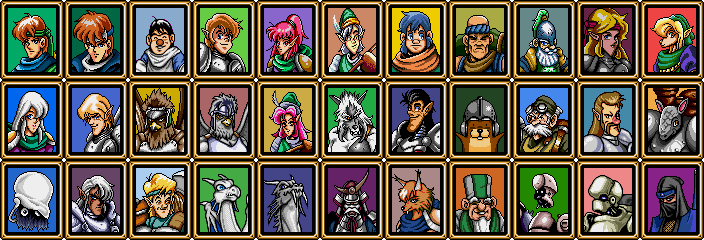
The release of Shining in the Darkness in March 1991 marked a pivotal moment for Sega and the independent developer Climax, proving that role-playing games (RPGs) could find a substantial audience on the Mega Drive and Genesis consoles. While fans anticipated a direct sequel to the successful dungeon crawler, the creative leadership at Climax, led by Hiroyuki Takahashi, envisioned a more ambitious expansion of the world of Rune. This vision would eventually manifest as Shining Force, a title that would not only redefine the tactical RPG genre but also establish a multi-decade franchise. However, the path to its creation was marked by technical hurdles, internal creative divisions, and a deteriorating relationship between Climax and Sega that would eventually reshape the landscape of 16-bit gaming.
The Strategic Shift: Redefining the Console RPG
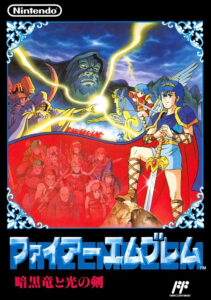
In the early 1990s, the RPG market was dominated by turn-based, menu-driven titles like Dragon Quest and Final Fantasy. While these games were immensely popular in Japan, Takahashi felt the genre was becoming stagnant. He sought to evolve the combat experience by introducing spatial dynamics—the concept of distance, terrain, and formation. Despite the popular belief that Nintendo’s Fire Emblem (1990) served as a template, Takahashi has historically maintained that he found the pacing of that title insufficient. Instead, his primary inspiration was the 1988 PC88 title Silver Ghost by Kure Software Koubou, which emphasized managing multiple characters in a more fluid, real-time environment.
Takahashi’s goal was to combine the narrative depth of a traditional RPG with the tactical complexity of a simulation game. This was a significant risk; at the time, strategy games were largely confined to the PC market and were often viewed as too cumbersome for console players. Within Climax, this shift caused friction. Directors Kenji Orimo and Yasuhiro Taguchi were initially skeptical, fearing that a departure from the first-person dungeon-crawling of Shining in the Darkness would alienate their newfound fan base. They advocated for a more traditional focus on plot and character interaction over complex battle maps.
The Formation of Sonic Co. and the Sega Partnership
To manage the increasing complexity of RPG development, Takahashi proposed a new collaborative model to Sega. This led to the founding of Sonic Co., Ltd. in June 1991. The venture was capitalized with 40 million yen, with Sega holding an 85 percent majority stake, Climax holding 6.25 percent, and Takahashi personally holding 4 percent. The company was named after Sega’s burgeoning mascot, Sonic the Hedgehog, following a suggestion by Sega CEO Hayao Nakayama.
Sonic Co. was designed to serve as a production hub, recruiting specialists from the manga and anime industries to ensure that game narratives and character designs met a high artistic standard. This allowed Climax to run multiple projects simultaneously. While Takahashi’s team focused on Shining Force, another unit led by Yasuhiro Naitō began work on Landstalker, utilizing the proprietary Diamond Shaped Dimension System (DDS520) to create an isometric perspective. This organizational structure was meant to professionalize the development process, but it also placed Climax under tighter corporate scrutiny from Sega.
Technical Innovation and the 12-Megabit Hurdle
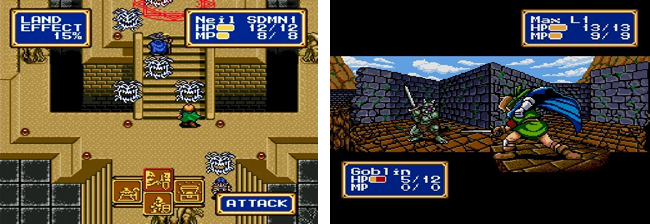
Shining Force was a massive undertaking for its time. While most Genesis games fit on four- or eight-megabit cartridges, the ambition of Shining Force required a 12-megabit ROM—the largest ever produced for the system at that point. The primary consumer of this data was the game’s cinematic battle sequences. Unlike other tactical games of the era that used small, static sprites, Takahashi insisted on full-screen, animated combat scenes.
This technical requirement forced programmer Yoshinori Tagawa to develop advanced compression routines. Standard compression at the time typically yielded a 50 percent reduction in file size, but Climax’s team managed to compress data to an unprecedented 22 percent of its original size. This allowed the game to feature over 30 playable characters and a wide array of unique enemies, each with distinct attack animations and promotional classes.
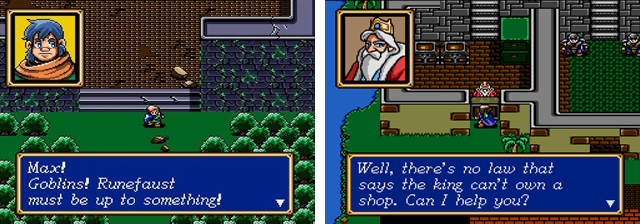
The development team also focused heavily on enemy artificial intelligence (AI). To avoid the "sluggish" feel of PC strategy games, the AI was programmed to calculate moves in under one second. The resulting "mixed battle" system, where turn order was determined by an agility stat rather than a strictly phased player-vs-enemy turn, made the combat feel more dynamic and less predictable than its contemporaries.
Artistic Vision and the World of Rune
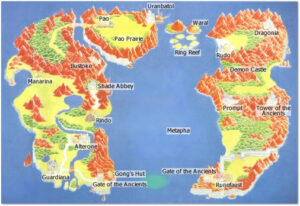
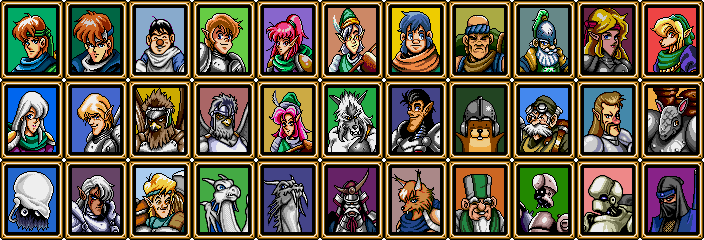
Character designer Yoshitaka Tamaki played a crucial role in shifting the visual tone of the series. While Shining in the Darkness utilized a Western-influenced "Disney-like" aesthetic to appeal to international audiences, Shining Force adopted a more realistic, albeit still fantasy-oriented, manga style. Tamaki’s designs for the 30-member "Force" included a diverse array of races—centaurs, birdmen, giants, and dragons—populating the continents of East and West Rune.
The game’s protagonist, Max, followed the tradition of the "silent hero," a choice intended to increase player immersion. However, the supporting cast was where the game’s personality truly shone. One of the most famous inclusions was Jogurt (Yogurt in Japan), a hamster-like creature that began as a graphics test using the face of director Kenji Orimo. Despite having no combat utility, the character became an in-house joke and eventually a fan-favorite mascot for the series.
The narrative, written by Masaki Wachi, served as a prequel to the events of Shining in the Darkness. By establishing a shared lore involving the villain Darksol and the resurrection of the Dark Dragon, Climax created a cohesive universe that rewarded long-term fans while remaining accessible to newcomers.
Sound Design and the Mystery of Masahiko Yoshimura
The soundtrack was composed by Masahiko Yoshimura, who had previously scored Shining in the Darkness. His work on Shining Force was characterized by a noble, orchestral tone that pushed the Genesis’s FM synthesis hardware to its limits. Yoshimura was known for his dissatisfaction with the console’s internal sound chip, often recording orchestrated versions of his tracks for separate CD releases to show how he intended the music to sound.
Following the completion of Shining Force, Yoshimura’s involvement with the series abruptly ended. Subsequent titles were scored by Motoaki Takenouchi. While no official reason was ever given for his departure, industry analysts suggest that Yoshimura’s perfectionism and frustration with hardware limitations may have led him to move away from game composition, as he became an increasingly enigmatic figure in the years that followed.
Marketing, Launch, and Global Reception
Sega’s marketing for Shining Force was aggressive, particularly in Japan. A high-budget television commercial featuring professional models and miniature sets was produced to showcase the game’s cinematic battles. On February 9 and 16, 1992, Famitsu magazine hosted "Shining Force First Party" events in Tokyo and Osaka, allowing hundreds of fans to demo the game weeks before its official launch.
The game was released in Japan on March 27, 1992, and arrived in North America and Europe nearly a year later. Despite universal critical acclaim and its eventual status as a "seminal" title, sales figures remained a point of contention. Estimates suggest the game sold approximately 200,000 units worldwide. While respectable, this was lower than the sales of its predecessor. Analysts attribute this to the niche nature of strategy RPGs in the West at the time and the confusion caused by the radical change in gameplay style between the two entries.

Corporate Fracture and the Legacy of Climax
Behind the scenes, the relationship between Climax and Sega was fracturing. Takahashi later revealed that as Sega grew into a global powerhouse, its corporate culture shifted. New management viewed Climax as an "unruly subsidiary," and the budgets for their projects remained stagnant despite their commercial success. The friction reached a breaking point during the Saturn era, culminating in the truncated Western release of Shining Force III, which saw only one of its three scenarios localized for North America.
Ultimately, the Dreamcast became the only major Sega platform not to receive a mainline Shining Force entry, a testament to the total breakdown in the partnership. Climax eventually transitioned to developing for other platforms, such as the PlayStation and Dreamcast (with Time Stalkers), before the original team dispersed.
Despite these internal struggles, the impact of Shining Force is undeniable. It pioneered the "console-style" tactical RPG, blending accessible mechanics with deep narrative stakes. Its influence can be seen in modern franchises like Fire Emblem and Final Fantasy Tactics, which adopted many of the UI and pacing innovations first seen in the lands of Rune. Today, the game remains a staple of Sega’s retro collections, consistently cited as one of the greatest titles of the 16-bit era and a masterclass in overcoming technical limitations through creative engineering.