 Jia Lissa
The landscape of 8-bit home console gaming in the late 1980s was defined by rapid iteration and the pursuit of arcade-perfect experiences. Central to this era was the evolution of the block-breaking genre, a staple of the arcade industry since the release of Atari’s Breakout in 1976. By 1987, the genre had been significantly redefined by Taito’s Arkanoid, a title that introduced power-ups, enemy encounters, and a distinct aesthetic. In a competitive move to bring this arcade dynamism to the Sega Mark III—known internationally as the Master System—Sega released Woody Pop: Shinjinrui no Block Kuzugi. This title was not merely a software release but a hardware-dependent experience, bundled with a dedicated paddle controller that sought to replicate the high-precision analog input required for the genre.
The Evolution of Input Precision
The reliance on paddle controllers during the Atari 2600 era established a gold standard for block-breaking games. Unlike digital D-pads, which operate on binary on/off inputs, paddle controllers utilize potentiometers to convert rotational movement into variable voltage signals. This mechanism allows for granular control over the on-screen paddle, essential for managing high-velocity projectiles. Games such as Astroblast, Kaboom!, and Warlords thrived due to this hardware.
As the industry transitioned to the Nintendo Entertainment System (NES) and the Sega Master System, the standard inclusion of digital controllers created a functional barrier for arcade ports. When Taito ported Arkanoid to the Famicom, they were forced to bundle their own proprietary controller, a move that limited the game’s adoption to a niche audience. Sega followed this trajectory with the Mark III, releasing two distinct hardware packages in 1987: one featuring Woody Pop on a My Card, and another featuring Alex Kidd BMX Trial on a 1Mb Gold Cartridge. While the paddle controller supported seven games on the Japanese Mark III, it remained absent from Western markets, effectively isolating these titles from global players.
Technical Specifications and Development Strategy
Woody Pop represents a curious intersection of Sega’s arcade-centric design philosophy and the limitations of the Mark III’s hardware. Released as the final Sega My Card for the system, the game attempted to modernize the Arkanoid formula through several mechanical adjustments.
Technically, the game introduced visual feedback for destructible environments, specifically utilizing cracked-brick animations to indicate structural integrity—a feature notably absent in the original Arkanoid. Furthermore, the inclusion of branching paths at the conclusion of stages introduced a rudimentary form of non-linearity, allowing players to select different rooms that varied in both difficulty and potential point rewards.
Despite these additions, the game faced significant architectural challenges. The transition from the vertical, high-aspect-ratio arcade cabinets of the mid-80s to the 4:3 horizontal orientation of home television sets fundamentally altered the game’s difficulty curve. To fill the wider playfield, Sega increased the velocity of the projectile, which, when combined with a sprawling horizontal space, necessitated excessive paddle movement. The inclusion of moving obstacles, such as mechanical trains and invincible barriers, often resulted in "dead zones" where the ball could be redirected into the pit without player intervention, a common critique of the title’s balancing.
Aesthetic Choices and Audio Composition
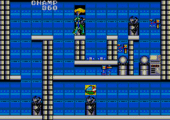
The visual presentation of Woody Pop reflects the design trends of the late 1980s, characterized by a heavy reliance on earthy tones. The titular character, a "Wood Spirit," navigates the "Bizarre Mansion," an environment rendered in varying shades of brown and orange. This aesthetic, while technically proficient, resulted in low contrast, making it difficult to distinguish game elements against the background.
The audio design remains a point of historical curiosity. Rather than utilizing a traditional melodic soundtrack, the game relies on an array of percussive sound effects and rhythmic pulses. Industry analysts have often compared this approach to the experimental work of later Sega composers, such as Motohiro Kawashima, suggesting that the development team opted for atmospheric sound design to avoid the clutter of a repetitive melodic loop, which might have conflicted with the high-frequency sound effects of the ball colliding with bricks.
Chronology of the Mark III Paddle Library
The life cycle of the Sega paddle controller was short-lived, spanning only a handful of releases between 1987 and 1988. The following represents the key titles supported by the peripheral:
- 1987: Woody Pop: Shinjinrui no Block Kuzugi – The flagship title for the paddle, introducing branching paths and power-up combinations.
- 1987: Alex Kidd BMX Trial – A departure from the brick-breaking genre, utilizing the paddle for steering precision.
- 1987: Megumi Rescue – Often cited as the most polished of the paddle-exclusive titles, featuring unique mechanics that bridged the gap between standard arcade fare and experimental design.
- 1988: Chase H.Q. – A racing title that adapted the paddle for steering, demonstrating the versatility of the peripheral beyond the static screen.
Analysis of Market Impact
The decision to bundle Woody Pop with a proprietary controller suggests a strategic attempt by Sega to capture the "arcade-at-home" market segment. However, the commercial results were tempered by the limitations of the hardware’s availability. Because the controller was not a standard component of the console, the target audience was inherently restricted to enthusiasts who were willing to purchase specialized hardware for a limited library of games.
From a design perspective, Woody Pop serves as a "missing link" between the foundational mechanics of Arkanoid and the more refined, modern interpretations of the genre, such as Wizorb. Its innovations—specifically the stacking of power-up effects, such as combining the "glue" item (which traps the ball) with the "flame" item (which increases destructive power)—offered a glimpse into potential gameplay depth. Yet, these additions were often offset by repetitive gameplay elements, such as the "toy box" blocks that continuously spawned enemies, creating a sense of attrition rather than challenge.
Conclusion and Historical Legacy
In the broader context of gaming history, Woody Pop is frequently categorized as a secondary effort—a title designed primarily to incentivize the purchase of a niche peripheral. While it introduced features that were ahead of their time, such as branching level progression and advanced power-up synergies, the execution was hampered by a restrictive color palette and an unforgiving difficulty curve caused by the console’s aspect ratio.
Today, the title is remembered largely by collectors and historians as a footnote in the Mark III’s library. With a score of 4 out of 10 in retrospective analysis, Woody Pop stands as a reminder of the volatility inherent in the 8-bit era, where hardware limitations and aggressive design experimentation often produced titles that were historically significant for their ambition, if not their lasting playability. The legacy of the Sega paddle controller itself remains a symbol of an era when manufacturers were willing to invest in specialized hardware to bridge the gap between the arcade and the living room, even when the software ecosystem to support such hardware was limited.