Vera Clarissa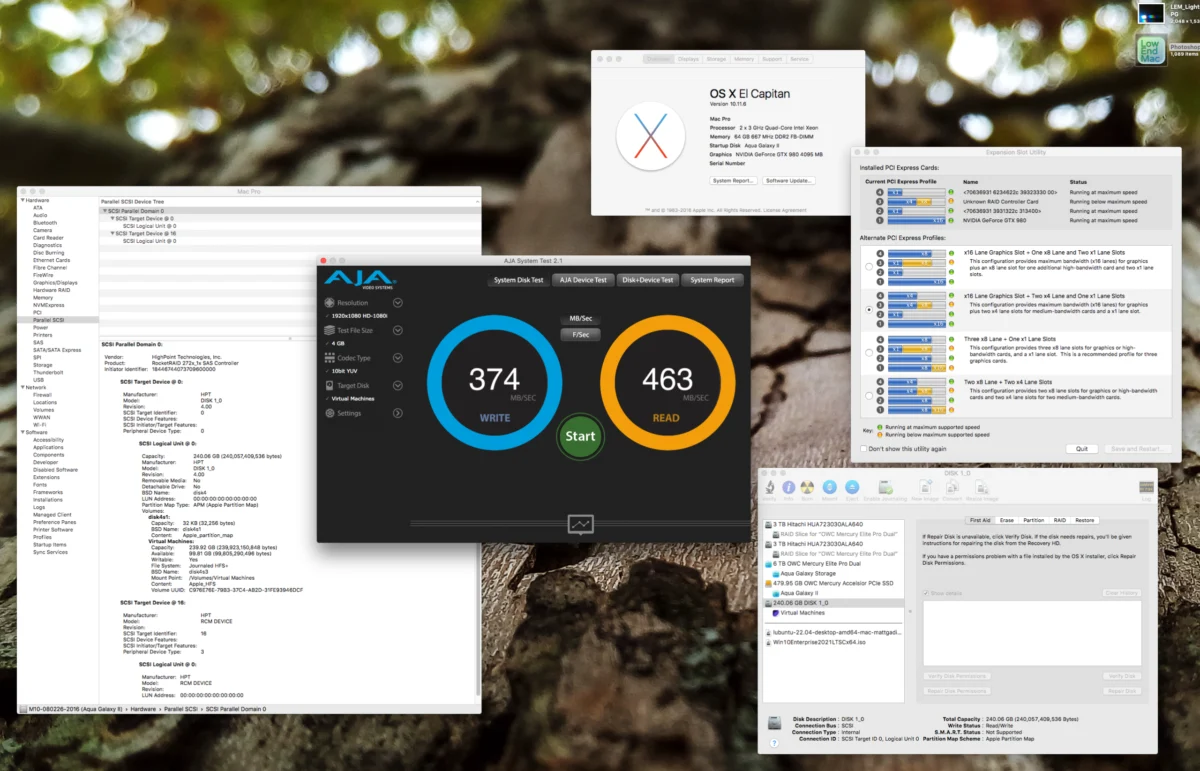
The vintage computing community has long championed the Apple Mac Pro 1,1 and 2,1 series as iconic examples of engineering longevity. Despite being released nearly two decades ago, these workstations remain popular among enthusiasts for their robust chassis and relative ease of hardware modification. A significant performance bottleneck, however, has historically been the onboard SATA II interfaces, which limit modern SSD speeds to approximately 280 MB/s. Recent developments in driver integration and PCIe controller adaptation have successfully bypassed this constraint, enabling the installation of the HighPoint RocketRAID 2720SGL to achieve SATA III 6.0 Gb/s speeds on legacy Mac hardware.

Context and Historical Limitations of the Mac Pro 1,1
Released in 2006, the original Mac Pro architecture was designed around a 3.0 Gb/s SATA II standard. While sufficient for the mechanical hard drives of the era, the platform remains severely hampered when paired with contemporary Solid State Drives (SSDs). For users attempting to maintain these machines as functional productivity tools or high-performance retro-gaming rigs, the lack of modern bandwidth has remained a primary obstacle.

Previous attempts to solve this, such as utilizing the original Apple RAID card, often resulted in proprietary limitations and cumbersome management software that lacked support for newer macOS iterations. The search for a cost-effective, high-speed alternative led researchers to the HighPoint RocketRAID 2720SGL. Although this card is a hardware RAID SAS/SATA controller, it requires precise driver orchestration to function within the restricted kernel environment of OS X El Capitan (10.11), which introduced stringent System Integrity Protection (SIP) protocols.

Chronology of the Integration Project
The effort to integrate the 2720SGL card began with a review of legacy hardware documentation and community-driven research. In October 2011, industry reports from entities such as Other World Computing identified the RocketRAID 2721 as a viable upgrade for internal drive bays. However, the 2721 and its variants became increasingly scarce on the secondary market.

In April 2017, documentation provided by Creation Machines LLC detailed the successful deployment of the 2720SGL within the Mac Pro 5,1 series. This provided a crucial roadmap for testing the card in the earlier 1,1 and 2,1 architectures. By August 2026, researchers began systematically addressing the driver compatibility gap. The primary challenge was that while HighPoint provided native drivers for OS X 10.8, the transition to El Capitan required deeper kernel-level modifications due to Apple’s move toward digitally signed kexts (kernel extensions).

The troubleshooting process involved a multi-stage technical audit using the macOS Terminal. By executing queries against the I/O Registry (ioreg), users confirmed that the Mac Pro’s PCIe bus successfully identified the card as a "pci1103,2720" device. This confirmed the physical handshake between the legacy logic board and the modern controller. The subsequent hurdle was the absence of a matching kext for the 2720SGL in the default installation packages, necessitating the manual extraction and modification of existing driver bundles.

Technical Implementation and Driver Calibration
The success of the integration hinged on the manual extraction of the 64-bit kext from the RR272x_1x.mpkg installer. Because the driver originated in 2012, it predated the mandatory kext-signing requirements of 10.11, leading to immediate system rejection.

To resolve this, the following methodology was employed:

- Environment Preparation: SIP was disabled via a custom Recovery USB to allow for the installation of unsigned kernel extensions.
- Package Extraction: Utilizing
gzcatandpaxcommands, therr272x6.pkgwas unpacked to expose the necessary driver files. - PCI ID Verification: A grep-based inspection of the
Info.plistfile confirmed that the 2720SGL’s specific hardware ID (0x27201103) was correctly mapped to the driver. - Kernel Injection: The kext was moved to
/Library/Extensions, followed by a mandatory update of the kernel cache usingkextcache -system-prelinked-kernel.
Following these steps, system logs confirmed the successful binding of the com.highpoint-tech.kext.rr272x_1x extension.

Data Performance Metrics
Initial benchmarking of the setup has shown significant improvements over the onboard SATA II controller. A single SATA III SSD connected through the RocketRAID 2720SGL achieved read speeds of 477 MB/s and write speeds of 388 MB/s. While this does not reach the theoretical limit of SATA III (600 MB/s), it represents a substantial increase over the sub-300 MB/s ceiling of the original logic board, providing a tangible boost to system responsiveness and file transfer times.

Further testing involved a custom-wired internal harness. By repurposing a standard Mac Pro drive bay backplane and routing power through the optical drive bay via Molex connectors, users were able to provide stable power to the controller’s internal ports. This modification bypasses the need for external cabling, maintaining the professional aesthetic of the internal Mac Pro drive cage.

Broader Implications for Legacy Hardware
The ability to successfully integrate modern storage controllers into nearly twenty-year-old hardware has significant implications for the sustainability of legacy computing. As software support for these machines wanes, the burden of maintenance falls to the user community. Projects such as this demonstrate that with sufficient understanding of kernel-level I/O and driver patching, the functional lifespan of high-end, vintage workstations can be extended well beyond their intended service life.

From a sustainability standpoint, extending the utility of older hardware reduces electronic waste. Furthermore, the use of hardware RAID controllers provides a level of data redundancy and speed that was previously inaccessible to the 1,1/2,1 Mac Pro demographic without resorting to expensive, proprietary hardware.

Challenges and Future Directions
Despite these successes, the project is not without limitations. The current configuration is not natively bootable. While some documentation suggests that EFI ROM updates exist, they remain difficult to source and carry a high risk of "bricking" the hardware if applied incorrectly. The requirement to disable SIP remains a primary security concern for those looking to use these machines for daily production tasks, as it leaves the kernel vulnerable to unsigned code execution.

Industry experts observe that as these machines age, the reliance on such "workaround" configurations will become the standard for preservationists. Future efforts are expected to focus on creating a streamlined, automated script to handle the kext-patching process, potentially removing the need for manual terminal intervention and increasing accessibility for less technical users.

In conclusion, the successful deployment of the HighPoint RocketRAID 2720SGL in a legacy Mac Pro 1,1 is a testament to the enduring appeal of the platform. By bridging the gap between 2006-era architecture and modern storage performance, enthusiasts have effectively modernized a piece of computing history. While the process requires a deep commitment to technical troubleshooting and a tolerance for experimental modification, the result is a measurable increase in performance that validates the ongoing investment in these classic machines. As the community continues to refine these techniques, the "Low End Mac" philosophy—doing more with less—remains a cornerstone of the retro-computing ecosystem.