Jia Lissa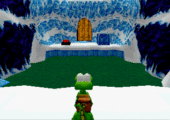
The transition from two-dimensional sprite-based gaming to polygonal 3D environments represents arguably the most significant technological leap in the history of interactive entertainment. While the early 1990s saw the initial testing of 3D capabilities within arcade environments, the true paradigm shift occurred with the widespread adoption of 32-bit home consoles. Among the titles that defined this experimental era was Croc: Legend of the Gobbos, a 1997 platformer developed by Argonaut Software and published by Fox Interactive. Originally released for the Sony PlayStation, the Sega Saturn, and later PC, the title serves as a historical case study in the rapid, often volatile evolution of early 3D game design and the intense industry competition that characterized the late 1990s.
Origins and the Nintendo Connection
The genesis of Croc is inextricably linked to the history of the Super Nintendo Entertainment System (SNES). Argonaut Software, a British studio, had gained notoriety for its technical prowess, specifically its collaboration with Nintendo on the 1993 hit Star Fox. This title utilized the Super FX chip, a custom RISC processor designed by Argonaut to facilitate polygonal graphics on hardware otherwise incapable of rendering them.
Following this success, Argonaut pitched a concept to Nintendo that would have integrated the Japanese gaming giant’s iconic character, Yoshi, into a 3D platforming and racing hybrid. Documentation from the period suggests that Argonaut intended for this project to be a foundational 3D title. However, Nintendo’s corporate strategy was undergoing a significant shift. By the mid-1990s, Nintendo had begun development of Super Mario 64, a project led by Shigeru Miyamoto that would ultimately set the industry standard for 3D navigation. Records indicate that Nintendo was hesitant to grant third-party developers access to their most valuable intellectual properties, particularly while their internal teams were finalizing their own 3D breakthroughs. Consequently, the collaboration was shelved. Argonaut, retaining the technical assets and the core gameplay concepts developed for the project, repurposed the mechanics and the central crocodile protagonist, eventually rebranding the title as Croc: Legend of the Gobbos.
Technical Architecture and Design Philosophy
Croc: Legend of the Gobbos was designed during a period when the "rules" of 3D movement had not yet been codified. When the game launched in 1997, it faced a market already influenced by the release of Super Mario 64 (1996) and looking ahead to the launch of titles like Spyro the Dragon (1998).
A defining feature of the game’s control scheme was the use of "tank controls"—a system where the player uses forward input to move in the direction the character is facing, and lateral inputs to rotate. While this method was common for survival horror titles of the era, such as Resident Evil or Tomb Raider, its implementation in a platformer presented a significant departure from the more fluid analog-stick movement popularized by Nintendo. Industry analysts at the time noted that while this design choice provided a high degree of precision in static environments, it often created friction in fast-paced platforming sections. The inclusion of support for the Sega Saturn’s 3D Control Pad attempted to mitigate these limitations, though contemporary reviews frequently noted that the movement remained inherently stiff compared to the emerging standards of the genre.
Structural Design and Gameplay Mechanics
The structural framework of the game is divided into four distinct worlds, each featuring six standard levels, two boss battles, and a secret level. The objective-based gameplay centers on the retrieval of Gobbos—small, anthropomorphic creatures held captive by the antagonist, Baron Dante.
From a level design perspective, Argonaut utilized a "room-based" architecture. Each level was composed of distinct, interconnected segments separated by doors, a technique that allowed developers to optimize the limited memory of the 32-bit hardware. Despite the simplicity of the enemies and the repetitive nature of combat—which relies heavily on a tail-spin attack—the game is widely cited by industry historians for its coherent spatial design. Unlike many of its contemporaries, which often forced players into "leaps of faith" due to poor camera angles or obscured geometry, Croc consistently provided clear visual indicators to guide player navigation. This design consistency suggests that Argonaut employed rigorous iterative testing, focusing on player psychology and spatial awareness.
Platform Disparities and Porting Challenges
The 1997 release saw the game appear on the PlayStation, Sega Saturn, and PC. While the PlayStation version is widely regarded as the definitive release, the Saturn port suffered from technical inconsistencies common to multi-platform development during the mid-90s.
One notable anomaly in the Saturn version was a rendering bug that caused character geometry, specifically the protagonist’s snout, to vanish if the console was powered on with the disc already inside. This issue, caused by improper initialization of the Saturn’s VDP1 (Video Display Processor) during the boot sequence, highlighted the difficulties developers faced when porting titles across different hardware architectures. Furthermore, the Saturn version exhibited a noticeably grainier visual output, a byproduct of the console’s distinct method of handling transparency and texture filtering. Despite these technical hurdles, the game maintained a dedicated following, aided in part by a memorable, upbeat musical score that helped differentiate the game’s atmosphere from the more somber aesthetic of other Saturn platformers.
Legacy and Modern Re-evaluation
In 2025, the release of a high-definition remaster introduced Croc: Legend of the Gobbos to a new generation of players. This release addressed many of the original title’s criticisms by introducing modern control options, effectively removing the barrier of the original tank-based movement.
The significance of Croc extends beyond its individual success or failure; it represents a snapshot of an industry in transition. The development of the game occurred at a time when publishers and developers were navigating the transition from 2D logic to 3D spatial awareness without the benefit of decades of established best practices. The game serves as a testament to the "leaps of faith" taken by developers who were forced to invent new mechanics in real-time.
From a broader historical perspective, the interaction between Argonaut and Nintendo remains a pivotal "what-if" moment in video game history. Had the original partnership yielded a Nintendo-branded 3D platformer, the trajectory of 3D gaming might have been altered, and the history of Argonaut Software—a studio that significantly contributed to the technological advancement of the 16-bit and 32-bit eras—might have taken a different path.
Ultimately, Croc: Legend of the Gobbos is viewed by critics as a foundational experiment. While its mechanics and control systems reflect the limitations of 1997 technology, its thoughtful level design and distinct musical identity have secured its place as a representative title of the 32-bit era. It remains a classic example of the high-risk, high-reward creative environment that defined the 1990s gaming boom, illustrating the industry’s shift toward the complex, immersive, and fully realized 3D worlds that have since become the standard in modern gaming.