
 Jia Lissa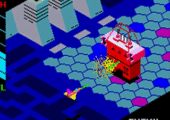
The Technological Leap: Isometric Projection and the G80 Hardware
Zaxxon’s most significant contribution to the medium was its use of axonometric projection, a form of isometric perspective that allowed the game to display three-dimensional movement on a two-dimensional screen. Unlike its contemporaries, such as Defender or Galaxian, which operated on strictly linear planes, Zaxxon required players to manage three axes of movement. This was achieved through the Sega G80 hardware, a sophisticated system for 1982 that utilized a Zilog Z80 primary CPU and specialized video hardware capable of handling complex tile-based backgrounds.
The visual depth was not merely aesthetic; it was a fundamental mechanic. To navigate the game’s various fortresses and space environments, players had to monitor an altitude meter located on the left side of the screen. This required a paradigm shift in player perception, as they had to learn to judge their ship’s position relative to ground-based obstacles and airborne enemies. The inclusion of a shadow directly beneath the player’s ship served as a critical visual cue, allowing players to triangulate their position in the simulated 3D space. This "shadow-based navigation" would later become a standard feature in 3D platformers and shooters decades later.
Gameplay Mechanics and the Challenge of Altitude
In Zaxxon, the player assumes control of a "Zaxon" spacecraft tasked with infiltrating a series of heavily fortified space stations. The game is divided into distinct phases: the approach to the space fortress, the navigation of the fortress interior, a deep-space dogfight, and the final confrontation with the titular Zaxxon robot.
The complexity of the game was heightened by its control scheme. Unlike the standard four-way or eight-way joysticks common in 1982, Zaxxon utilized a flight-style control stick. Pushing forward on the stick caused the ship to descend, while pulling back caused it to climb, mimicking the pitch controls of an actual aircraft. This inverted control scheme, while intuitive for aviation enthusiasts, presented a steep learning curve for the general public.
Furthermore, the game introduced a fuel consumption mechanic that added a layer of resource management to the high-speed action. The player’s fuel supply constantly depleted, necessitating the destruction of fuel tanks scattered throughout the enemy base to replenish the gauge. This forced players into high-risk maneuvers, as fuel tanks were often positioned near lethal obstacles or guarded by anti-aircraft batteries. The synergy of altitude control, fuel management, and traditional combat created a high-intensity environment that rewarded precision over mindless firing.
A Chronology of the Zaxxon Franchise (1981–2010)
The history of Zaxxon spans several decades, encompassing original arcade hardware, numerous home ports, and several attempts to modernize the brand.
- 1981–1982: Development and Arcade Debut: Developed by Ikegami Tsushinki and published by Sega, Zaxxon was released in Japanese arcades in late 1981 and reached North American shores in early 1982. It quickly became one of the top-earning arcade cabinets of the year.
- 1982: Home Console Licensing: Seeing the arcade success, Coleco secured the home console and tabletop rights. The ColecoVision port became a "killer app" for the system, being one of the first home versions to accurately capture the arcade’s isometric look.
- 1982: Super Zaxxon: Sega released a sequel in arcades, Super Zaxxon. While it increased the speed and difficulty, it was criticized for being too similar to the original and lacked the same market impact.
- 1983–1985: The Porting Era: Zaxxon was ported to nearly every major platform of the time, including the Atari 2600, Atari 5200, Commodore 64, Apple II, and the IBM PC. Each port struggled with the technical limitations of home hardware, often sacrificing the isometric view for a more traditional perspective.
- 1987: Zaxxon 3-D: Released for the Sega Master System, this version utilized the SegaScope 3-D glasses. It attempted to enhance the depth perception that was the original’s hallmark but was limited by the niche nature of the peripheral.
- 1995: Zaxxon’s Motherbase 2000: A reimagining for the Sega 32X. This version moved toward fully polygonal 3D graphics but failed to resonate with a market that was already shifting toward the Sega Saturn and Sony PlayStation.
- 2010: Wii Virtual Console Release: The original arcade version was made available on the Nintendo Wii’s digital storefront, introducing the 1982 classic to a new generation of players.
Market Performance and Economic Impact
Zaxxon was a commercial powerhouse for Sega. In the United States, the game was distributed by Gremlin Industries (then a subsidiary of Sega). Upon its release, it consistently ranked in the top five highest-grossing arcade games according to RePlay and Play Meter magazines. By the end of 1982, Sega had sold an estimated 30,000 arcade units in the U.S. alone, a significant figure given the intense competition from titles like Ms. Pac-Man and Dig Dug.
The success of the arcade version translated into a massive windfall for Coleco. The ColecoVision version of Zaxxon sold over 1.5 million units, becoming one of the best-selling cartridges for the platform. This success helped establish Sega as a premier developer for home consoles, even before they became a dominant hardware manufacturer with the Master System and Genesis.
Industry analysts at the time noted that Zaxxon’s success was driven by its "spectacle factor." In an era where many games looked like basic geometric shapes, Zaxxon’s detailed sprites and faux-3D environments were used as a benchmark for what arcade hardware could achieve. This set a precedent for "graphics-first" marketing that would define the industry for decades.
Critical Analysis: Innovation vs. Frustration
While Zaxxon is universally praised for its innovation, it is also remembered for its punishing difficulty. The isometric perspective, while visually stunning, introduced significant issues with collision detection. Players often found it difficult to judge whether their ship was at the correct altitude to pass through a narrow opening in a wall or to avoid a radar dish.
The game’s reliance on the altitude meter meant that players had to split their attention between the center of the screen and the UI on the left. In modern game design, this is often considered a flaw, but in 1982, it was viewed as a necessary part of the "simulation" experience. Critics have argued that the difficulty was a deliberate design choice intended to maximize "quarter-munching" in the arcade environment. The rapid depletion of fuel and the lack of invincibility frames upon being hit meant that sessions were often short, encouraging a high turnover of players.
Furthermore, the transition from the arcade’s dedicated flight stick to home console D-pads significantly hampered the experience. The digital nature of a D-pad (which is either "on" or "off") lacked the nuanced control required to make the fine altitude adjustments that the original arcade hardware allowed. This disconnect between the original design and the limitations of home hardware is often cited as the reason why Zaxxon’s reputation has polarized over time.
Broader Impact and Industry Implications
Zaxxon’s influence extends far beyond its own sequels. It proved that there was a market for complex, pseudo-3D environments, paving the way for later hits such as Blue Max, Viewpoint, and the Desert Strike series. The game’s use of axonometric projection became a staple for the industry, eventually leading to the development of "2.5D" games.
Moreover, Zaxxon represented a shift in Sega’s corporate strategy. It was one of the first games to demonstrate that Sega could compete on a global scale with Nintendo and Namco. The branding of Zaxxon was so strong that it was featured in various media, including television commercials and Saturday morning cartoon segments, signaling the beginning of video games as a multi-media cultural phenomenon.
In a broader sense, Zaxxon was a harbinger of the industry’s move toward realism. While it was still an abstract shooter, its attempts to incorporate physics (momentum and altitude) and resource management (fuel) showed a desire to move beyond the simple "shoot everything" mechanics of the late 1970s. It challenged players to think in three dimensions, a skill that would become essential as the industry transitioned to true 3D in the 1990s.
Today, Zaxxon remains a significant entry in the history of electronic entertainment. While its difficulty and specific control requirements may alienate modern audiences accustomed to more forgiving design, its status as a technical marvel of 1982 is undisputed. It stands as a testament to Sega’s early willingness to take risks and redefine the boundaries of what was possible in the digital space. For historians and enthusiasts, Zaxxon is not merely a game but a landmark that signaled the end of the flat, 2D era and the beginning of a journey toward immersive, three-dimensional worlds.








