
 Jia Lissa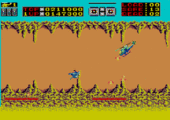
Choplifter for the Sega Master System stands as a definitive milestone in the early history of the shoot-’em-up (shmup) genre, representing a sophisticated bridge between home computer origins and the high-octane requirements of the arcade and console markets. Originally conceived by Dan Gorlin and published by Brøderbund for the Apple II in 1982, the title underwent a transformative evolution when Sega Enterprises USA acquired the rights for an arcade conversion. This arcade iteration, which debuted in October 1985 as a conversion kit alongside the seminal racer Hang-On, introduced significant structural refinements that would eventually define the 1986 Sega Master System port. Programmed by Rikiya Nakagawa—a figure who would later gain renown for his work on Alien Syndrome and Thunder Blade—the Sega version of Choplifter shifted the game’s focus from a minimalist rescue simulator to a more complex, multi-environment action experience.
The Evolution of a Digital Rescue Mission: A Historical Chronology
The journey of Choplifter from a 1982 home computer project to a 1986 flagship console title illustrates the rapid maturation of the video game industry during the mid-1980s. When Dan Gorlin first designed the game, the Apple II hardware limited the scope of the environments; the original game featured a singular, unchanging desert backdrop where players rescued 64 hostages in groups of 16. The primary tension was derived from the physics of the helicopter and the vulnerability of the civilians.
By 1985, Sega’s arcade division saw the potential for a more visually dynamic experience. Rikiya Nakagawa was tasked with re-engineering the game for Sega’s System 1 and System 2 arcade boards. Nakagawa’s intervention was crucial; he reduced the number of hostages the helicopter could carry from 16 down to eight, a move that fundamentally altered the game’s pacing by forcing the player to make more frequent, high-risk trips into enemy territory. He also expanded the game’s world, introducing three distinct environments: the classic desert, a naval fleet on the open ocean, and a claustrophobic subterranean cave system.
When the Master System (known as the Sega Mark III in Japan) launched, Sega utilized Choplifter as a showcase for the console’s superior graphical capabilities compared to its primary competitor, the Nintendo Entertainment System (NES). The Master System port, released in 1986, was a faithful translation of the arcade experience, retaining the new environments and the refined rescue mechanics. This release marked a period where Sega was aggressively courting the Western market, utilizing established arcade hits to build a library that emphasized "arcade-perfect" gameplay at home.
Technical Specifications and Gameplay Mechanics
At its core, Choplifter is a multidirectional scrolling shooter that emphasizes precision over mindless destruction. The player assumes the role of a pilot operating a rescue helicopter across six stages—essentially three unique environments that loop twice with increased difficulty. The objective remains consistent: fly into hostile territory, destroy the barracks or obstacles holding hostages captive, land to allow the hostages to board, and return them safely to the home base.
The Master System’s Zilog Z80 central processing unit and its dedicated Video Display Processor (VDP) allowed for features that were advanced for 1986. Most notably, the game utilized parallax scrolling, giving the backgrounds a sense of depth as the player traversed the horizontal landscape. The color palette, a strong suit of the Master System, enabled vibrant blues for the ocean stages and rich, earthy tones for the desert and cave levels.
The rescue mechanic itself introduced a layer of moral and tactical complexity. Unlike many shmups of the era where the player only needed to worry about their own survival, Choplifter required the protection of non-player characters (NPCs). The helicopter’s weapons—a forward-facing machine gun and the ability to drop bombs while tilted—could inadvertently kill the very hostages the player was sent to save. This "friendly fire" element necessitated careful positioning. Furthermore, the enemy AI was programmed to target hostages once they were outside their barracks, creating a frantic scramble where the player had to provide cover fire while simultaneously managing a delicate landing.
Data-Driven Analysis of Level Design and Difficulty
The progression system in Choplifter is governed by a strict hostage count. To advance to the next stage, the player must successfully return 40 hostages to the base. With each stage containing 64 potential rescuees, there is a margin for error of 24 lives. However, this margin thins rapidly as the difficulty ramps up.
- The Desert (Stages 1 and 4): This serves as the introductory environment. It mimics the original Apple II layout but adds more aggressive tank divisions and jet fighters. The primary hazard here is the open space, which leaves the helicopter vulnerable to anti-air fire. In the fourth stage (the first loop), the environment shifts to a night setting, reducing visibility and increasing enemy fire rates.
- The Ocean (Stages 2 and 5): This environment introduces naval warfare. Hostages are held on submarines and transport ships. The technical challenge here involves landing on moving platforms or hovering steadily while hostages swim to the chopper. The lack of solid ground forces the player to master the "hover" mechanic, a skill that is vital for the final environment.
- The Cave (Stages 3 and 6): Widely regarded as the most difficult section of the game, the cave environment features low ceilings and stalactites. The confined space limits the helicopter’s mobility, making it an easy target for ground-based turrets and hovering airships. This stage represents a significant spike in difficulty, often cited by contemporary players as a "quarter-munching" design holdover from the arcade version.
The Master System port is noted for its brevity; a skilled player can complete all three primary environments in approximately 15 minutes. To compensate for this, Sega utilized a steep difficulty curve. The "Cave" stage, in particular, requires rote memorization of enemy patterns and pixel-perfect navigation.
Cultural Impact and Hidden Features
Sega’s development team included several "Easter eggs" in the Master System version that added a layer of personality to the title. If a player managed to destroy 16 rockets in specific sequences, iconic characters like Superman or E.T. the Extra-Terrestrial would appear in the background. These inclusions were not just whimsy; they served as a testament to the era’s burgeoning pop-culture crossover in digital media.
Furthermore, the game’s presentation was bolstered by its attention to detail. Hostages exhibited distinct behaviors: they would cheer upon seeing the helicopter, run in panic when fired upon, and jump in frustration if the player took off before they could board. These small animations provided a sense of urgency and emotional stakes that were often missing from more abstract shooters like Galaga or Gradius.
Critical Assessment and Broader Industry Implications
From a journalistic and historical perspective, Choplifter on the Master System is viewed as a high-water mark for 8-bit ports. While the NES version of the game (published by Jaleco) existed, the Master System version is generally considered superior due to its closer adherence to the Sega arcade aesthetics and smoother scrolling.
However, the game was not without its critics. The absence of traditional "boss" encounters—a staple of the shmup genre by the mid-80s—meant that the gameplay loop could feel repetitive. The reliance on environmental hazards and increased enemy density to provide challenge was a polarizing design choice. Additionally, the lack of an ending sequence beyond the loop provided little narrative closure, a common limitation of the time but one that hindered the game’s longevity for some players.
The legacy of Choplifter extends beyond the 1980s. It established a sub-genre of "rescue shmups" that influenced later titles such as Desert Strike and Armorines: Invasion. The emphasis on physics-based flight and the dual responsibility of combat and transport paved the way for more complex military simulators.
Conclusion: A Timeless Entry in the Sega Library
Choplifter for the Sega Master System remains a quintessential example of how a simple concept—save the innocent—can be elevated through refined mechanics and technical excellence. Despite the frustrations caused by its punishing third stage and its relatively short length, the game’s contribution to the evolution of the console experience is undeniable. It demonstrated that home consoles were capable of delivering arcade-quality tension and visual fidelity, solidifying the Master System’s reputation as a powerhouse for arcade enthusiasts. As a piece of software, it continues to be studied for its balance of risk versus reward and its early attempts at environmental storytelling within the constraints of 8-bit hardware. For collectors and historians of the platform, it remains an essential artifact of Sega’s early golden age.








