 Vera Clarissa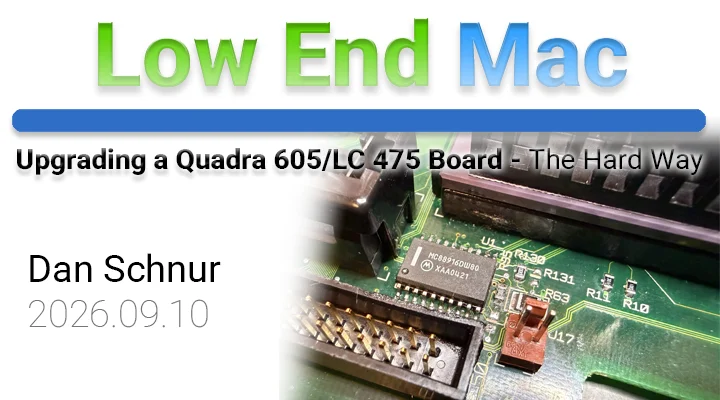
The restoration and modification of legacy hardware represent a specialized intersection of electrical engineering and historical preservation. A recent project involving the Macintosh Quadra 605 demonstrates the feasibility of performing factory-level hardware modifications to achieve performance specifications beyond the original retail configuration. By utilizing internal schematics originally intended for Apple’s internal engineering teams, a technician successfully upgraded a 25 MHz Quadra 605 logic board to a stable 33 MHz configuration, complete with the addition of a functional Floating Point Unit (FPU).
Historical Context of the Quadra 605
Released in October 1993, the Macintosh Quadra 605 was positioned as an entry-level professional desktop, often marketed under the Performa 475 and LC 475 branding in various retail channels. At its core, the machine utilized the Motorola 68LC040 processor. The "LC" designation in the processor model specifically indicated the absence of an integrated FPU, a cost-cutting measure that reduced the unit’s manufacturing price point. While this configuration was sufficient for standard word processing and basic educational software common in the early 1990s, it created a significant bottleneck for users attempting to run sophisticated graphical design software or complex mathematical applications.

The Quadra 605 architecture was fundamentally built upon a highly flexible logic board design. As internal documentation reveals, Apple engineers had designed the PCB (printed circuit board) to support a variety of clock speeds, ranging from 20 MHz to 40 MHz. This modularity was intended to allow for future iterations or regional variations, though the consumer-facing models were strictly locked at lower speeds to segment the market and protect higher-tier product lines.
Chronology of the Hardware Modification
The project commenced with the identification of a failed microprocessor on a Quadra 605 logic board. The diagnostic phase confirmed that the original MC68LC040RC25 was non-functional. Rather than replacing it with an identical part, the decision was made to leverage the board’s latent architectural capacity.
The modification process followed a rigid sequence dictated by Apple’s original system schematics:

- Clock Configuration Resistor Adjustment: The board utilized a matrix of four resistor positions to define the system’s operational frequency. The shift from 25 MHz to 33 MHz required the relocation of existing components. Resistors at R21 and R25, which configured the 25 MHz state, were desoldered and moved to positions R24 and R22.
- Impedance Matching at R13: The R13 resistor serves a critical role in signal integrity for the processor. The schematic designated a specific 140-Ohm value for the 33 MHz tier. Due to the scarcity of this specific surface-mount component, a series configuration—combining a 120-Ohm and a 20-Ohm resistor—was implemented to achieve the exact required resistance.
- Clock Path Reconfiguration: The board’s logic path, managed by resistors R95 and R96, required physical adjustment. Moving the resistor from R95 to R96 signaled the board’s firmware to engage the 33 MHz timing sequence.
- Clock Driver Replacement (U1): The final, and most complex, technical requirement involved the U1 clock management chip. The stock MC88920 chip was incompatible with the 33 MHz timing requirements. It was replaced with an obsolete, but essential, MC88916 component. This step necessitated the use of professional-grade hot-air rework equipment to ensure the preservation of the surrounding PCB traces.
Technical Data and Component Specifications
The success of the upgrade relied on precise adherence to the electrical parameters outlined by the original design documentation. The following table illustrates the configuration requirements identified during the modification:
| Target Clock Speed | Resistor Configuration | R13 Value (1% Tolerance) | Clock Chip Requirement |
|---|---|---|---|
| 20 MHz | R22, R25 | 121 Ohm | MC88920 |
| 25 MHz | R21, R25 | 212 Ohm | MC88920 |
| 33 MHz | R22, R24 | 140 Ohm | MC88916 |
| 40 MHz | R21, R24 | 110 Ohm | MC88916 |
The inclusion of the MC68040RC33 processor not only increased the raw clock speed by 32% but, more importantly, introduced the full 68040 feature set, including the dedicated math coprocessor (FPU). This component is essential for rendering 3D graphics, performing complex spreadsheet calculations, and running specialized scientific software that requires hardware-level floating-point arithmetic.
Implications for Legacy Preservation
The ability to perform these modifications underscores a growing trend in the retro-computing community: the transition from simple component replacement to "factory-plus" engineering. By utilizing original schematics, enthusiasts are able to extend the lifespan and utility of machines that would otherwise be discarded due to component failure.

While the real-world performance gains in standard desktop tasks remain marginal—due to the limitations of other system components like the data bus width and hard drive access speeds—the intellectual impact is significant. The project proves that documentation from the 1990s remains a vital asset for modern maintenance.
Industry observers note that the primary challenge for this type of work is the scarcity of "New Old Stock" (NOS) components, such as the MC88916 clock driver. As these parts become increasingly difficult to source from the secondary market, the community is beginning to explore FPGA-based replacements or modern silicon equivalents that can emulate the function of these legacy chips.
Conclusion and Future Outlook
The successful reboot of the 33 MHz Quadra 605 confirms that the hardware, when properly configured, remains stable and functional. The project serves as a case study for the rigorous engineering standards applied by Apple in the early 1990s. The fact that a consumer-grade motherboard could be reconfigured to a higher performance tier simply by shifting resistors and updating a single clock driver demonstrates the foresight of the original designers.

As vintage hardware continues to age, the integration of modern tools—such as infrared rework stations and high-precision SMD (Surface Mount Device) components—allows for a level of repair accuracy that was not possible for the average consumer in 1993. This project highlights that the ceiling for performance in legacy hardware is often defined not by the silicon itself, but by the availability of technical schematics and the willingness of the user to engage in advanced electrical diagnostic work. For the vintage Macintosh enthusiast, the upgrade represents a successful bridge between historical computing and modern technical skill.