Jia Lissa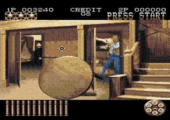
Historical Context and Regulatory Shift
The release of Lethal Enforcers II: Gun Fighters occurred during a period of intense scrutiny for the video game industry. The original Lethal Enforcers had been a primary target during the 1993 United States Senate hearings on video game violence, led by Senators Joe Lieberman and Herb Kohl. The first game’s use of digitized photographic sprites and realistic modern weaponry contributed to its MA-17 rating under the Sega Videogame Rating Council (VRC). In a strategic shift, Konami opted for a historical setting for the sequel. By moving the action to 1873, the violence was contextualized within the "Western" genre, a staple of American cinema and folklore. This thematic change, combined with a slight reduction in graphic intensity, resulted in an MA-13 rating, making the game accessible to a broader demographic while maintaining its edge-of-your-seat gameplay.
Hardware Integration and Peripheral Requirements
A defining characteristic of Lethal Enforcers II: Gun Fighters is its reliance on specialized hardware to achieve the intended arcade experience. The game was designed specifically for use with the Konami Justifier, a light gun peripheral modeled after a high-caliber revolver. On the Sega CD platform, the Justifier connects directly to the console’s controller port, utilizing light-sensing technology to determine the point of impact on the screen.
From a technical standpoint, the game serves as a legacy marker for Cathode Ray Tube (CRT) technology. Because the Justifier relies on the precise timing of the CRT’s electron beam scanning the phosphor coating of the screen, the game is functionally incompatible with modern Liquid Crystal Display (LCD), Light Emitting Diode (LED), or Plasma televisions. For contemporary enthusiasts, this necessitates the maintenance of vintage hardware to play the game as originally intended. While the game supports the standard Sega Genesis three-button or six-button controllers, this method is widely considered a secondary experience. The manual movement of an on-screen reticle lacks the instantaneous response time required for the game’s later stages, where enemy draw speeds are calibrated for the rapid "point-and-shoot" mechanics of the Justifier.
Chronology of Operations: The Five Stages of 1873
The narrative and gameplay progression of Lethal Enforcers II: Gun Fighters is structured across five distinct stages, each simulating a high-stakes confrontation typical of Western frontier lore.
Stage 1: The Bank Robbery
The game opens in a frontier town where a criminal gang has initiated a daylight heist. Players must clear the town square and the interior of the bank. The stage concludes with a confrontation against a boss positioned in a fortified covered wagon. This boss utilizes three mounted cannons, requiring the player to manage incoming projectiles while simultaneously targeting the antagonist. This dual-focus mechanic establishes the defensive shooting requirements that persist throughout the game.
Stage 2: The Stagecoach Rescue
The second mission shifts to a high-speed pursuit. Players are tasked with defending a stagecoach and a covered wagon under siege by mounted outlaws. The introduction of moving targets on horseback increases the mechanical difficulty. The boss encounter involves a character throwing an infinite supply of wooden barrels from the back of a wagon. Success requires the player to destroy the barrels in mid-air to prevent damage while finding windows of opportunity to deplete the boss’s health bar.
Stage 3: The Saloon Brawl and Quick-Draw Duel
Stage three moves into the interior of a local saloon. This environment is densely populated with non-combatants, specifically "ladies of the evening," who act as obstacles to clear lines of fire. Enemies in this stage are more diverse, wielding knives, hatchets, and firearms. The climax of this stage departs from standard gameplay, featuring a "Quick-Draw" standoff against three gunmen clad in black. This sequence tests the player’s reaction time, mimicking the cinematic tropes of the Old West.
Stage 4: The Great Train Robbery
Players transition to the railway, working their way from the caboose to the locomotive of a moving train. The verticality and horizontal movement of the train setting add complexity to the enemy placements. The final encounter of this stage features a boss who hurls sticks of dynamite. Similar to the cannonballs and barrels of previous levels, the dynamite must be intercepted in flight to avoid life loss.
Stage 5: The OK Mine Company
The final stage takes the player into the subterranean depths of a mining operation. This level introduces supernatural or highly stylized elements, as the primary antagonist summons skeletal warriors. These skeletons attack by throwing knives or their own detached heads. Notably, the game’s logic dictates that shooting the skeletal minions provides no progress; the player must focus entirely on the boss while dodging the projectiles. The game concludes with the boss’s defeat and a transformation sequence, followed by the credits.
Technical Analysis: Graphics and Redbook Audio
The Sega CD version of Lethal Enforcers II: Gun Fighters presents a technical dichotomy. Graphically, the game is largely identical to the Sega Genesis cartridge version. Both versions suffer from the Genesis hardware’s limited 64-color on-screen palette, which results in a significantly more "dithered" and muted appearance compared to the arcade original’s vibrant, high-color digitized sprites. The images appear somewhat blurry, and the level of detail in the backgrounds is reduced to accommodate the hardware’s VDP (Video Display Processor) limitations.
However, the Sega CD version provides a substantial upgrade in the audio department. By utilizing the CD-ROM format’s capacity for Redbook Audio, Konami included a high-fidelity soundtrack and crystal-clear voice samples. In the arcade and Sega CD versions, the "Reload!" command and the taunts of the outlaws are sharp and distinct, whereas the cartridge version features heavily compressed, "scratchy" audio. This auditory clarity significantly enhances the immersion, bringing the home experience closer to the arcade environment.
Performance Metrics and Accuracy Ranking
Konami implemented a rigorous scoring and ranking system that tracks player performance based on precision. Unlike the first game, which often required a minimum accuracy percentage to progress to the next stage, Lethal Enforcers II: Gun Fighters allows players to continue regardless of their hit ratio, provided they have remaining lives or credits. However, the game compensates for this by increasing the speed and aggression of the enemies.
Upon the completion of a stage, the player is assigned a rank based on their accuracy percentage, with significant penalties applied for hitting "innocents." The hierarchy of the law is used to categorize performance:
- U.S. Marshal: 90% accuracy or above
- Deputy Marshal: 80% to 89% accuracy
- Sheriff: 70% to 79% accuracy
- Deputy: 60% to 69% accuracy
- Posse: 59% accuracy and under
To assist players in achieving higher ranks, the game includes hidden weapon upgrades. By shooting specific environmental objects such as saloon signs, vases, or crates, players can uncover dual pistols, rifles, shotguns, 50-caliber Sharps buffalo guns, and even Gatling guns. These weapons offer increased fire rates or wider hit boxes but are limited by a hidden ammunition count, necessitating strategic use.
Broader Impact and Legacy
Lethal Enforcers II: Gun Fighters stands as a testament to the peak of the light gun genre in the 1990s. At the time of its release, Konami was a dominant force in the arcade industry, and their commitment to bringing "arcade-perfect" (or as close as hardware allowed) experiences to the home helped define the Sega CD’s library. The game’s increased difficulty—offering nine credits compared to the original’s five—reflected a trend toward more challenging home conversions intended to extend the longevity of the title.
The game also highlights the era’s transition from 16-bit 2D sprites to the 3D polygonal worlds that would soon follow with the release of the Sega Saturn and Sony PlayStation. While titles like Virtua Cop would eventually revolutionize the genre with 3D environments, Lethal Enforcers II remains one of the finest examples of the digitized sprite-based shooter. For historians and collectors, the Sega CD version remains the definitive home iteration due to its superior audio and the tactile satisfaction of the Justifier peripheral. It remains a significant cultural artifact of the 1870s frontier, as viewed through the lens of 1990s Japanese arcade development.