Jia Lissa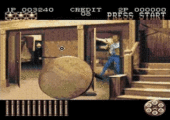
Historical Context and Development
The early 1990s were a turbulent time for the video game industry, marked by both technological leaps and intense legislative scrutiny. The original Lethal Enforcers, released in 1992, was a central figure in the United States Senate hearings on video game violence, primarily due to its use of digitized photographic sprites. By the time Lethal Enforcers II: Gun Fighters was slated for release in 1994, the industry had established the Video Game Rating Council (VRC).
Unlike the first game, which often carried an MA-17 rating on Sega platforms due to its depictions of modern-day police shootings, the sequel was rated MA-13. Industry analysts at the time attributed this shift to the historical setting; the "Wild West" aesthetic was perceived as more fantastical and less immediate than the urban violence of the original. Despite the change in setting, Konami maintained the use of digitized imagery, a signature of the series that aimed for a level of realism that traditional hand-drawn sprites could not match.
Technical Architecture and Hardware Requirements
The Sega CD version of Lethal Enforcers II: Gun Fighters is frequently cited as a case study in the strengths and limitations of the 16-bit "multimedia" era. To experience the game as intended, players required the Konami Justifier, a proprietary light gun peripheral. The Justifier functioned through a photodetector system that relied on the specific timing of the electron beam in a Cathode Ray Tube (CRT) television.
Because modern liquid crystal displays (LCD) and organic light-emitting diode (OLED) screens do not utilize a scanning electron gun, the Justifier—and by extension, the core experience of Lethal Enforcers II—is incompatible with contemporary display technology without specialized third-party converters or software emulation. For the 1994 consumer, the Justifier provided a tactile connection to the arcade experience, offering superior precision over the standard Genesis D-pad, which struggled to keep pace with the game’s escalating difficulty.
Comparative Analysis: Graphics and Audio
When compared to the standard Sega Genesis cartridge version, the Sega CD iteration of Lethal Enforcers II presents a clear dichotomy in technical performance. The visual assets are largely identical, constrained by the Genesis hardware’s limited 64-color on-screen palette. This results in a somewhat muted and grainy aesthetic that lacks the vibrancy of the original arcade cabinet’s hardware.
However, the audio department saw a massive upgrade. By utilizing the CD-ROM format, Konami was able to implement Redbook Audio, providing high-fidelity musical scores and crystal-clear voice samples. In the Genesis version, voice clips were often heavily compressed and distorted; on the Sega CD, the shouts of bandits and the environmental sounds of the Old West are delivered with a clarity that rivaled the arcade original. This auditory immersion was a primary selling point for the Sega CD, justifying the hardware’s premium price point in the mid-90s.
Comprehensive Stage Chronology
The narrative and gameplay progression of Lethal Enforcers II: Gun Fighters is divided into five distinct stages, each culminating in a high-stakes boss encounter.
Stage 1: The Bank Robbery
The game opens in the heart of a frontier town, where a gang of outlaws has seized a local bank. This stage serves as a tutorial for the player’s reaction speed. The environment is interactive; players can shoot signs and vases to uncover weapon upgrades such as dual pistols or rifles. The stage concludes with a battle against a boss positioned in a reinforced covered wagon equipped with three cannons. This encounter introduces a "multitasking" mechanic where the player must neutralize incoming projectiles (cannonballs) while simultaneously chipping away at the boss’s health bar.
Stage 2: The Stagecoach Pursuit
Moving into the open wilderness, Stage 2 features high-speed scrolling as the player defends a stagecoach from mounted bandits. The transition to moving targets significantly increases the difficulty, requiring tighter lead shots. The boss of this segment utilizes environmental hazards, throwing an infinite supply of barrels at the player. Upon the boss’s defeat, the game transitions to its first bonus round—a saloon-based accuracy test where players must clear bottles and sliding glasses within a 15-second window.
Stage 3: The Saloon Shootout
Returning to an indoor setting, Stage 3 emphasizes target discrimination. The player must navigate a crowded saloon filled with knife-wielding bandits and "ladies of the evening" who act as civilian obstructions. Accidentally shooting a civilian results in a life penalty and a reduction in the final accuracy rank. The stage ends with a classic quick-draw duel against three elite gunmen, a sequence that tests the Justifier’s calibration and the player’s draw speed.
Stage 4: The Great Train Robbery
This stage takes place across a moving locomotive, beginning at the caboose and moving toward the engine. The vertical and horizontal movement of the train adds a layer of complexity to the aiming reticle. The boss is a demolition expert who hurls sticks of dynamite. Success in this stage requires the player to prioritize the dynamite in mid-air, as a single explosion results in immediate damage. A second bonus stage follows, focusing on aerial target practice with bottles thrown by a civilian.
Stage 5: The OK Mine Company
The final confrontation occurs within a deep-vein mine. This stage introduces supernatural or highly stylized elements, as the player faces an onslaught of skeletal warriors. These enemies are unique because they act as distractions; shooting the skeletons does not advance the boss fight. The player must focus fire on the primary antagonist while dodging the projectiles thrown by the skeleton minions. The game concludes with a cinematic transformation of the villain, signaling the restoration of order to the frontier.
Gameplay Mechanics and Scoring Data
Konami adjusted the difficulty curve for the sequel, making the enemies significantly more aggressive. Unlike the first Lethal Enforcers, which would terminate a player’s session if they failed to meet a minimum accuracy percentage, Lethal Enforcers II allows players to progress regardless of their precision, provided they have remaining lives.
To compensate for this, the number of "continues" was increased from five to nine. However, the enemies fire much faster upon appearing on screen, and several late-game enemies require multiple hits to neutralize. The game’s performance evaluation is based on a ranking system tied to the player’s final accuracy percentage:
- U.S. Marshal: 90% or above
- Deputy Marshal: 80% – 89%
- Sheriff: 70% – 79%
- Deputy: 60% – 69%
- Posse: 59% and under
Points are strictly deducted for every civilian hit, and these penalties are weighted heavily against the final score, reinforcing the "Enforcer" theme of the title.
Arsenal and Power-Up Systems
The player begins with a standard six-shooter, which requires manual reloading by aiming off-screen. Throughout the five stages, hidden power-ups can be found by destroying background objects. These include:
- Magnum/Dual Pistols: Increased fire rate and stopping power.
- Shotguns: A wider hit box, ideal for clearing multiple enemies or projectiles.
- Gatling Guns: Rapid-fire capabilities that eliminate the need for frequent reloading.
- Cannons/50-Caliber Sharps: High-damage single shots for boss encounters.
Each weapon is temporary, disappearing after a set number of shots or if the player takes damage, adding a layer of resource management to the twitch-based gameplay.
Broader Impact and Industry Legacy
Lethal Enforcers II: Gun Fighters remains a definitive example of the "Light Gun" era of the 1990s. Its release on the Sega CD highlighted the potential of optical media to enhance arcade ports through superior sound, even when the visual hardware remained stagnant. While the genre eventually migrated to 3D polygons with titles like Time Crisis and The House of the Dead, the digitized sprites of Lethal Enforcers II represent the peak of 2D photo-realistic shooters.
The game also served as a precursor to the industry’s shift toward historical settings as a way to mitigate controversies surrounding realistic violence. By moving the action to 1873, Konami was able to maintain the visceral thrill of the light gun genre while framing it within a "Western" context that was more palatable to contemporary ratings boards. Today, the title is remembered by collectors as a mandatory component of the Sega CD library, particularly for those who maintain functional CRT televisions to support the original Justifier hardware.