Jia Lissa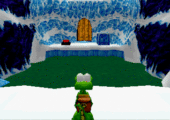
The release of Croc: Legend of the Gobbos in 1997 marked a significant milestone in the history of the fifth-generation console era, representing a bridge between the experimental early days of three-dimensional rendering and the established conventions of the platforming genre. Developed by the British studio Argonaut Software and published by Fox Interactive, the title arrived at a time when the video game industry was undergoing a seismic shift from two-dimensional sprites to polygonal environments. While the transition was led by high-profile releases such as Super Mario 64 on the Nintendo 64 and Crash Bandicoot on the Sony PlayStation, Croc: Legend of the Gobbos offered a unique technical and creative perspective that was deeply rooted in the history of hardware innovation.
The Argonaut-Nintendo Partnership and the Origins of Croc
The development history of Croc: Legend of the Gobbos is inextricably linked to the professional relationship between Argonaut Software and Nintendo. During the early 1990s, Argonaut founder Jez San and his team worked closely with Nintendo to develop the Super FX chip, a custom RISC processor that allowed the Super Nintendo Entertainment System (SNES) to render polygonal graphics. This partnership resulted in the 1993 hit Star Fox, which demonstrated Argonaut’s technical prowess in 3D math and hardware design.
Following the success of Star Fox, Argonaut pitched a concept to Nintendo for a 3D platforming game featuring Yoshi, the dinosaur companion from the Super Mario series. This prototype was intended to be a flagship title for Nintendo’s next-generation hardware. However, Nintendo ultimately declined the proposal. Industry analysts and historians note that Nintendo’s policy of maintaining strict internal control over its core intellectual properties likely influenced this decision. Furthermore, Nintendo was already internally developing Super Mario 64, a project that would redefine 3D movement and camera control.
The rejection led Argonaut to pivot, transforming the Yoshi prototype into an original intellectual property. The character of Croc, a young crocodile raised by furry creatures known as Gobbos, was created to replace the Nintendo-owned reptile. This shift allowed Argonaut to retain its technical work while building a new brand that could be published across multiple platforms, including the Sony PlayStation, Sega Saturn, and Microsoft Windows.
Technical Architecture and the Tank Control Paradigm
One of the most discussed aspects of Croc: Legend of the Gobbos is its control scheme, which utilizes a "tank control" system. In this configuration, the directional pad (or analog stick) rotates the character left or right and moves him forward or backward relative to his own orientation, rather than moving him relative to the camera’s perspective. This system was a common solution to early 3D navigation challenges, also utilized by contemporaries such as Resident Evil and Tomb Raider.
By the time of the game’s 1997 release, however, the industry was beginning to move toward the "camera-relative" movement perfected in Super Mario 64. Argonaut’s decision to stick with tank controls has been analyzed by critics as both a technical limitation and a stylistic choice. While it provided a certain level of precision in narrow corridors, it often felt cumbersome in open environments. The game did include support for the Sega Saturn 3D Control Pad and the PlayStation DualShock controller, but the underlying engine logic remained tethered to the original digital input design, leading to a gameplay experience that many modern players find rigid.
Gameplay Structure and Narrative Framework
The narrative of Croc: Legend of the Gobbos is presented through real-time cinematic sequences that establish the conflict without the use of spoken dialogue. The story follows Croc, an abandoned hatchling adopted by the Gobbos, as he attempts to rescue his family from the villainous Baron Dante. The game is divided into four primary worlds: a forest region, an ice-themed world, a desert landscape, and a final castle environment.
Each world is composed of six main levels, two boss encounters, and a hidden secret level. The primary objective in each stage is to locate and rescue six Gobbos. Five of these are hidden throughout the level, while the sixth is locked behind a challenge door that requires the collection of five colored gems. This structural design encouraged exploration and rewarded players for thoroughness, a hallmark of the "collect-a-thon" subgenre of platformers that dominated the late 1990s.
The enemy AI in Croc is relatively rudimentary, with most adversaries following fixed patrol paths or lunging at the player when within a specific radius. A notable mechanic is the respawning of enemies; defeated foes typically reappear after a short duration, maintaining a constant level of threat and requiring players to maintain a steady pace through the levels.
Sound Design and Aesthetic Identity
The auditory experience of Croc: Legend of the Gobbos is frequently cited as one of its strongest attributes. The soundtrack, composed by Justin Scharvona, Karin Griffin, and Martin Schioeler, is characterized by its upbeat, melodic, and often Caribbean-influenced arrangements. The main menu theme, featuring prominent brass and a lively tempo, set a whimsical tone that contrasted with the often-lonely atmosphere of the game’s sparsely populated 3D environments.
In terms of visual design, the game utilized a room-based system. Levels were not seamless open worlds but were instead comprised of distinct "rooms" connected by loading transitions disguised as doors. This approach allowed Argonaut to push higher polygon counts and more detailed textures within smaller spaces, ensuring a stable frame rate on the 32-bit hardware of the era. However, it also gave the game a somewhat fragmented feel compared to the expansive vistas found in competing titles.
Comparative Performance and Sales Data
Upon its release, Croc: Legend of the Gobbos was a commercial success, particularly on the Sony PlayStation. It sold over three million copies globally, eventually earning a place in the "Greatest Hits" and "Platinum" budget ranges. This success proved that there was a significant market for 3D platformers outside of Nintendo’s ecosystem.
However, the Sega Saturn version faced specific technical challenges. Due to the Saturn’s complex dual-CPU architecture and its preference for quadrilateral-based polygons over the triangles used by the PlayStation, the port suffered from minor graphical glitches and a slightly more somber color palette. One well-documented issue was a visual bug triggered by booting the game with the disc already in the drive, which could cause parts of Croc’s character model, such as his snout, to disappear. Despite these issues, the Saturn version was welcomed by the console’s user base, which lacked a dedicated 3D Sonic the Hedgehog platformer at the time.
Chronology of the Croc Franchise
The timeline of the franchise reflects the rapid evolution and eventual consolidation of the gaming industry at the turn of the millennium:
- 1993–1995: Argonaut Software develops the Super FX chip and pitches the 3D Yoshi game to Nintendo.
- 1996: Development of Croc: Legend of the Gobbos begins in earnest as an independent IP.
- September 1997: The game is released on PlayStation, followed shortly by Saturn and PC versions.
- 1999: The sequel, Croc 2, is released. It introduced a more complex quest system and "hub" worlds but received more polarized reviews due to its high difficulty.
- 2000–2001: Spin-off titles are released for the Game Boy Color, attempting to translate the 3D aesthetic into a 2D side-scrolling format.
- 2004: Argonaut Software faces financial difficulties and eventually ceases operations, leaving the Croc IP in a state of dormancy for two decades.
- 2024: Jez San announces the revival of Argonaut Games and confirms that a high-definition remaster of the original Croc is in development.
- 2025: The remaster is scheduled for release on modern platforms, featuring updated controls and enhanced visuals.
Broader Impact and Industry Implications
The legacy of Croc: Legend of the Gobbos is defined by its role as an experimental pioneer. It demonstrated that third-party developers could successfully navigate the transition to 3D without the direct oversight of hardware manufacturers like Nintendo or Sony. The game’s level design philosophy—prioritizing clear signposting and logical progression—influenced how developers approached spatial navigation in 3D environments.
The upcoming 2025 remaster signifies a growing trend in the industry toward the preservation of "middle-tier" hits from the 32-bit era. By introducing modern control schemes, the remaster aims to address the primary criticism of the original title, allowing a new generation to experience the game’s intelligent level design and iconic soundtrack.
In historical context, Croc: Legend of the Gobbos serves as a reminder of a period of intense creative risk-taking. For Argonaut Software, it was a leap of faith that transitioned them from a hardware-focused support studio to a successful independent developer. While it may have been overshadowed by the technical leaps of Mario and the marketing might of Crash Bandicoot, Croc remains a foundational piece of the 3D platforming puzzle, representing the industry’s collective effort to find its footing in a three-dimensional world.