Jia Lissa
As the global amusement industry enters a period of unprecedented technological transition, Sega Enterprises, Ltd. has unveiled a comprehensive strategic roadmap aimed at consolidating its position as a dominant force in the television game market. In a detailed disclosure of corporate policy, Hayao Nakayama, Executive Vice President and Representative Director of Sega’s Japanese operations, has outlined the company’s intent to harmonize its manufacturing and operational arms while navigating the complexities of international trade, intellectual property rights, and shifting consumer preferences. This strategic pivot comes six years after Sega’s integration into the Gulf & Western (G&W) Corporation group, a move that has fundamentally reshaped the company’s capital structure and research capabilities.
Corporate Architecture and the Gulf & Western Integration
The organizational structure of Sega Enterprises in 1980 reflects the intricate nature of modern multinational conglomerates. Following its acquisition in 1974, Sega of Japan operates as a critical component of the G&W leisure portfolio. G&W, a New York-based powerhouse led by President Charles Bluhdorn, currently ranks 52nd in the United States corporate hierarchy, reporting annual sales of approximately $5.3 billion. While G&W is widely recognized for its ownership of Paramount Pictures and its significant investments in energy and automotive sectors—notably the development of high-capacity automotive batteries—its stewardship of Sega represents a sophisticated entry into the burgeoning field of electronic entertainment.
The relationship between the Japanese and American entities is characterized by a "grandchild company" hierarchy. Sega of America (Sega Enterprises Inc.) serves as the immediate subsidiary of G&W and holds 100% ownership of Sega of Japan (Sega Enterprises Ltd.). This structure allowed for the public listing of Sega on United States stock exchanges, providing the capital necessary for aggressive expansion. Under the leadership of President David Rosen, this dual-hub system has facilitated the acquisition of Gremlin Industries in the U.S. and Esco Trading in Japan, creating a vertically integrated network capable of simultaneous development and distribution across the world’s two largest gaming markets.
Financial Trajectory and Operational Scale
The fiscal year ending April 1979 serves as a benchmark for Sega’s robust growth in the arcade sector. The company reported sales of 24 billion yen (approximately $107 million USD at 1980 exchange rates) with a declared income of 5.37 billion yen. This financial performance is supported by a substantial workforce of 1,200 employees and an extensive domestic infrastructure. Sega’s Japanese operations currently include three major branch offices in Sapporo, Osaka, and Fukuoka, supplemented by four sales offices and 89 operational centers.

This dual identity as both a manufacturer and an operator is a defining characteristic of the Japanese amusement industry. Nakayama acknowledges that while most major Japanese firms began as operators, Sega’s primary identity remains rooted in manufacturing. However, the company maintains a massive network of game centers to ensure a steady revenue stream and to gather direct market intelligence. This "operator mindset" allows Sega to support its external clients by testing products in-house before a wider release, balancing the pursuit of consistent revenue with the need for innovative product development.
The Strategic Shift Toward Television Games
The most significant policy shift identified by Nakayama is the allocation of 70% to 80% of Sega’s research and development resources toward television (video) games. This decision aligns with a global trend where digital entertainment is rapidly displacing traditional mechanical amusements. The company views the novelty and visual engagement of video games as the primary drivers of future growth, despite localized debates regarding the social impact of purely visual content.
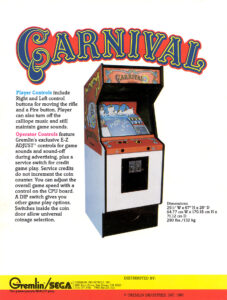
In the global marketplace, Sega/Gremlin now stands as one of the "Big Three" in the United States, alongside Atari and Midway. This positioning is bolstered by a reciprocal technology exchange: Sega imports advanced American hardware and licensing while exporting Japanese-developed titles. Recent data indicates that Japanese titles such as Astro Fighter, Carnival, and Mini Monaco have achieved significant success in Western markets, sometimes exceeding their performance in their domestic territory.
Market Divergence and the Evolution of Cabinet Design
One of the most complex challenges facing Sega is the stark divergence between Japanese and Western consumer habits. A prominent example is the performance of Mini Monaco and Carnival. While Mini Monaco was a commercial failure in Japan, it became a significant hit in the U.S. and Europe. Nakayama attributes this to the American market’s increasing focus on space efficiency and the popularity of two-player competitive play. Conversely, the Japanese market’s preference for table-type cabinets—a trend solidified by the "Invader House" phenomenon of the late 1970s—has forced a temporary de-prioritization of upright cabinets in Japan, even as they remain the standard in the West.
Despite the current dominance of table-type machines in Japan, Sega remains committed to the upright format for its added value and aesthetic appeal. The company continues to experiment with hybrid models and conversions, such as Car Hunt and Deep Scan, as it seeks to find a sustainable balance between the two hardware formats.

Intellectual Property and the Legal Frontier
The issue of software piracy and unauthorized "clones" has emerged as a primary threat to the industry’s stability. During the height of the Space Invaders era, a lack of legal clarity allowed copyists to flourish, often citing supply shortages as a justification for their actions. However, Sega is now leading a rigorous campaign to establish and enforce intellectual property rights.
A landmark case in the United States involved Sega/Gremlin’s successful litigation against Exidy regarding the game Head-On. This case served as a catalyst for the industry, proving that trademarks, copyrights, and unfair competition laws could be used to protect digital assets. Nakayama emphasizes that the era of "defiant copying" is ending in Japan as well. Sega is actively identifying and taking action against counterfeiters, arguing that piracy ultimately harms the operator by devaluing the product and forcing manufacturers to increase prices to cover the costs of more complex, uncopyable hardware.
Diversification: From Pizza to Pinball
Sega’s strategy extends beyond the arcade floor into the broader leisure and hospitality sectors. The company has launched "Sega Center" game complexes and a new pizza restaurant chain, "PJ Pizzazz," in the United States. These ventures are managed by Sega of America and represent an attempt to create family-oriented entertainment destinations that combine food and gaming.
In the traditional amusement sector, Sega is not abandoning mechanical games. The company continues to distribute high-quality pinball machines from manufacturers like Williams and Stern. Furthermore, Sega is revitalizing the "medal game" market (token-based gambling simulations) by improving older machines and offering them at lower price points. Recent successful conversions include Blackjack, Faro II, and Punto Banco, reflecting a commitment to eliminating waste and maximizing the lifecycle of existing hardware.
Chronology of Key Developments (1974–1980)
- 1974: Gulf & Western Corporation acquires Sega Enterprises, Ltd., integrating it into its global conglomerate.
- 1976: Sega of America acquires Gremlin Industries, a move that secures a dedicated manufacturing and R&D base in the United States.
- 1978: The release of Space Invaders by Taito triggers a global arcade boom, fundamentally changing the scale of the Japanese market.
- 1979: Sega of Japan acquires Esco Trading; annual sales reach a record 24 billion yen.
- 1979: Sega/Gremlin wins a pivotal legal battle against Exidy over Head-On copyright infringement.
- 1980 (August): Hayao Nakayama outlines the 80% television game focus and the shift toward specialized regional distribution networks.
Broader Impact and Industry Implications
The policies articulated by Nakayama suggest that the arcade industry is maturing from a fragmented collection of local operators into a sophisticated global technology sector. By prioritizing R&D and legal protections, Sega is setting a precedent for how intellectual property will be managed in the digital age. The company’s focus on "economies of scale" and "long-term business sustainability" indicates a move away from the boom-and-bust cycles of the early 1970s toward a more stable, corporate-led growth model.
Furthermore, Sega’s emphasis on strengthening its distribution network by training major local companies as regional distributors suggests a decentralization of sales. This allows the corporate headquarters to focus on high-level strategy while ensuring that localized market demands are met with "attentive service." As Sega continues to bridge the gap between Japanese engineering and American marketing, its influence on the global entertainment landscape is expected to expand, paving the way for the next generation of home and arcade hardware.
In conclusion, Sega Enterprises in 1980 stands at the intersection of traditional amusement and the digital future. Under Nakayama’s marketing leadership and Rosen’s presidency, the company is leveraging its relationship with Gulf & Western to build a robust, legally protected, and technologically advanced empire. The success of this strategy will likely dictate the trajectory of the electronic gaming industry for the decade to come.